
Systems
Deep-Fill Liquid Screed Systems
Deep-fill liquid screed pours address uneven substrates, service ducting or level changes, but bring different shrinkage, drying and reinforcement considerations than standard depths.
Got an uneven slab or deep build-up to deal with?
We'll assess the depths involved and advise a suitable screed design — call 07791 510849.
Or call our landline on 01392 237700
Some floors need considerably more than a standard screed depth — an uneven existing slab, buried services, or a design level change can all push the pour well beyond typical thickness. Liquid screed handles increased depth more readily than traditional sand and cement in a single pour, but it isn't simply a case of pouring more material and waiting longer.
As depth increases, the thermal mass, drying time and shrinkage behaviour of the screed all change, and some binder systems set limits on maximum pour depth in a single lift. Deep sections are also more likely to need consideration of reinforcement or fibre dosing to manage restrained shrinkage cracking.
Getting a deep-fill pour right starts with establishing why the depth is needed in the first place, then working through the specification with the datasheet limits for that particular screed rather than treating it as a scaled-up standard pour.
Deep-Fill Screed Systems — the points that decide it
- Deep sections increase drying times, which affects the overall programme
- Some binders cap maximum single-lift pour depth — check before specifying
- Fibre or mesh reinforcement is often considered for deeper or variable-depth pours
- Variable depth across a floor (e.g. over service trenches) needs a plan for transition zones
- Thermal mass increases with depth, which can be relevant where underfloor heating is involved
- Shrinkage stresses can be greater over deep sections, making movement joint design important
- A deep-fill pour is not automatically the answer to a poorly prepared subfloor
- Deep-fill areas often coincide with underfloor heating pipe zones that need adequate cover depth
- Pour sequencing across variable depths should be agreed with the screed supplier in advance
- Material cost typically rises with depth simply due to the extra volume being placed
When deep fill is actually needed
Common triggers include an uneven existing base that needs levelling before a consistent screed depth can sit above it, retrofitted underfloor heating pipework that raises the finished floor level, or a design decision to bury significant insulation or services beneath the screed.
It's worth distinguishing between a genuinely deep-fill requirement and a case where a separate levelling layer beneath a standard-depth screed would be the more appropriate and cost-effective solution — this is a specification conversation worth having early.
Drying and structural considerations
Because drying is depth-dependent, deep-fill areas will take noticeably longer to reach a moisture level suitable for flooring than the standard depth on the same slab, so programmes need to allow for this difference rather than assuming a single uniform drying time across the whole floor.
Where depth varies significantly across a single floor, transition details and reinforcement should be discussed with the screed manufacturer's technical team, since uneven restraint across variable thicknesses is one of the more common causes of cracking in deep or stepped pours.
Reinforcement options for deep sections
Fibre reinforcement, dosed into the mix, is a common way of helping deep or variable-thickness screeds resist restrained shrinkage cracking without the labour of laying mesh, and is often the manufacturer's preferred approach for liquid screed systems.
Steel or polypropylene mesh is used less often in liquid screed than in traditional sand and cement work, but may still be specified in particular deep or heavily loaded situations — the choice should follow the specific product's technical guidance rather than habits carried over from a different screed type.
Sequencing a deep or variable-depth pour
On floors where depth steps up significantly in places — over a service duct, for example — the pour sequence and any staging between deeper and shallower sections needs planning before the pump arrives, since an uncoordinated pour can leave weak transition lines.
Pumping a genuinely deep section also takes longer per square metre than a standard pour, so programme and labour allowances on site should reflect the actual depths involved rather than a generic day-rate assumption.
Got an uneven slab or deep build-up to deal with?
We'll assess the depths involved and advise a suitable screed design — call 07791 510849.
Or call our landline on 01392 237700
Reference points for deep-fill screed systems
| Typical trigger | Uneven substrate, service ducting, level changes |
|---|---|
| Reinforcement | Fibre or mesh, per manufacturer guidance |
| Drying time | Depth-dependent, follow datasheet |
Deep-Fill Screed Systems — your questions
In short
Deep-fill liquid screed pours address uneven substrates, service ducting or level changes, but bring different shrinkage, drying and reinforcement considerations than standard depths.
Related reading
Screed systems & build-ups
Thin-Section Bonded Screed
Compare
30mm vs 50mm screed depth
Screed systems & build-ups
Surface Regularity & Finishing
Screed systems & build-ups
Screed Over Timber Deck
Screed systems & build-ups
Fibre-Reinforced Screed
Screed systems & build-ups
Choosing a Screed System: Decision Guide
Got an uneven slab or deep build-up to deal with?
We'll assess the depths involved and advise a suitable screed design — call 07791 510849.
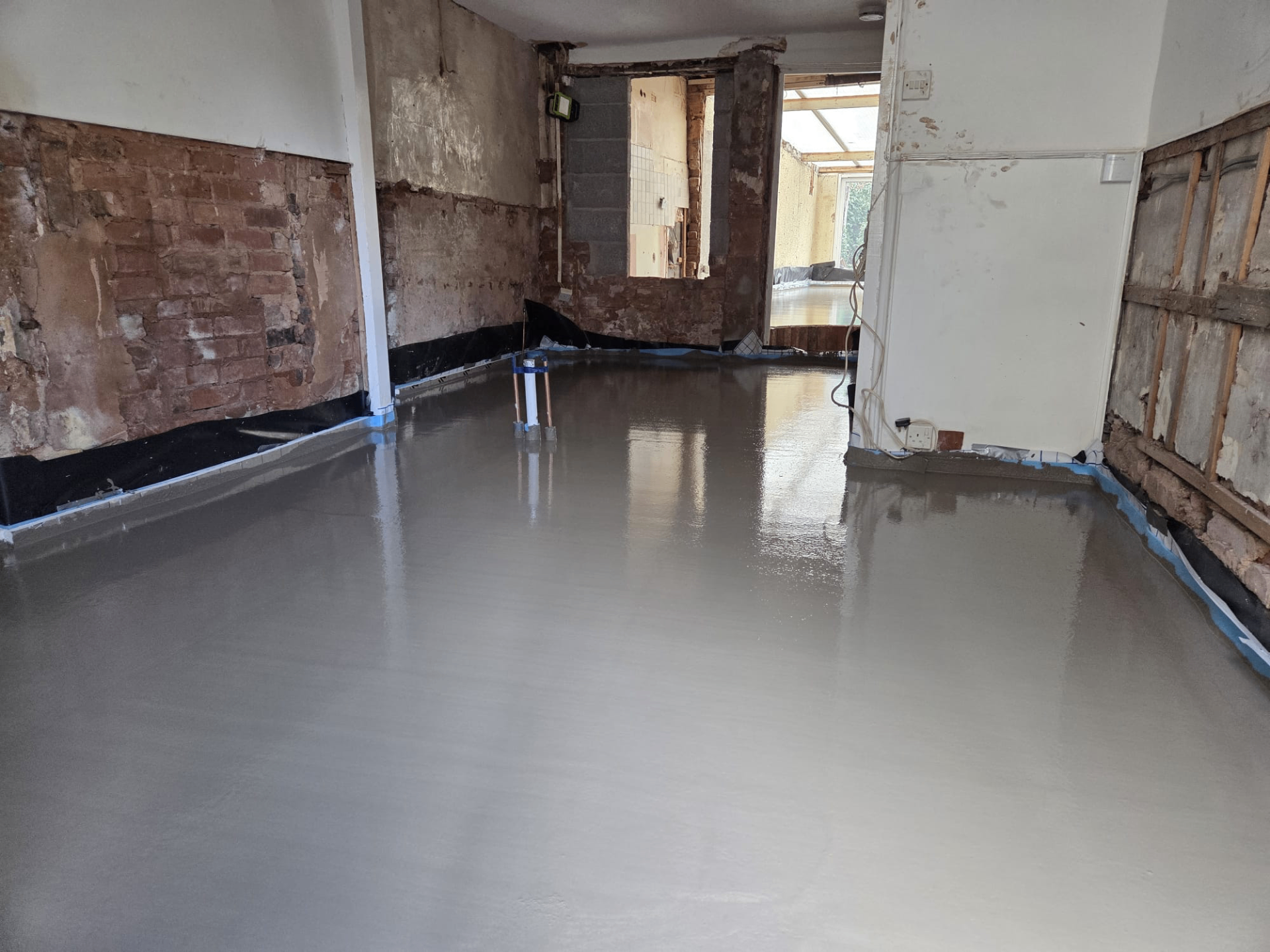
Deep-Fill Liquid Screed at 80–120mm
Deep-fill pours (80–120mm) are common in rural conversions where the original floor levels wander. The trick is a single pour rather than two — a lift joint at depth is a weakness.
We use mix designs rated for deep pour and take extra care with edge detail and drying.
Deep-pour rules
Single pour to full depth — no lift joints
Edge foam full depth up all walls
Drying budget: 1mm/day slows above 80mm — plan for 8–10 weeks
Force-drying almost always required if flooring is on programme