
Systems
Surface Regularity and Finishing of Liquid Screed
Surface regularity in liquid screed is assessed against SR classes from BS 8204, and depends on both the self-levelling nature of the material and correct finishing technique.
Need a specific flatness standard for your flooring?
Tell us your intended floor finish and we'll advise the appropriate SR class and pour approach — call 07791 510849.
Or call our landline on 01392 237700
One of the reasons liquid screed is chosen over traditional sand and cement is its ability to self-level, producing a flatter surface with less manual effort. But 'self-levelling' doesn't mean 'finish itself' — achieving a consistently regular surface across a whole floor still depends on correct placement, the use of levelling tools during the pour, and appropriate follow-up finishing.
Surface regularity is assessed using SR classes as set out in BS 8204, which define acceptable deviation under a straight edge over a given span. The class required depends on the final floor finish — a thin, unforgiving finish like polished concrete or vinyl demands tighter tolerances than a floor that will carry carpet and underlay.
Understanding what SR class is realistic and appropriate for a given project, and communicating it clearly before the pour, avoids disputes later about whether a floor is 'flat enough' for its intended finish.
Surface Regularity & Finishing — the points that decide it
- SR classes from BS 8204 define acceptable deviation under a straight edge over a specified length
- The appropriate SR class depends on the floor finish, not a single fixed standard for all floors
- Liquid screed's self-levelling action reduces manual effort but doesn't eliminate the need for finishing technique
- Datum points and level control during the pour affect the achievable flatness
- Thin, unforgiving finishes (polished concrete, resin, vinyl) typically call for tighter SR tolerances
- Post-pour finishing tools can be used within the working window to refine surface levelness
- Surface regularity should be checked and agreed against the specified class, not assessed by eye alone
- SR1 is the tightest commonly referenced class, with SR2 and SR3 progressively more tolerant of deviation
- Localised re-levelling compounds can correct isolated high or low spots without a full re-pour
- Lighting conditions at handover can make minor surface irregularities more or less noticeable
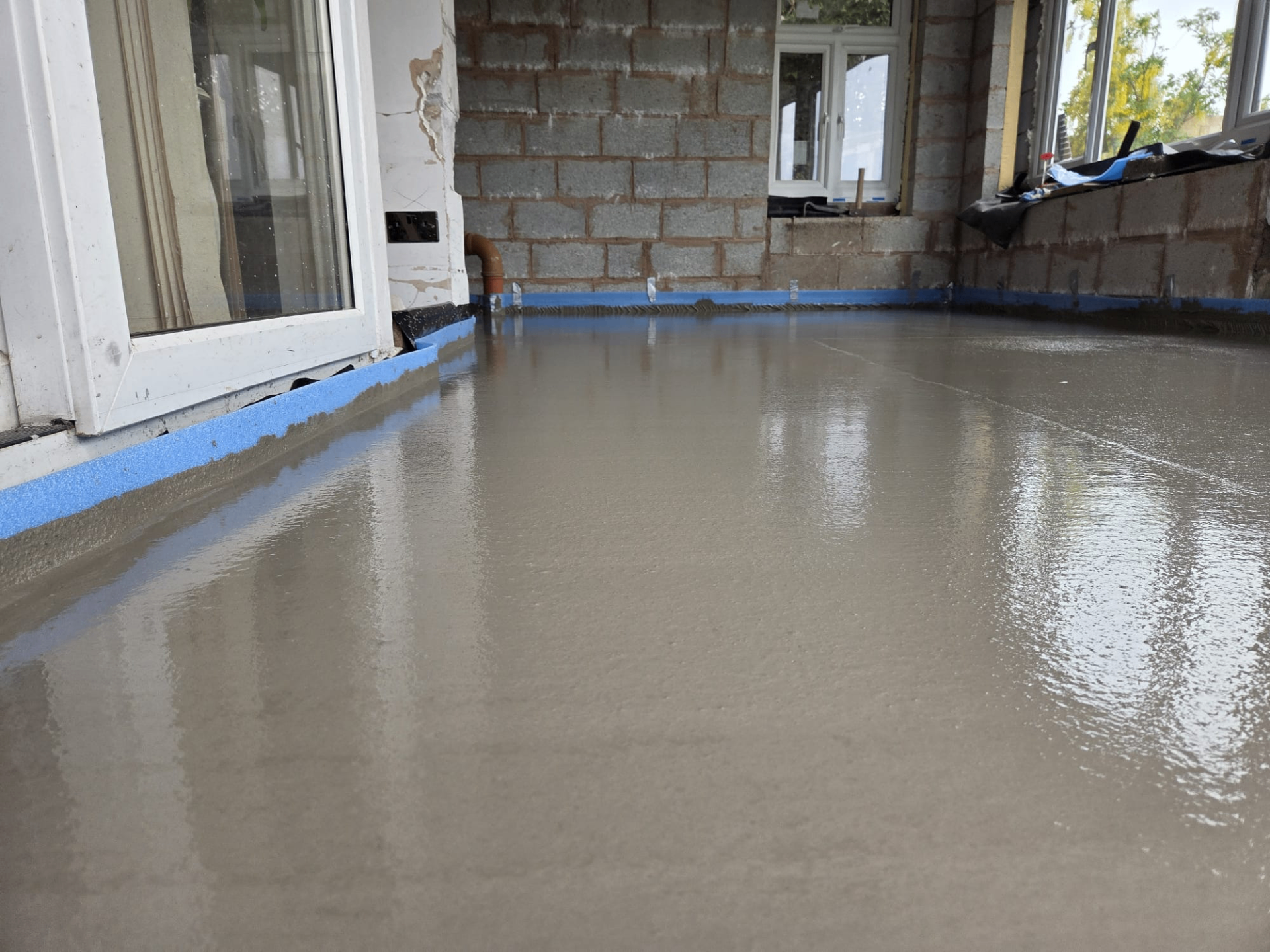
Reference points for surface regularity & finishing
| Standard | BS 8204 SR classes |
|---|---|
| Measured with | Straight edge over specified span |
| Tighter tolerance typical for | Polished concrete, resin, vinyl finishes |
How SR classes are set and checked
BS 8204 defines surface regularity classes that specify maximum permitted deviation measured with a straight edge over a set span. The tighter classes are appropriate where the floor finish itself has little tolerance for irregularity, such as thin resin coatings or polished finishes, while more forgiving classes are appropriate under carpet, tiling on a bed, or other finishes with their own levelling capacity.
Agreeing the required SR class before the pour — as part of the specification — means expectations are aligned in advance, rather than trying to judge acceptability against a subjective sense of 'flat' once the floor is down.
Getting a regular surface on the day
Consistent datum levels, correct screed consistency at the point of pour, and skilled use of levelling tools during placement all contribute to the final regularity, alongside the inherent self-levelling behaviour of the material.
Environmental conditions on the day — draughts, temperature swings, or an uneven substrate profile — can all affect how evenly the screed settles, which is why experienced placement and finishing technique still matter even with a self-levelling product.
Understanding the SR class scale
SR1 represents the tightest commonly referenced surface regularity class, generally reserved for the most demanding finishes, while SR2 and SR3 allow progressively greater deviation and suit floors with more forgiving coverings on top.
Specifying a tighter class than a project actually needs adds cost and time without benefit, so the SR class should be matched to the intended finish rather than defaulted to the tightest option as a precaution.
Correcting localised irregularities
Where an isolated high or low spot falls outside the agreed SR class, a localised re-levelling compound can often correct it without disturbing the surrounding floor, provided the area is properly identified and prepared first.
Widespread irregularity across a floor is a different matter and usually points back to placement or finishing technique during the original pour, which a patch repair won't resolve — this is worth diagnosing honestly rather than papering over repeatedly.
In short
Surface regularity in liquid screed is assessed against SR classes from BS 8204, and depends on both the self-levelling nature of the material and correct finishing technique.
Need a specific flatness standard for your flooring?
Tell us your intended floor finish and we'll advise the appropriate SR class and pour approach — call 07791 510849.
Or call our landline on 01392 237700
Surface Regularity & Finishing — your questions
Other pages that answer this properly
Need a specific flatness standard for your flooring?
Tell us your intended floor finish and we'll advise the appropriate SR class and pour approach — call 07791 510849.