Systems
Day Joints in Flowing Liquid Screed
A day joint marks where one liquid screed pour session ends and another begins, and needs specific edge preparation to bond and perform correctly.
On larger floors, it isn't always practical to pour the entire area in a single continuous session — pump capacity, access, or simply the size of the floor can mean the work is split across more than one pour. The line where an earlier pour meets a later one is called a day joint, and unlike a structural movement joint, it exists purely because of the sequencing of the work rather than a design requirement for movement.
Because a day joint interrupts the otherwise continuous, self-levelling nature of a liquid screed pour, the edge of the earlier pour needs specific preparation before the next section goes in, so the two sections bond and finish flush rather than leaving a step, a weak line, or a visible seam.
Day joints are a normal and manageable part of large or multi-day screeding projects, but they do need planning — both in terms of where they fall on the floor plan and how the edge is treated between sessions.
Day Joints in Flowing Screed — the points that decide it
- A day joint results from pour sequencing, not from a structural movement requirement
- Edges of the earlier pour typically need trimming and priming before the next pour
- Poorly prepared day joints can result in a stepped or weak line in the finished floor
- Day joint locations are best planned in advance, ideally away from high-visibility or high-wear areas
- Some binder systems have specific guidance for the time window and edge treatment for day joints
- A day joint is not the same thing as a designed movement joint, though the two are sometimes combined
- Ambient temperature and weather can affect how quickly an exposed edge needs preparing before the next pour
- Clear communication with the pump operator and screeding crew reduces the risk of an unplanned day joint appearing mid-floor
Why day joints happen
Even with a liquid screed's fast placement rate compared with traditional screed, there's a limit to how much floor area a pump and finishing crew can cover in a single working session, particularly on larger commercial floors or where access requires multiple pump moves.
Rather than rushing a pour beyond what can be properly finished, splitting the work across sessions with a planned day joint is the more reliable approach, provided the joint is detailed correctly.
How the joint is detailed
The edge of the first pour is typically cut back to a clean, sound edge and primed before the adjoining section is poured, so the new material bonds properly rather than simply butting up against a weak or contaminated edge.
Where possible, day joint lines are positioned to coincide with natural breaks such as doorways or planned movement joints, reducing the chance of a visible line running across an open area of floor.
Planning pour sequencing across multiple sessions
Splitting a large floor across two or more pour days works best when the sequence is planned in advance, taking into account pump access, drying between sessions, and which areas of the floor can be safely worked around without disturbing an earlier, still-curing section.
Weather and site temperature can affect the timing between sessions, since a faster or slower set changes how soon an edge is ready for the day joint preparation described below, so a fixed day-by-day plan sometimes needs adjusting on site.
Inspecting and finishing the completed joint
Once the second pour has gone in against a prepared day joint edge, the junction is checked for level match and a sound bond, ideally before the surrounding screed has fully cured, so any minor adjustment can still be made.
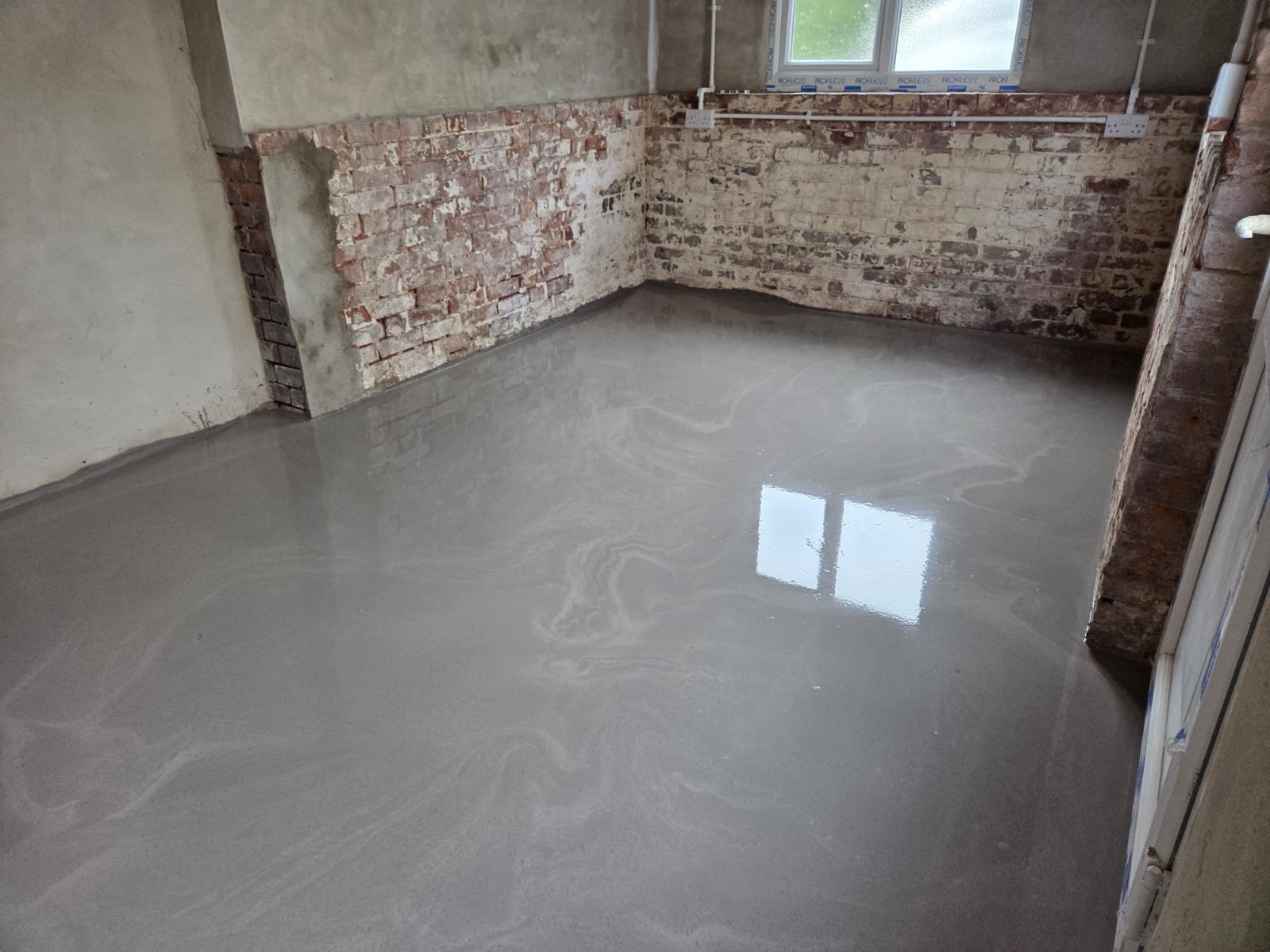
A well-executed day joint should read as a single continuous floor once finished flooring is installed, with no discernible step or seam — this is the standard against which the joint's preparation and execution should be judged.
Working on a large multi-day pour?
We plan pour sequencing and joint locations before starting so the floor performs as one system — call 07791 510849.
Or call our landline on 01392 237700
Day Joints in Flowing Screed — your questions
In short
A day joint marks where one liquid screed pour session ends and another begins, and needs specific edge preparation to bond and perform correctly.
Working on a large multi-day pour?
We plan pour sequencing and joint locations before starting so the floor performs as one system — call 07791 510849.