
Heating Response
Low Thermal Mass Screed Systems
Low thermal mass screed systems, typically thinner and lighter than standard structural screeds, are designed to heat up and cool down faster in response to underfloor heating demand.
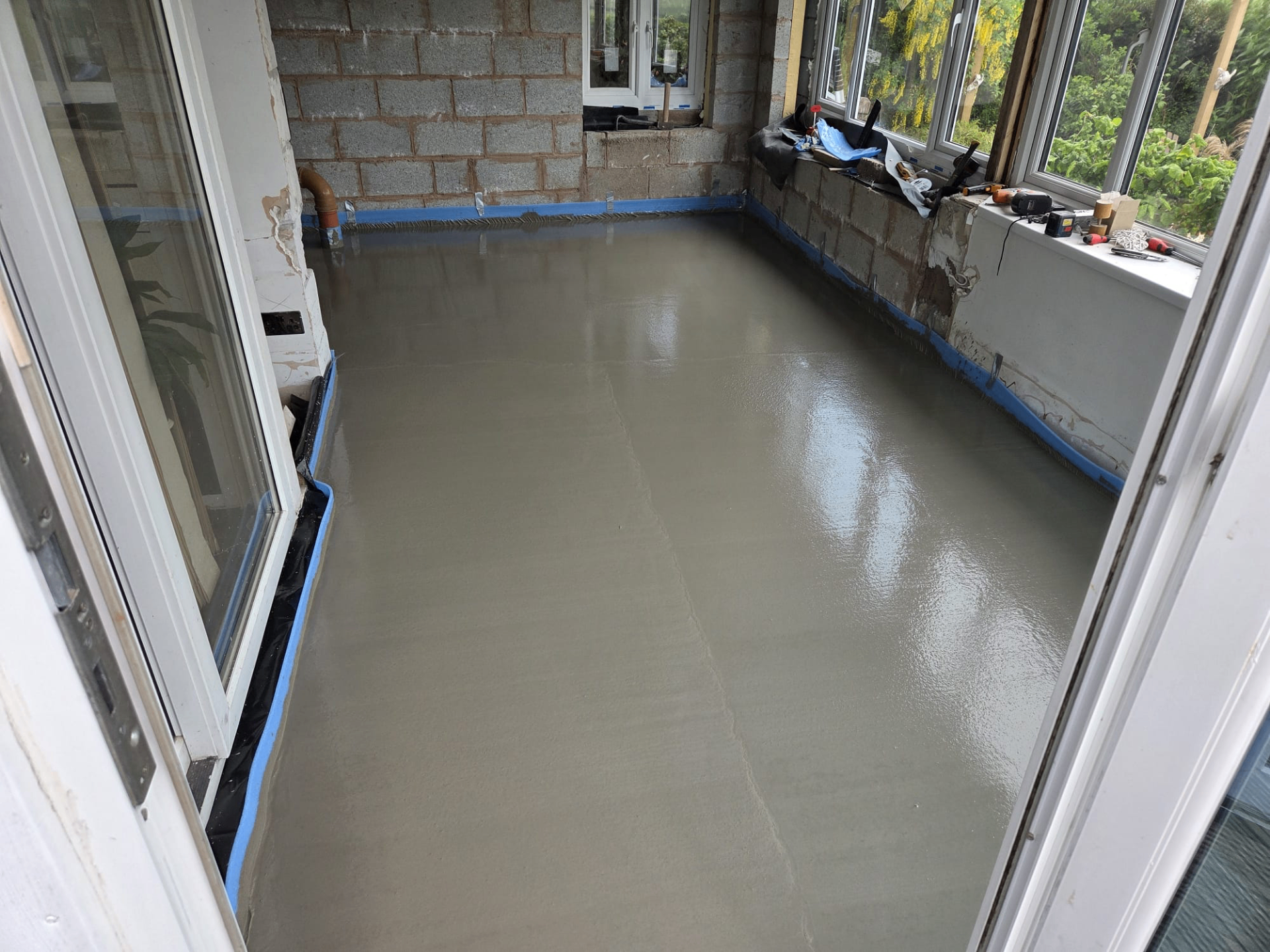
Retrofit projects, particularly those replacing timber suspended floors or working within limited floor build-up heights, often bring low thermal mass screed systems into the conversation. These systems reduce the volume and density of screed above the heating pipework, allowing the floor to respond more quickly to changes in heat demand than a conventional, thicker structural screed would, which can suit properties with variable occupancy patterns.
The trade-off is that a lower thermal mass floor generally holds less residual heat, meaning it can cool more quickly once the heating system stops calling for heat, which affects how a heating control strategy should be set up. This makes low thermal mass systems well suited to renovation work in older Exeter and Devon properties where floor depth is tightly constrained, but less commonly the default choice for new-build slabs with no depth restriction, where a deeper structural screed's steadier heat output is often preferred.
Choosing a low thermal mass approach is a design decision that should be made alongside the heating engineer, not assumed purely on the basis of available depth, since the heating emitters, flow temperatures and controls all need to be matched to the chosen floor build-up for the system to perform well.
Why depth and response time are linked
Thermal mass in a floor build-up is largely a function of the volume and density of material sitting above (and to a lesser extent around) the heating pipe. A thick, dense cementitious screed stores considerably more heat than a thin, low-density system, which is why traditional deep screeds are known for slow but steady, even heat output, while low thermal mass options are chosen specifically to shorten the lag between calling for heat and feeling warmth at the floor surface.
This responsiveness can suit spaces used intermittently, such as home offices or occasionally used rooms, where waiting hours for a conventional screed to warm up isn't practical, though it does mean heating schedules may need to run more frequently in shorter bursts rather than one long steady cycle. Heating controls specified for these systems should reflect this different operating pattern.
Retrofit applications in older properties
Many period and older properties across Devon have limited scope to raise finished floor levels without affecting door thresholds, staircases or skirting details, which makes a low thermal mass system attractive where underfloor heating is still desired. Low-profile pipe and panel systems combined with a thin levelling or liquid screed layer can sometimes achieve workable heating performance within depths that a standard structural screed build-up could not fit into.
As with any retrofit, the existing subfloor's structural capacity and moisture condition need to be assessed before specifying a system, since a shallow build-up does not remove the need for a sound, dry base. Surface preparation, including checking for existing laitance, contamination or unevenness, remains essential even where the new layer itself is thin.
Matching heating controls to a low thermal mass floor
Because a low thermal mass floor responds and cools more quickly than a deep structural screed, the heating controls strategy often needs adjusting to suit. Weather-compensated or room-based thermostatic control tuned to shorter response cycles can help avoid the floor overshooting or undershooting the target temperature, which is a more noticeable problem on lower mass systems than on deep, slow-responding screeds.
Flow temperatures may also need to be set slightly differently to achieve comfortable surface temperatures without excessive cycling of the heat source, and this is best worked through with the heating engineer at design stage rather than adjusted reactively once the system is installed and occupants report discomfort.
Assessing whether a low thermal mass system suits your project
The decision to use a low thermal mass system should weigh available depth, the pattern of room occupancy, and the client's expectations around heat-up time against the steadier but slower performance of a standard structural screed. Rooms used constantly, such as an open-plan living space, may benefit less from rapid response than intermittently used spaces where quick warm-up matters.
We talk through these trade-offs with clients considering a retrofit, since the right answer depends as much on how the space will actually be used as on the depth constraint itself, and a system chosen purely because it fits the available depth may not always deliver the comfort outcome the client is expecting.
Low Thermal Mass Screed Systems — the points that decide it
- Low thermal mass systems typically use thinner screed depths or lightweight/insulated overlay boards above the heating pipe
- Faster response times can suit rooms with variable occupancy or intermittent heating patterns
- Reduced thermal mass generally means less heat storage, so cooling is also quicker once heating stops
- Often specified in retrofit projects where raising floor levels significantly is not practical
- Heating controls and flow temperatures may need adjusting to suit the faster response characteristics
- Structural loading and finish compatibility still need checking even at reduced depths
- Manufacturer-specific low-profile UFH and screed systems exist and should be assessed against their own datasheets
- Drying times for thinner low thermal mass pours are often shorter than for deep structural screeds
- Surface preparation of the existing subfloor remains important even where the new layer itself is thin
Renovating with limited floor depth?
We can advise on low thermal mass options that suit your existing floor levels. Call 07791 510849 to discuss your project.
Or call our landline on 01392 237700
Low Thermal Mass Screed Systems — your questions
Keep going — closely linked topics
Screed systems & build-ups
Screed Over Existing Screed (Overlay)
Building types & floor performance
Building types & floor performance
Costs
Costs & planning
Screed systems & build-ups
Forced Drying Systems
Screed systems & build-ups
Wet Area Screed Systems
Screed systems & build-ups
Day Joints in Flowing Screed
In short
Low thermal mass screed systems, typically thinner and lighter than standard structural screeds, are designed to heat up and cool down faster in response to underfloor heating demand.
Renovating with limited floor depth?
We can advise on low thermal mass options that suit your existing floor levels. Call 07791 510849 to discuss your project.