
Quality Assurance
Testing and Handover Requirements by Screed System
Testing and handover expectations vary between calcium sulphate, cementitious and modified screed systems, and knowing what to expect helps avoid disputes at practical completion.
Want a clear handover process from day one?
We agree testing and documentation expectations upfront so there's no ambiguity at completion. Call 07791 510849 to discuss your project's handover needs.
Or call our landline on 01392 237700
Handover on a screed package should never be a formality. Different screed systems carry different testing regimes, and being clear about what evidence will be provided at the end of the job protects both installer and client from disagreements later in the build programme, particularly where follow-on trades are relying on the screed being genuinely ready for their work.
For most projects this means agreeing, before the pour, what moisture testing method will be used, what strength class the screed is being installed to under BS EN 13813, and what surface regularity tolerance applies under BS 8204. Handover documentation should reflect these agreed criteria rather than generic paperwork copied between projects regardless of the system actually installed.
We set out testing and handover expectations at quotation stage so there are no surprises when flooring contractors or other trades are ready to follow on, and so that everyone involved understands what evidence will exist to confirm the floor has met its specification.
Testing and Handover by System — the points that decide it
- Moisture testing method (RH probe or carbide bomb) should be agreed before the pour, not decided retrospectively
- Calcium sulphate and cementitious screeds have different typical drying behaviours, which affects testing timing
- Surface regularity is checked against the SR classification and tolerance bands set out in BS 8204
- Strength class (C or CA per BS EN 13813) should be confirmed on the delivery ticket or batch record where site-batched
- Handover packs typically include curing and drying records, test results, and any relevant datasheets
- Underfloor heating commissioning records should be handed over separately where UFH is embedded
- Any deviations from the original specification should be documented and agreed in writing at handover
- Laitance removal on calcium sulphate screeds should be recorded as part of the preparation evidence before flooring begins
- Protection measures taken during curing, such as covering or restricted access, are worth noting in the handover pack
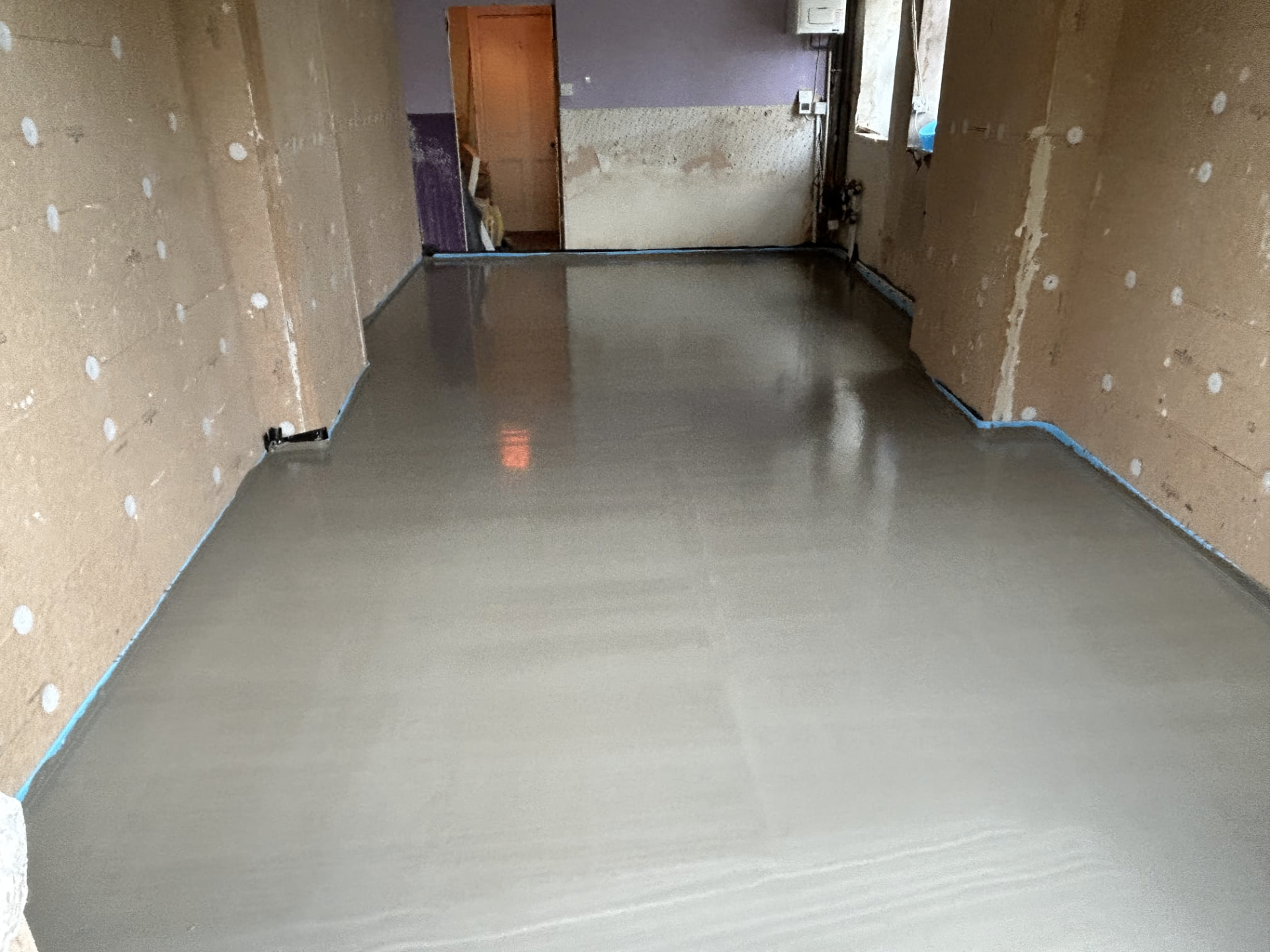
What differs between screed types at test stage
Calcium sulphate (anhydrite) screeds are commonly tested using RH probes once they've reached the manufacturer's stated minimum curing period, and typically require the surface laitance to be removed before floor coverings are laid. Cementitious screeds can be tested by carbide bomb or RH probe, and generally have different drying profiles that need to be assessed on their own datasheet rather than assumed to match anhydrite timescales.
Where a proprietary rapid-drying or modified screed has been used, its own manufacturer testing protocol takes precedence over generic guidance, since these products are formulated to behave differently from standard mixes. Confirming which protocol applies before testing begins avoids results being misread against the wrong benchmark.
Building a clean handover pack
A useful handover pack records the screed type and strength class installed, the date of the pour, curing conditions maintained, moisture test results with dates and locations, and confirmation of surface regularity checks. Where underfloor heating is present, a record of the commissioning heat-up procedure should also be included.
Keeping this documentation organised from day one, rather than reconstructing it at project end, makes it far easier to resolve any later query about floor performance and gives follow-on trades confidence to proceed. It also provides a clear reference point if a dispute over flooring failure arises months after completion.
Protection during the period between pour and handover
The condition a screed is handed over in depends heavily on how it's protected between the pour and the point other trades return to the area. Uncontrolled foot traffic, dropped materials, or other trades working on the surface before it has cured sufficiently can all cause surface damage that shows up as a defect at handover even though the screed itself was installed correctly.
Agreeing a protection strategy, whether boarding, restricted access, or a phased handover of different areas, and recording that this was followed, helps demonstrate that any damage identified after handover occurred due to activity beyond the screed installer's control rather than a fault in the original work.
Resolving disagreements at practical completion
Even with good documentation, disagreements can arise at practical completion, often around whether the floor was ready for flooring installation at the point it was handed over. Having agreed testing criteria and dated records from the outset gives both parties an objective reference point to work from, rather than relying on recollection or assumption about what was promised.
Where a genuine dispute does arise, independent testing against the same method used during the original works is usually the most straightforward way to establish the floor's actual condition, and this is far easier to arrange credibly when the original testing regime was clearly documented and agreed in advance.
Want a clear handover process from day one?
We agree testing and documentation expectations upfront so there's no ambiguity at completion. Call 07791 510849 to discuss your project's handover needs.
Or call our landline on 01392 237700
In short
Testing and handover expectations vary between calcium sulphate, cementitious and modified screed systems, and knowing what to expect helps avoid disputes at practical completion.
Testing and Handover by System — your questions
Want a clear handover process from day one?
We agree testing and documentation expectations upfront so there's no ambiguity at completion. Call 07791 510849 to discuss your project's handover needs.