
Systems
Perimeter Edge Insulation Systems for Liquid Screed
Perimeter edge insulation isolates the screed from walls and upstands, allowing thermal movement and reducing cold bridging around a floating floor.
Every floating liquid screed needs a perimeter isolation strip separating it from walls, columns, door thresholds and other upstands. It's a small detail relative to the overall floor build-up but it does two distinct jobs: it allows the screed slab to expand and contract without cracking or pushing against rigid structure, and where it's an insulating strip, it reduces cold bridging at the floor edge.
It's easy to treat this as a minor finishing detail, but poorly fitted or missing edge strip is a recurring cause of cracking at abutments and of hollow-sounding or debonded edges once the floor is in use. Getting the strip continuous, correctly height, and properly trimmed after the pour matters more than its low profile suggests.
Selection of the strip material and thickness should follow the screed manufacturer's design guidance and the relevant BS 8204 recommendations for movement provision at abutments.
Structural role of edge isolation
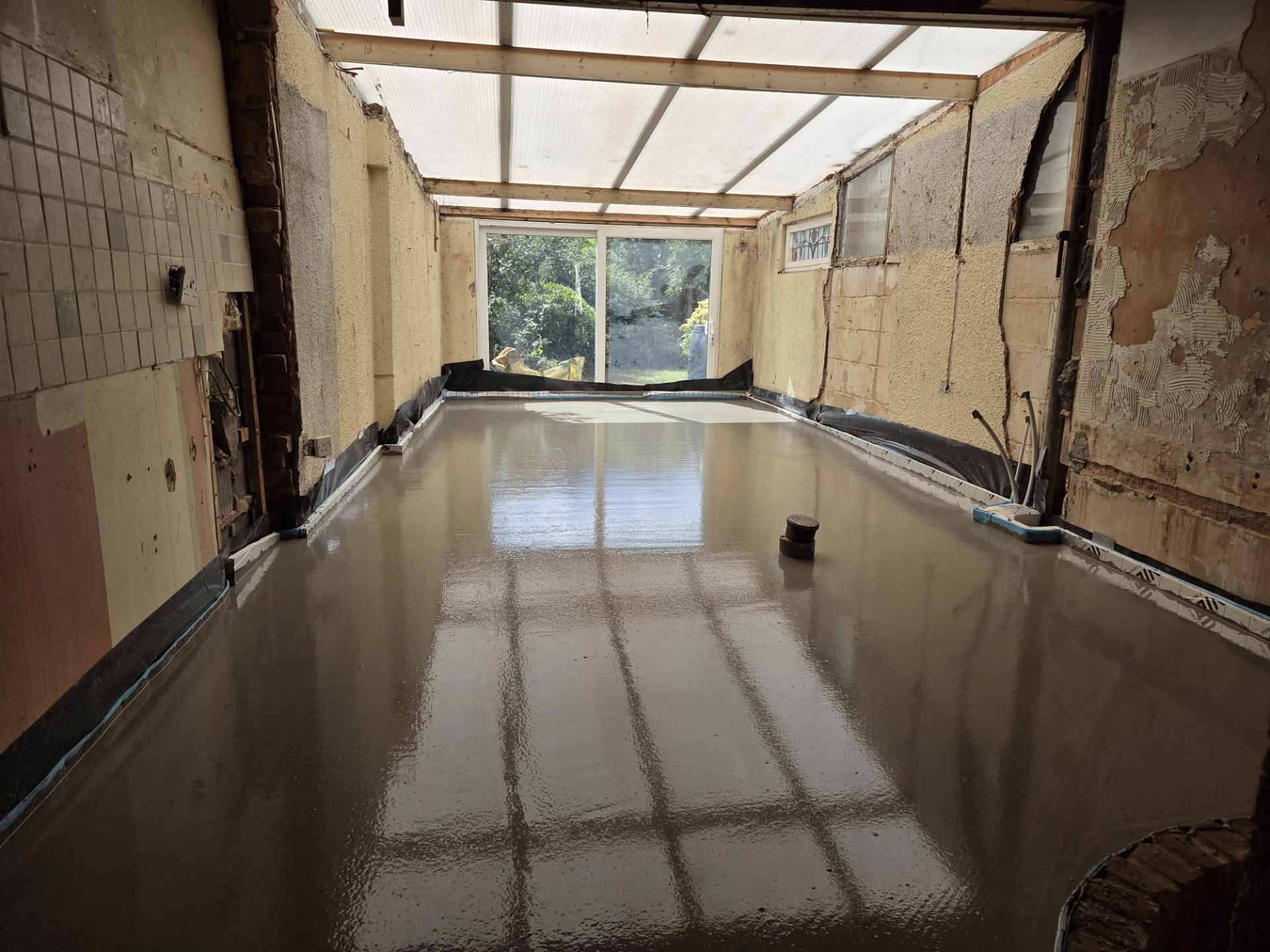
A floating liquid screed needs room to move independently of the surrounding structure. Without an isolation gap, thermal or drying-shrinkage movement in the screed can transmit stress into the slab at its edges, showing up as cracking or debonding along walls and around columns.
The strip needs to be continuous around every upstand in the floor plate — not just external walls — including internal partitions, structural columns and service penetrations, since any rigid contact point can become a stress concentration.
Thermal performance and detailing
Where the perimeter strip is an insulating product rather than a simple compressible foam, it also plays a role in reducing cold bridging at the floor edge, which is particularly relevant on ground floors with underfloor heating where edge heat loss can be disproportionate to its area.
After the screed has cured, the strip is trimmed back to just below the finished floor level so it doesn't interfere with skirting boards or floor coverings, while still leaving the movement gap intact beneath.
Selecting the right strip material and thickness
Common perimeter strip materials range from simple compressible foam to purpose-made insulating edge boards, and the choice depends on whether cold-bridging performance is required at that junction, alongside the general guidance on movement provision found in BS 8204.
Thickness needs to be sufficient to accommodate the screed's anticipated drying shrinkage across the floor plate, so a strip that's too thin for the floor's dimensions can be compressed solid before the screed has finished moving, defeating its purpose.
Common installation errors and how they surface later
Gaps in the strip run at corners, around pipe penetrations, or where sections haven't been butted tightly are among the most frequent installation errors, and each gap is a potential point where the screed can bear directly on the substrate or wall and later crack.
Compressed or displaced strip — sometimes trodden down during the pour or trapped under formwork — can also lose its function, so a check of the strip's condition immediately before pouring is worth the few minutes it takes.
Perimeter Edge Insulation — the points that decide it
- Isolation strip separates the floating screed from all rigid vertical elements, not just external walls
- It accommodates thermal and moisture-related movement of the screed slab
- Where insulating, it also reduces heat loss and cold bridging at the floor perimeter
- Strip must run continuously around columns, door frames and pipe penetrations
- Trimming back after the screed has cured leaves a clean junction for skirting or flooring
- Missing or compressed edge strip is a common cause of edge cracking
- Height of the strip should exceed the finished floor level to avoid bridging by later floor coverings
- BS 8204 gives general guidance on movement provision at abutments referenced when specifying strip thickness
- Strip thickness should also allow for the screed's expected drying shrinkage across the floor plate
- Skirting or trim covering the gap afterward should not itself bridge and stiffen the joint
Getting your perimeter edge detailing right?
We fit continuous, correctly specified edge isolation on every floating screed we lay — call 07791 510849.
Or call our landline on 01392 237700
Perimeter Edge Insulation — your questions
In short
Perimeter edge insulation isolates the screed from walls and upstands, allowing thermal movement and reducing cold bridging around a floating floor.
Getting your perimeter edge detailing right?
We fit continuous, correctly specified edge isolation on every floating screed we lay — call 07791 510849.