
Screed Systems
Bonded Screed Build-Up: Layers and Design Principles
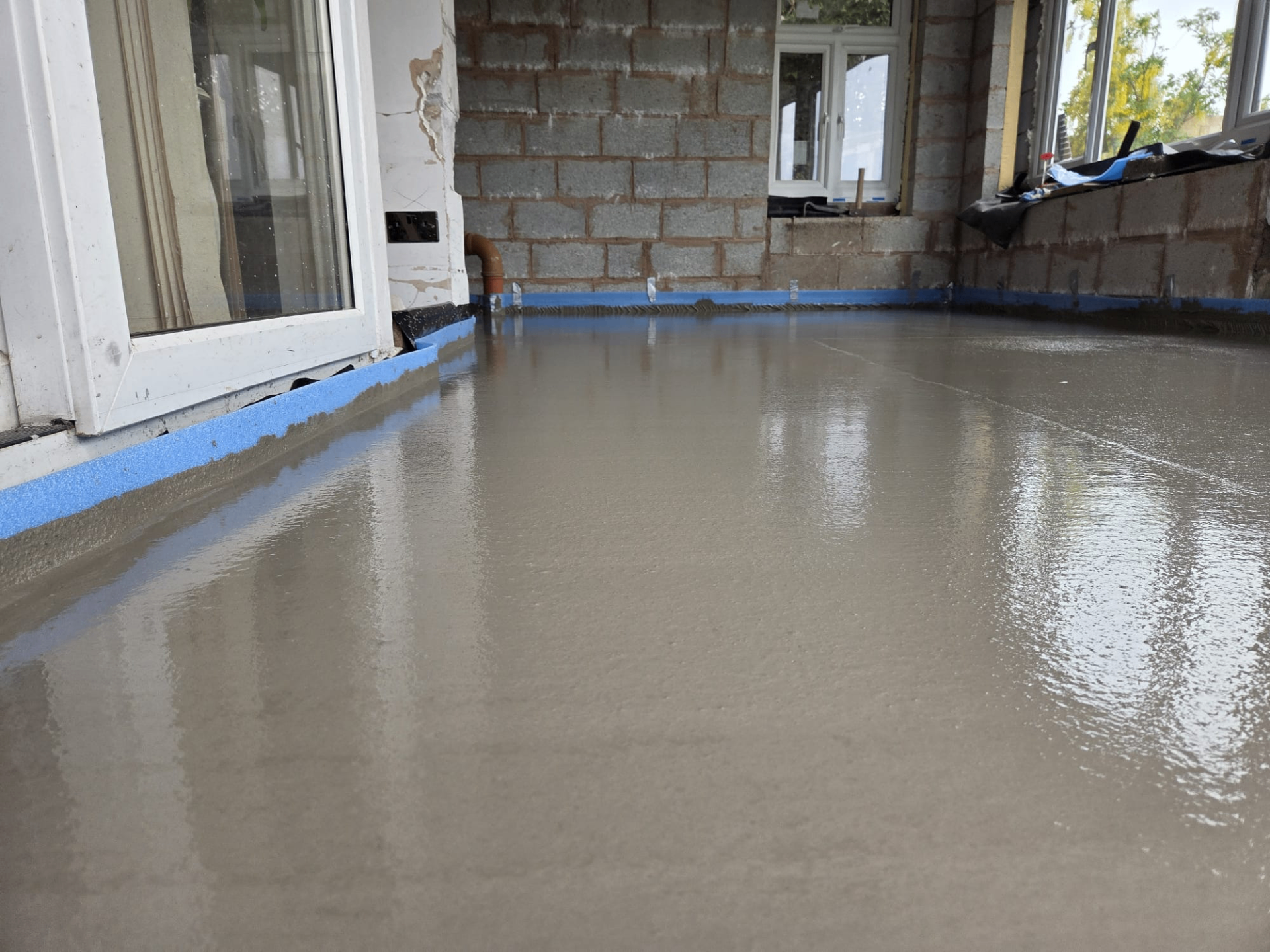
A guide to bonded screed construction, where the screed layer is mechanically and chemically keyed to the substrate below it.
Considering a bonded screed for your refurbishment?
Exeter Liquid Screeders can assess your existing slab and advise whether a bonded build-up is appropriate.
Or call our landline on 01392 237700
A bonded screed is laid directly onto a prepared concrete substrate with no separating membrane, relying on a strong mechanical and chemical bond to act monolithically with the base. Because there's no isolating layer, this build-up can typically be installed thinner than floating or unbonded alternatives, which matters where floor-to-ceiling heights are tight.
Bonding relies entirely on substrate preparation. The base concrete needs mechanical preparation — usually shot-blasting or scarifying — to remove laitance and open the surface texture, followed by a compatible primer or slurry coat before the screed goes down. Skipping or rushing this stage is the most common cause of debonding failures later.
Bonded build-ups are typically specified where depth is limited, the substrate is sound and dry, and there's no requirement for a separating membrane such as a DPM or acoustic layer, making this one of the more cost-effective options where an existing slab is in good condition.
Bonded Screed Build-Up — the points that decide it
- Screed bonds directly to a mechanically prepared substrate with no membrane in between
- Allows thinner overall screed depth than floating or unbonded designs
- Substrate preparation (shot-blasting, priming) is critical to long-term performance
- Not suitable where a DPM or acoustic separating layer is required by design
- Best suited to sound, dry, structurally stable concrete bases
- Reduced risk of the screed 'drumming' or delaminating when correctly prepared
- Often used in renovation where existing slabs are in good condition
- Bonding agent or slurry coat timing relative to the pour affects final bond strength
- Movement joints still need to align with any joints in the substrate below
Preparing the substrate for a bond
Mechanical preparation removes laitance, oil contamination and any loose material, exposing an open-textured surface for the bonding agent to key into. This is typically done by diamond grinding or shot-blasting rather than light sweeping or acid etching, which don't reliably achieve the required profile.
A bonding slurry or primer compatible with the screed system is then applied, usually just ahead of the screed pour so it remains tacky when the fresh material is placed on top. Timing here matters — leaving the primer too long to dry can reduce the bond strength achieved.
Where bonded screed fits and where it doesn't
Bonded designs suit refurbishment projects with an existing slab in reasonable condition, or new builds where minimum depth is a priority. They are not appropriate where the substrate has active damp, is structurally cracked, or where a DPM is needed — in those cases an unbonded or floating build-up is generally the better route.
Because there's no isolating layer, any substrate movement or cracking can telegraph through to the screed surface, so an assessment of the base slab's condition should always precede specifying a bonded system.
Testing the bond and identifying failure modes
A properly bonded screed should sound solid and consistent when tapped or chained across the surface; a hollow or drumming sound generally indicates a local area of debonding, often traced back to contamination, dust or an under-prepared patch missed during shot-blasting.
Debonding failures usually originate at the interface rather than within the screed body itself, which is why so much emphasis is placed on substrate cleanliness, moisture content and primer application rather than the screed mix alone.
Movement joints in a bonded build-up
Because the screed moves with the substrate rather than independently, movement joints in a bonded design are generally aligned with existing joints in the base slab, and additional joints may be introduced at doorways or large area breaks to control shrinkage cracking.
Getting joint layout right at design stage avoids random cracking later, since a bonded screed has less capacity than an unbonded or floating layer to absorb differential movement without a designed joint to accommodate it.
Considering a bonded screed for your refurbishment?
Exeter Liquid Screeders can assess your existing slab and advise whether a bonded build-up is appropriate.
Or call our landline on 01392 237700
Reference points for bonded screed build-up
| Typical minimum depth | Thinner than floating/unbonded — depends on loading and screed type, follow datasheet |
|---|---|
| Substrate prep method | Shot-blasting or diamond grinding plus compatible primer/slurry |
| Standard reference | BS 8204-1 (cementitious) / BS 8204-7 (calcium sulphate) |
Bonded Screed Build-Up — your questions
In short
A guide to bonded screed construction, where the screed layer is mechanically and chemically keyed to the substrate below it.
Considering a bonded screed for your refurbishment?
Exeter Liquid Screeders can assess your existing slab and advise whether a bonded build-up is appropriate.