
Moisture defects
Damp Patches Appearing in a Screed Floor
A patch that stays visibly darker or damp for longer than the rest of the floor is telling you something specific about what's underneath it.
Get a damp patch diagnosed
Name, phone, email — we'll reply the same working day with a fixed price.
Or call our landline on 01392 237700
Screed dries from the surface down as moisture migrates up and evaporates. In an even pour over a sound DPM and consistent insulation, that drying should look roughly uniform across the floor. Isolated damp patches that stay wet or dark long after the rest of the room has dried are the exception — and worth investigating rather than waiting out.
The cause can be as simple as a locally thicker pour, or as significant as a DPM breach letting ground moisture through from below. Both look similar to the eye, so a visual check alone isn't enough to tell you which one you're dealing with.
This page covers the usual suspects, how we test rather than guess, and the repair path depending on what the test finds.
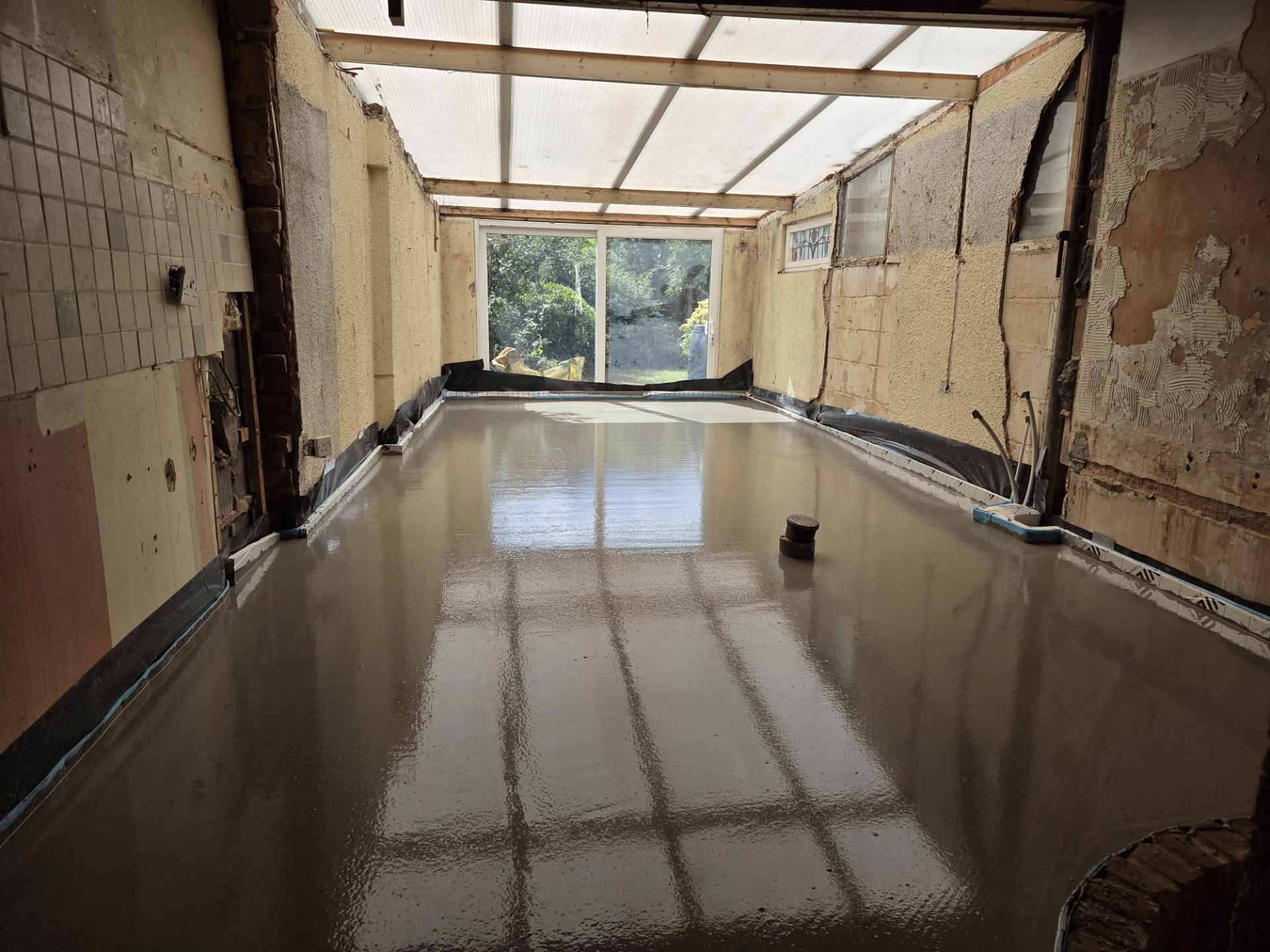
Likely causes of a localised damp patch
- DPM overlap, join or puncture allowing ground moisture up through the slab
- A locally deeper pour over an uneven insulation or subfloor
- A plumbing leak beneath or adjacent to the screeded area
- Poor perimeter detailing letting water track in from an external wall
- Condensation forming under a covering laid before the screed was ready
How we track the source down
- 1
Map the pattern
We note exactly where the patch sits relative to walls, pipework and the original pour sequence.
- 2
Surface moisture reading
A calibrated meter compares the patch against the surrounding dry areas.
- 3
Deeper RH test if needed
A hygrometer probe or drilled test at depth confirms whether moisture is coming from below.
- 4
Trace services
If a leak is suspected, we coordinate with a plumber to isolate and test pipework under the slab.
Reading the symptoms
| What you see | What it usually means |
|---|---|
| One patch, near a wall, stays damp | Perimeter detailing or DPM lap issue |
| Patch tracks along a known pipe run | Possible leak beneath the screed |
| Whole room drying unevenly, no pattern | Inconsistent screed depth or subfloor insulation |
| Patch appears after floor covering goes down | Trapped moisture, covering laid too early |
Get a damp patch diagnosed
Send us photos and the pour date, and we'll advise on the likely cause and what testing is needed before repair.
Or call our landline on 01392 237700
We won't repair a damp patch until we know why it's there. A patch caused by a leak needs a plumber first — patching the screed over it just hides the problem.
— Exeter Liquid Screeders
Damp Patches in Screed — questions we get asked
Related screed problems
Keep reading across the site
Get a damp patch diagnosed
Send us photos and the pour date, and we'll advise on the likely cause and what testing is needed before repair.