
Damp-proof membrane risk
DPM Failure Under a Screed Floor
A liquid screed is only as dry as the ground beneath it lets it be. When the damp-proof membrane fails, moisture rises straight through, no matter how well the pour went.
Suspect a DPM problem under your screed?
Name, phone, email — we'll reply the same working day with a fixed price.
Or call our landline on 01392 237700
The damp-proof membrane (DPM) sits between the ground slab and the screed above, stopping ground moisture from migrating upward. It's usually invisible once the screed is down, which means a failure in it — a puncture, an unsealed lap, or a membrane that was never continuous in the first place — often isn't discovered until a moisture problem appears months later.
Because the screed itself did nothing wrong, DPM failure is a frustrating diagnosis: the pour, the mix and the finish can all be perfect, and the floor still won't pass a moisture test or the flooring above still delaminates, because the water is coming from below, not from the screed drying process.
This page covers how we tell the difference between a slow-drying screed and a genuine DPM failure, and what the remediation actually involves.
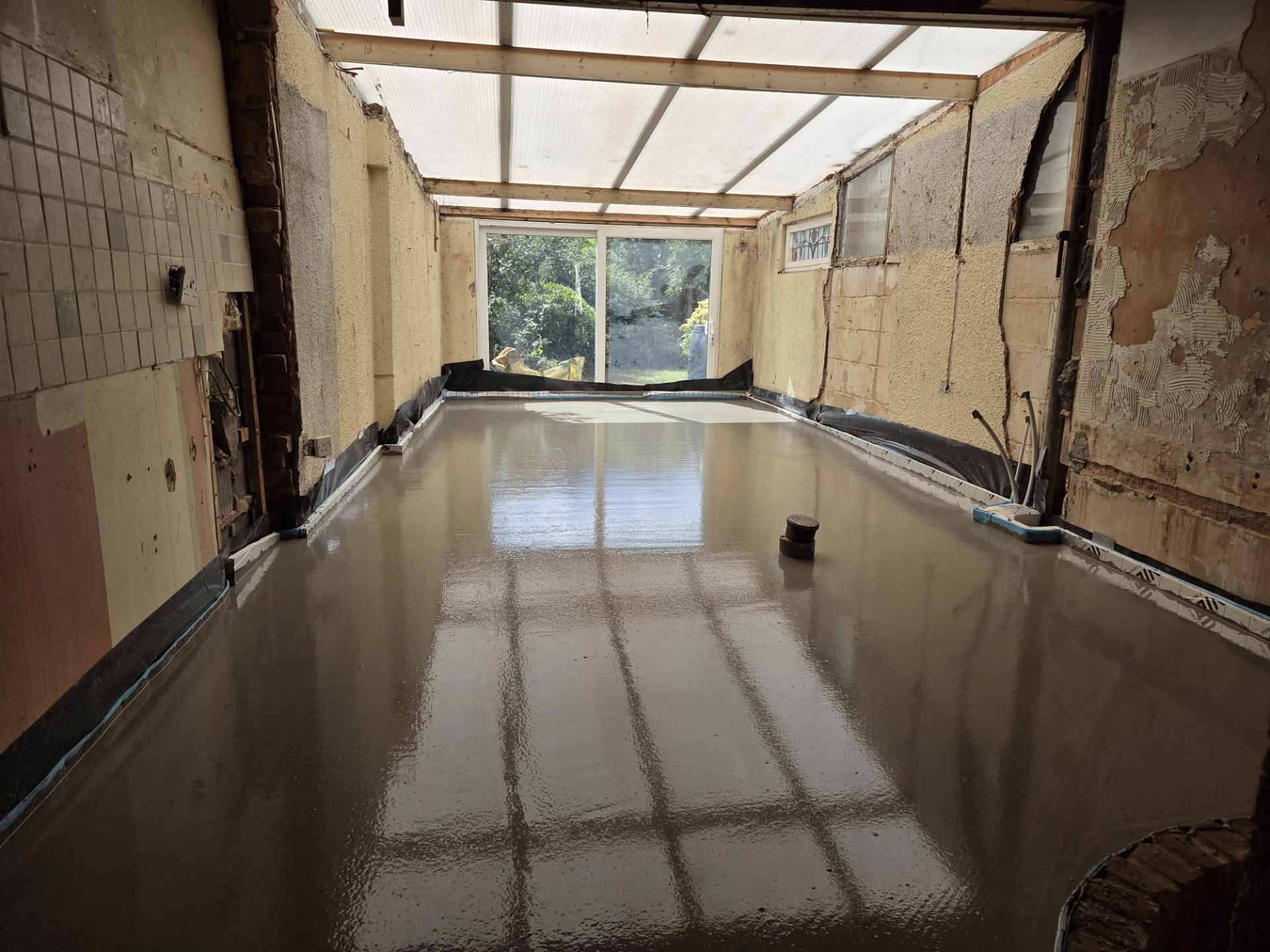
Signs pointing to a DPM issue rather than a drying issue
- Moisture readings that plateau or rise again after an extended drying period
- Damp patches that reappear in the same location after being dried out
- Musty smell persisting well beyond the expected drying window
- Flooring failures concentrated near known slab penetrations or perimeter edges
- A history of known groundwater or high water table on the site
How we investigate a suspected DPM failure
- 1
Extended moisture testing
Hygrometer or carbide readings taken over time rather than once, to see whether moisture is falling normally or plateauing.
- 2
Localise the pattern
Mapping affected areas against known service penetrations, edges and joints often points straight to where a membrane lap or puncture would be.
- 3
Core inspection
A core sample can sometimes reveal a visible membrane defect directly beneath the screed.
- 4
Confirm the source
Where needed, we bring in specialist damp surveying to confirm ground moisture ingress rather than assuming it.
DPM failure vs slow screed drying
| Indicator | Likely cause |
|---|---|
| Moisture falling steadily but slowly | Normal drying — needs more time or ventilation |
| Moisture plateaued or rising | Possible DPM or ground moisture ingress |
| Localised damp near penetrations | Membrane puncture or unsealed lap |
| Uniform dampness across whole floor | Membrane never continuous, or absent |
Suspect a DPM problem under your screed?
Get an extended moisture assessment before assuming it just needs more time. We'll tell you plainly what the readings show.
Or call our landline on 01392 237700
Waiting longer won't dry out a genuine DPM failure — it will just delay finding it. Extended moisture monitoring is the only reliable way to tell the two apart.
— Exeter Liquid Screeders
Damp-Proof Membrane Failure Beneath a Liquid Screed
On a ground floor construction, the damp-proof membrane sits below the insulation and screed build-up specifically to prevent moisture from the ground migrating upward into the floor structure. It is a single, continuous line of defence, and its effectiveness depends entirely on how completely and carefully it was installed — every lap sealed, every penetration detailed, and every join running correctly up the perimeter walls to meet the damp-proof course.
When persistent damp patches, ongoing high moisture readings, or a musty smell are traced back to a ground floor screed that otherwise appears to have dried and cured normally, a DPM problem is one of the possibilities that needs to be considered, particularly where the moisture pattern does not correlate with anything happening above the floor.
Because the membrane is completely hidden beneath the screed once installed, establishing a DPM failure with confidence usually relies on ruling out other moisture sources first and looking at the pattern and persistence of the symptoms.
DPM Failure Beneath Screed — key points
The DPM is the sole barrier against ground moisture reaching the floor build-up
Punctures, poor laps and incomplete perimeter detailing are common failure points
Symptoms can appear well after the screed has otherwise dried, not just during initial drying
Moisture readings that stay stubbornly high despite adequate drying time and conditions are a key indicator
Isolated failures (a puncture) behave differently from widespread detailing failures (unsealed laps)
Confirming a DPM failure with confidence usually requires more detailed investigation than surface moisture testing alone
How and where DPMs typically fail
A membrane can be damaged during its own installation by foot traffic or the following trades before it is protected, punctured by protruding debris on the base below it, or torn during the placement of insulation, pipework or the screed pour itself if it was not adequately protected during the sequence of works. Detailing failures are just as common as physical punctures: laps between sheets that were not sealed correctly, or a perimeter upstand that does not run high enough to meet the wall's damp-proof course, both leave a route for moisture even though the majority of the membrane is intact.
Because a screed can dry and test acceptably at the surface immediately after installation, some DPM-related moisture problems only become apparent later, once ground moisture has had time to migrate upward through the affected area and back into the screed after it had initially reached an acceptable state.
Approaching an investigation
A useful first step is confirming that any moisture affecting the floor genuinely correlates with ground conditions rather than a leak, spillage, or condensation source above the floor, since these can produce similar symptoms and are generally easier to resolve. Comparing moisture readings across different areas of the same floor can also help — a DPM puncture often produces a localised area of persistently high readings, while unsealed laps or perimeter details can produce a wider or edge-related pattern.
Because directly inspecting the membrane means removing the screed above it, this level of investigation is usually reserved for cases where other causes have been reasonably ruled out and the moisture pattern is not resolving with time or reasonable environmental measures.
DPM Failure Under Screed — questions we get asked
Related screed problems
Keep reading across the site
Suspect a DPM problem under your screed?
Get an extended moisture assessment before assuming it just needs more time. We'll tell you plainly what the readings show.