Screed Systems
Unbonded Screed Build-Up: Design and Uses
An overview of unbonded screed construction, where a separating membrane isolates the screed from the substrate beneath.
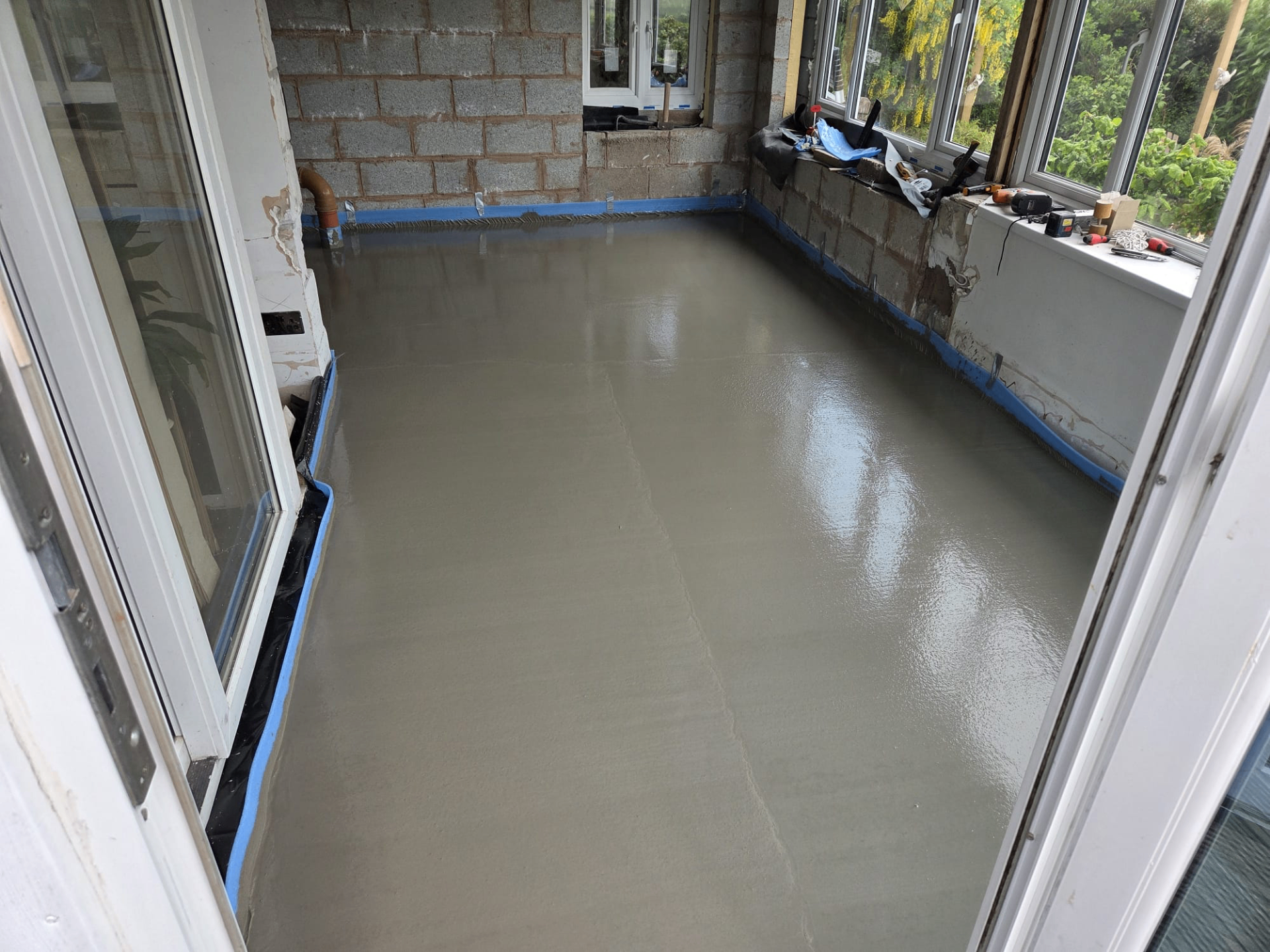
Unbonded screed is laid over a separating membrane — often a polythene DPM or slip membrane — rather than bonding directly to the substrate. This isolates the screed structurally from the base below, allowing it to move independently and accommodating substrate imperfections or contamination that would otherwise compromise a bonded design.
This approach is common where a damp-proof membrane is required over a ground-bearing slab, or where the base substrate isn't suitable for a reliable bond, whether due to residual laitance, unknown history, or the presence of existing services and coatings that can't be fully removed.
Because it isn't relying on adhesion to the base, an unbonded screed generally needs to be laid to a greater minimum thickness than a bonded design to achieve adequate strength and stiffness, and reinforcement is often specified to manage curling risk at joints and edges.
Need a screed build-up that isn't reliant on your existing slab?
Speak to Exeter Liquid Screeders about whether an unbonded design suits your substrate and moisture conditions.
Or call our landline on 01392 237700
Why isolate the screed from the base?
Isolating the screed avoids reliance on the condition or history of the substrate. Where the base slab has an unreliable finish, existing adhesive residue, or where full mechanical preparation for bonding isn't practical, a separating membrane sidesteps these issues entirely.
It also provides a route for a DPM to be positioned correctly in the build-up when rising damp or ground moisture is a risk, since the membrane sits directly on the slab beneath the screed rather than being interrupted by a bonding layer.
Design considerations for unbonded screeds
Because the layer isn't restrained by a bond to the substrate, unbonded screeds are more prone to curling at joints and edges if not adequately thick or reinforced, so panel sizes and movement joint layout need careful design, particularly over larger areas.
Depth is typically greater than a bonded equivalent to provide sufficient stiffness — the exact figure depends on loading, screed type and manufacturer design tables, so this should be confirmed against the specific product datasheet for your project.
Membrane detailing that protects the design
The separating membrane should be lapped generously at joints and taped to remain effectively continuous during the pour, since gaps or tears can allow fluid screed to migrate beneath, locally reducing thickness and undermining the intended isolation.
At the perimeter, the membrane is usually run up the wall above final screed level, working alongside the edge insulation strip so the screed layer is isolated on every side, not just from the substrate beneath.
Common failure modes and how design avoids them
The main risks with unbonded designs are curling at unrestrained edges and cracking from under-thickness relative to the loading applied — both are managed through correct minimum depth, reinforcement choice and movement joint spacing rather than after-the-fact repair.
Because the screed isn't gripping the substrate, poor compaction or trapped air during the pour can also be more noticeable than in a bonded system, so consistent placement and use of a dappling bar remain important even without a bonding interface to consider.
Unbonded Screed Build-Up — the points that decide it
- Screed is isolated from the substrate by a separating membrane rather than bonded to it
- Commonly used where a DPM is required over a ground-bearing slab
- Needs greater minimum thickness than bonded designs to perform structurally
- Tolerant of substrate imperfections that would compromise a bonded system
- Perimeter edge strips accommodate movement independent of the base
- Reinforcement (fibre or mesh) often specified to control curling and cracking
- Suited to both cementitious and calcium sulphate screed types
- Membrane laps and joints need taping to keep the layer effectively continuous
- Panel size and movement joint layout are more critical than in a bonded design
Unbonded Screed Build-Up — your questions
In short
An overview of unbonded screed construction, where a separating membrane isolates the screed from the substrate beneath.
Need a screed build-up that isn't reliant on your existing slab?
Speak to Exeter Liquid Screeders about whether an unbonded design suits your substrate and moisture conditions.