Substrates & Preparation
DPM Lapping and Junction Detailing Before Screed
A damp-proof membrane only works if its laps, upstands and junctions with walls and other membranes are continuous — gaps undermine the whole system.
Need DPM detailing checked before the screed goes down?
We'll review membrane laps, upstands and junctions on site and flag anything that needs addressing before we pour.
Or call our landline on 01392 237700
A damp-proof membrane is only as good as its weakest joint. Sheets need lapping by a sufficient margin and taping, upstands at perimeters need to run high enough to link with the wall DPC, and junctions with other membranes — a radon barrier, a cavity tray, a separate wall DPC — all need to connect into one continuous system rather than being treated as independent details.
This is one of those preparation tasks that's invisible once the screed and floor finish are down, which makes getting it right first time more important than usual.
Need DPM detailing checked before the screed goes down?
We'll review membrane laps, upstands and junctions on site and flag anything that needs addressing before we pour.
Or call our landline on 01392 237700
Getting laps and upstands right
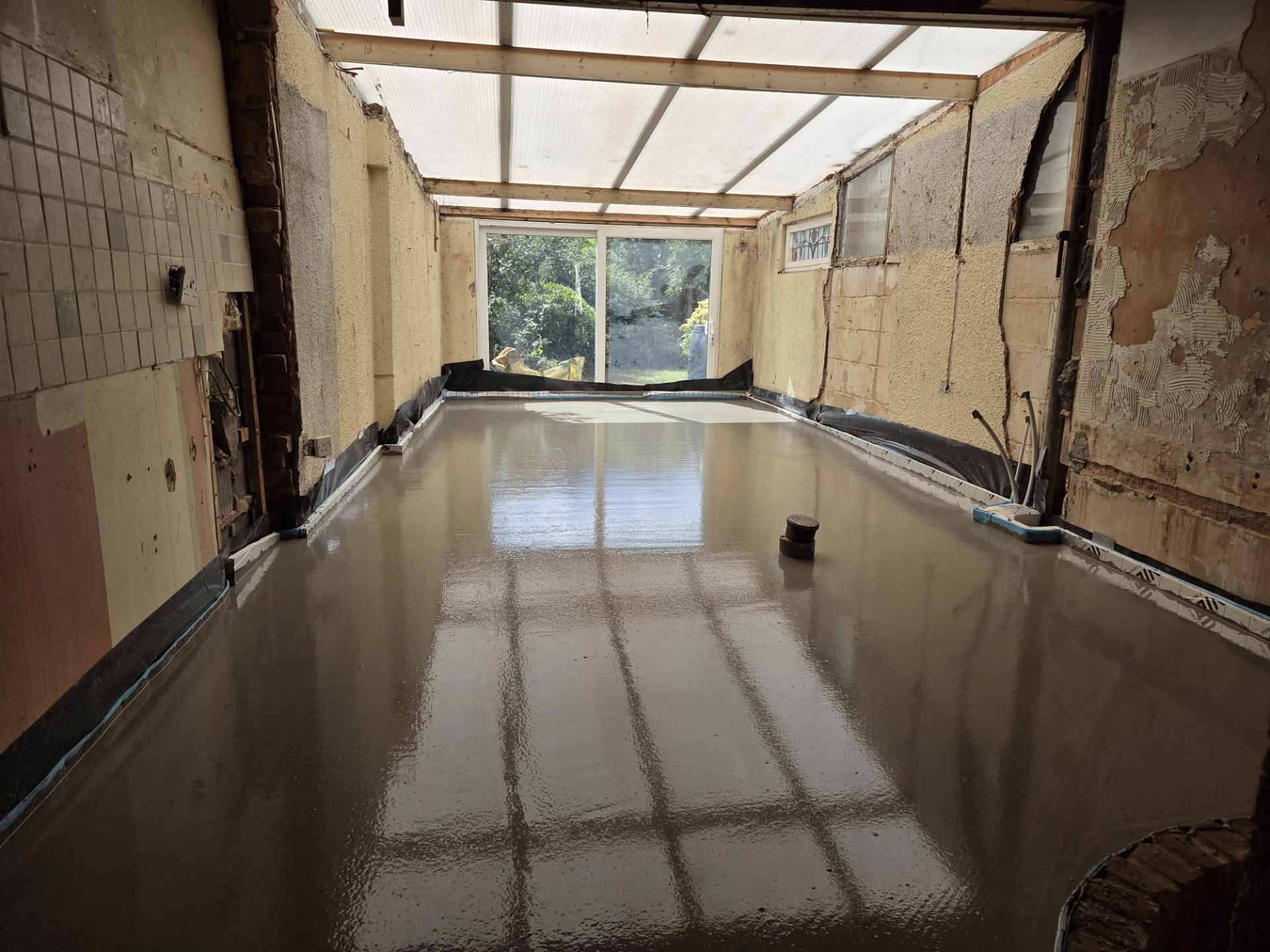
Lapped DPM joints need enough overlap to remain continuous even if there's slight movement or shrinkage in the sheet material, and taping the lap gives a more reliable seal than relying on overlap alone. At the perimeter, the DPM should turn up the wall to link with the DPC at a height that avoids leaving a gap between the two systems — a common point where inspectors will check on new build projects.
Coordinating multiple membrane systems
Where a site has both a standard DPM and, say, a radon or gas membrane, or a cavity tray at a threshold, these systems need to be detailed so they connect rather than simply sit near each other. This is usually worked out at design stage with input from whoever specified the additional protection measures, and the site team installing the membranes needs clear detail drawings to follow rather than making judgement calls on site.
The final membrane check before insulation and screed
Inspect every lap, perimeter turn-up and service penetration while it is still visible. Loose overlaps need taping with the product specified for the membrane, penetrations need a formed seal rather than an open cut, and any damage caused while moving insulation or fixing pipework must be patched before it is covered.
Keep the upstands in place through the screed and floor-finishing stages. Cutting them down early can break the connection at the wall junction or leave the final trim height short. Once the build-up is covered, photographs and the approved detail drawing are the clearest record that the membrane remained continuous.
DPM Lapping & Junctions — the points that decide it
- DPM sheet laps need a minimum overlap and should be taped, not just laid loosely on top of one another
- Perimeter upstands should run high enough to link with the wall's damp-proof course, avoiding a gap where moisture could bypass both membranes
- Junctions between different membrane types (DPM to radon barrier, DPM to cavity tray) need specific detailing rather than assuming they'll naturally align
- Service penetrations through the DPM need collar seals or similarly detailed treatment, not just a hole cut and left
- The membrane should be protected from puncture during insulation laying, reinforcement fixing and the screed pour itself
- Trimming the upstand to final height is usually done after the screed and floor finish are installed, not before
DPM Lapping & Junctions — your questions
In short
A damp-proof membrane only works if its laps, upstands and junctions with walls and other membranes are continuous — gaps undermine the whole system.
Need DPM detailing checked before the screed goes down?
We'll review membrane laps, upstands and junctions on site and flag anything that needs addressing before we pour.