
Substrates & Preparation
Taping and Sealing Joints to Prevent Grout Loss
Grout loss through unsealed joints is one of the most common causes of an uneven or thin patch in a finished liquid screed floor, and it's entirely preventable.
Liquid screed flows readily during installation, which is exactly what makes it self-levelling — and exactly why any gap in the layers beneath it, however small, is a route for cement paste and fines to escape. Grout loss through unsealed insulation joints, membrane laps or gaps around service penetrations can leave a patch of the floor with less binder than the rest, which shows up later as a soft spot or surface defect.
Taping and sealing before the pour is a relatively quick, low-cost step compared with the disruption of investigating and repairing a defect after the screed has cured.
Taping & Sealing Joints — the points that decide it
- Every joint in the insulation and membrane layer beneath a liquid screed is a potential route for grout loss if left unsealed
- Tape should be compatible with the specific board facing or membrane material, since generic tape can lift or fail to bond properly
- Perimeter junctions, door thresholds and service penetrations need the same attention as the main field joints, as these are common weak points
- A pre-pour walk-around, checking every joint and penetration methodically, catches gaps that are easy to miss when working at speed
- Any gaps around pipework, ducting or manifold boxes should be packed and taped before the pour, not addressed reactively as the screed is flowing
- Grout loss that does occur during a pour is far harder to manage retrospectively than preventing it at the taping stage
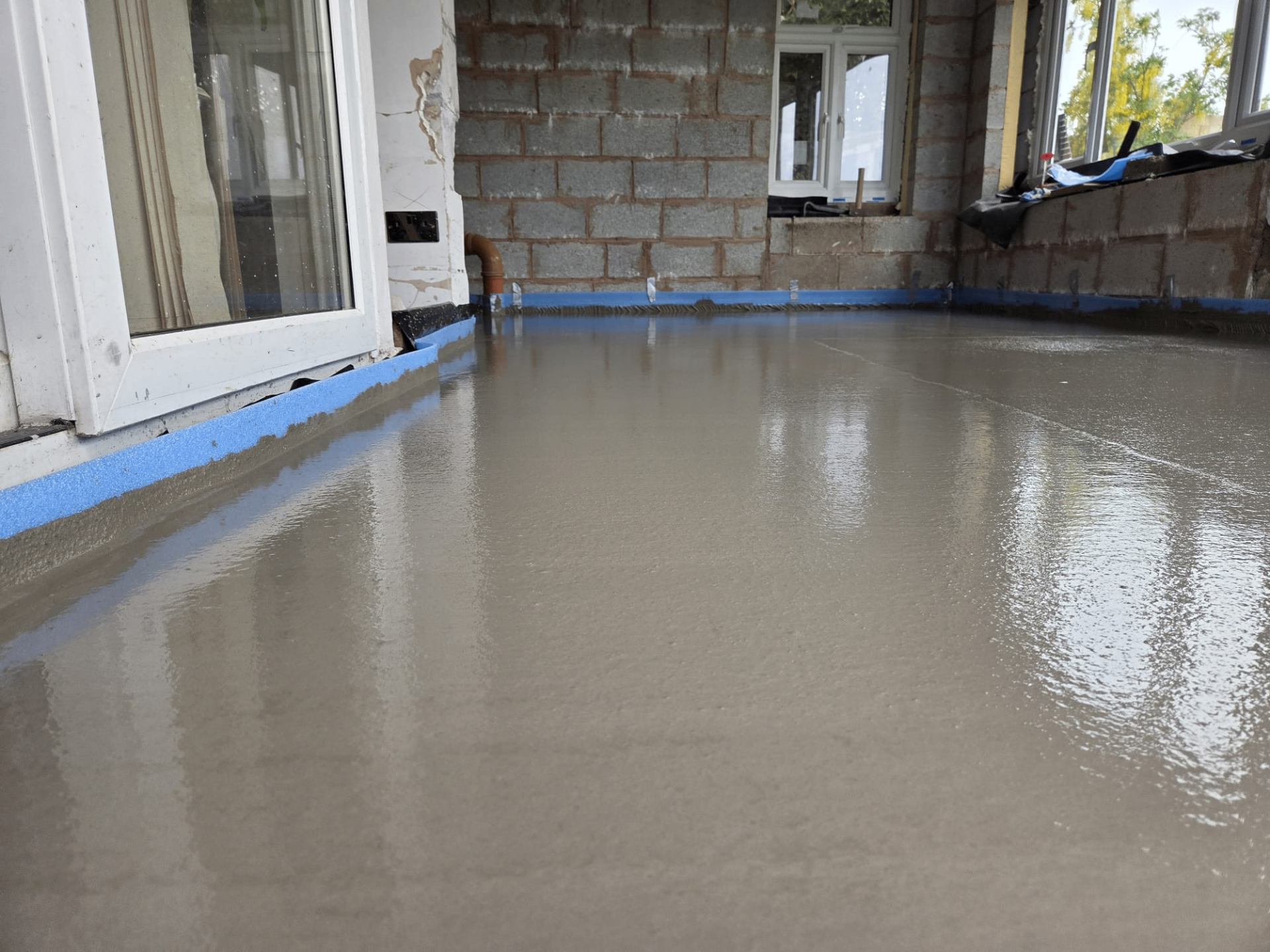
Why small gaps cause disproportionate problems
A liquid screed's flowable consistency means it will find any gap, however narrow, and the fine cement particles carrying much of the binder's strength are the first to migrate through. The result isn't just a leak — it's a localised area of the poured floor left with a different mix ratio to the rest, which can show up as a softer or less durable patch once the floor is in use.
A systematic pre-pour check
Rather than relying on memory during installation, a methodical walk-around immediately before the pour — checking every board joint, membrane lap, perimeter detail and penetration in sequence — catches the gaps that are easy to miss when several trades have been through the same area during earlier stages of the build. This final check is a standard part of a well-run pour day, not an optional extra.
Want to be confident your joints are sealed before we pour?
We carry out a thorough pre-pour check on every job, and we're happy to talk through what that involves for your specific floor.
Or call our landline on 01392 237700
In short
Grout loss through unsealed joints is one of the most common causes of an uneven or thin patch in a finished liquid screed floor, and it's entirely preventable.
Taping & Sealing Joints — your questions
Want to be confident your joints are sealed before we pour?
We carry out a thorough pre-pour check on every job, and we're happy to talk through what that involves for your specific floor.