
Large projects
Phasing pours across a large floor area
An explanation of when and why a large floor area is split into phased pours rather than completed in a single continuous pour.
Working on a large floor area?
Talk to us about your building's size and programme so we can advise on a sensible phasing strategy.
Or call our landline on 01392 237700
Not every floor can, or should, be poured in a single continuous operation. Phasing splits a large area into manageable sections, each with its own considerations for joints and sequencing, allowing a project to progress even where the whole floor area isn't ready to receive screed at the same time.
Deciding whether to phase a pour depends on area, pumping capacity, access and the building's own construction sequence, not a fixed size threshold alone. A large open-plan area that is fully accessible in one go might still be poured in a single day, while a smaller but more complex building with staged handover of different zones may need phasing regardless of overall area.
The decision is usually made jointly between the screed contractor, main contractor and, where relevant, the structural engineer, since movement joint positions, structural bay layout and the wider build programme all feed into where the sensible split points fall.
Phasing large floor areas — the points that decide it
- Very large floor areas may exceed what can realistically be poured to a consistent finish in a single day.
- Movement joints are often positioned to coincide with phase boundaries, reducing the number of additional joints needed.
- Phasing can also be driven by the building programme itself, where different zones become available at different times.
- Each phase needs its own edge detailing where it meets an adjoining phase, to manage the joint correctly.
- Sequencing between phases should avoid disturbing an already-poured area while later phases are completed.
- Phased floors need consistent depth and product across phases so the finished floor performs uniformly.
- Pumping capacity and hose run length can also influence how a large area is practically split into phases.
- Weather and drying conditions between phases should be considered where there is a significant gap between pours.
- Clear labelling or marking of phase boundaries on site helps avoid confusion for other trades working nearby.
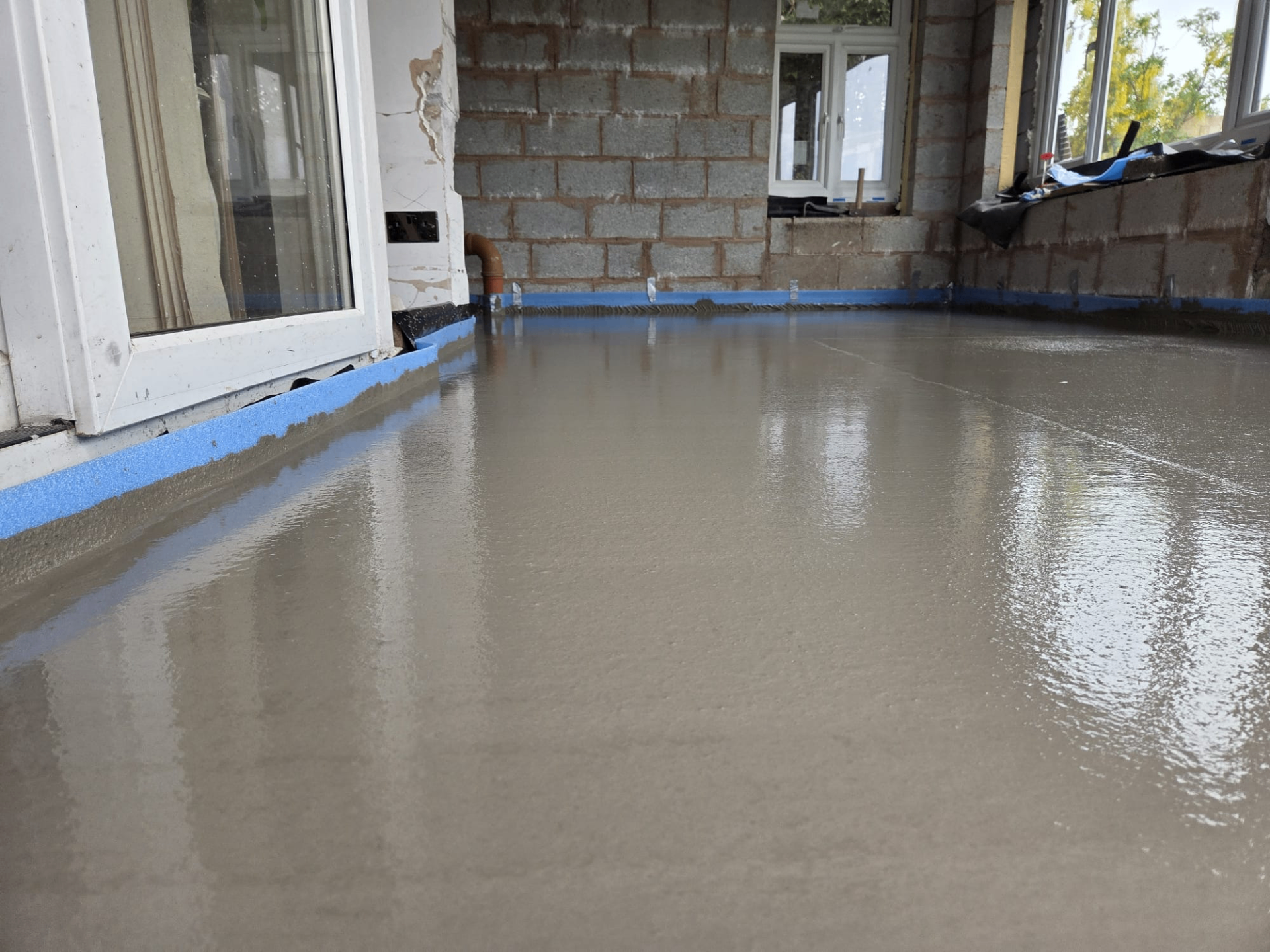
Deciding where to split a large floor
Phase boundaries are usually chosen to align with natural breaks in the building — door openings, structural bays or planned movement joints — so the split doesn't create an awkward junction in the middle of an open space. Structural drawings and the movement joint layout are reviewed together before phase lines are agreed.
Where the building itself is being handed over in stages, phase boundaries often follow those same handover zones, since it makes little sense to pour an area that isn't yet accessible or that other trades are still actively working in.
Keeping phases consistent with each other
Where phases are poured on different days, care is taken to use the same product, depth and mix approach so there isn't a visible or performance difference between one phase and the next. Records are kept of exactly what was used for each phase so this consistency can be checked later if needed.
Surface finish can vary slightly with conditions on the day, so where phases will be visible together under a thin floor covering, this is discussed in advance so expectations are realistic.
Managing the junction between phases
The edge of an already-poured phase needs protecting while an adjoining phase is being prepared and poured, since it will already be curing and vulnerable to damage from ongoing works nearby. Temporary edge boards or barriers are commonly used to define and protect this junction.
Level matching across the joint is checked carefully, particularly where phases are poured some time apart, to avoid a visible step or ridge where the two meet under the final floor covering.
Coordinating phasing with the wider programme
Phasing a floor inevitably means coordinating pour dates with whichever other works are happening in adjoining or nearby areas, so that trades aren't disrupted and access for the pump and hose remains available for each phase in turn.
Because each phase effectively restarts its own curing and drying clock, the overall programme benefit of phasing needs to be weighed against the fact that different areas of the same floor may become ready for covering at different times.
In short
An explanation of when and why a large floor area is split into phased pours rather than completed in a single continuous pour.
Working on a large floor area?
Talk to us about your building's size and programme so we can advise on a sensible phasing strategy.
Or call our landline on 01392 237700
Phasing large floor areas — your questions
Other pages that answer this properly
Working on a large floor area?
Talk to us about your building's size and programme so we can advise on a sensible phasing strategy.