
Substrates & Preparation
Weatherproofing and Building Envelope Requirements Before Screeding
Liquid screed needs a reasonably weathertight building envelope before it's poured, since wind, rain and temperature swings all affect a wet, self-levelling material.
Planning a pour before the envelope is fully finished?
We can advise on what level of weatherproofing is needed for your specific site and timetable across Exeter and the South West.
Or call our landline on 01392 237700
Liquid screed is applied wet and needs a period undisturbed to begin curing before it can take foot traffic. That makes the state of the building envelope — windows, external doors, roof coverings and any large temporary openings — directly relevant to whether a pour can go ahead as planned.
On a new build this is usually straightforward because the sequence naturally has the roof and windows finished before floor finishes start. On refurbishment and extension projects, where a screed might be poured into an existing structure with temporary openings, the envelope requirements are worth confirming explicitly rather than assumed.
A weathertight envelope isn't only about keeping rain off the surface on the day of the pour — it also protects the curing screed over the following days and weeks, when the material is still sensitive to draughts, temperature swings and any water finding its way in through an unfinished junction or a badly sealed opening.
Weatherproofing the Envelope — the points that decide it
- 1External doors and windows should be fitted, or openings sheeted, before the pour to keep wind and driven rain off the fresh surface
- 2Roof coverings need to be watertight so rainwater can't track down through the building onto the new screed
- 3Draughts across a curing screed can dry the surface unevenly, increasing the risk of shrinkage cracking or curling at the edges
- 4Large open gable ends or unglazed openings may need temporary screening even in otherwise dry weather
- 5Site heating or drying equipment introduced too early, before the envelope is sealed, can pull in dust and debris on the airflow
- 6On phased projects, each area being poured should be individually weathertight rather than relying on the building as a whole being 'mostly' enclosed
- 7Junctions around temporary openings, such as scaffold access points or partially glazed rooflights, are worth checking specifically rather than assuming the main structure covers them
- 8Any temporary sheeting used as a stand-in for glazing should be secure enough to withstand expected wind loading, not just draped loosely across the opening
Why wind and rain matter to a wet pour
A liquid screed surface is levelled and then needs a period of gentle, even curing rather than rapid or uneven drying. A sudden gust of wind through an open doorway, or rain blowing in through an unglazed window, can disturb the surface, introduce debris, or cause localised drying that affects the finish. None of these are usually structural problems, but they can mean patch repairs or a compromised surface in the affected area.
Keeping the envelope closed also protects the screed from temperature swings during the first days of curing, when the material is most sensitive to its environment. A building that's open to the elements overnight can see much larger temperature drops than one that's sealed, even where daytime conditions look similar.
Refurbishment and extension projects
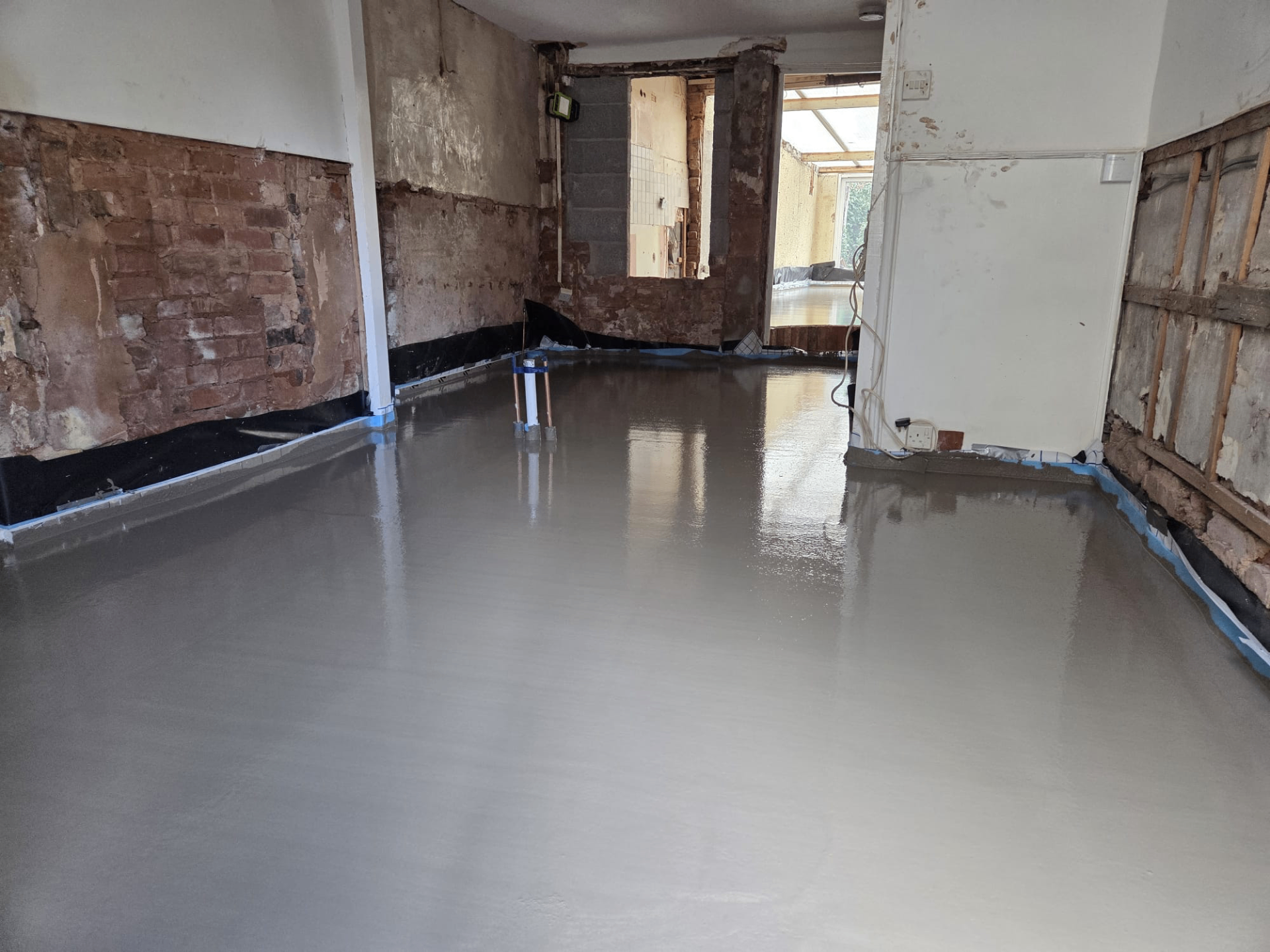
Where a screed pour is only part of a wider refurbishment, it's common for some external openings to still be under construction elsewhere in the building. In these cases, temporary sheeting or hoarding around the specific pour area can allow the work to proceed even if the whole building isn't finished, as long as the immediate area is protected from the weather.
It's worth discussing this with the screed contractor at the planning stage so any temporary weatherproofing measures are agreed before the pour date is set, rather than improvised on the day. On a phased refurbishment this conversation is often best had room by room, since one part of a property can be weathertight while another is still open to the elements.
Sealing junctions and penetrations before the pour
Beyond the obvious doors, windows and roof, it's worth checking smaller junctions that can let weather in unnoticed — service penetrations through external walls, temporary cable routes, or gaps around scaffold access points that haven't yet been made good. These are easy to overlook because they aren't full openings, but even a modest gap can let enough wind-driven rain through to affect a curing floor nearby.
A short walk of the building's external envelope specifically looking for these smaller gaps, rather than just confirming the main doors and windows, catches issues that a general site inspection might miss.
Temporary protection when full weatherproofing isn't yet possible
Where full weatherproofing genuinely isn't achievable by the planned pour date, temporary measures — heavy-duty sheeting fixed securely over openings, weighted down and taped at the edges — can bridge the gap, provided they're inspected regularly during the curing period rather than fitted once and forgotten.
This kind of temporary protection works best as a short-term measure rather than a long-term substitute for finishing the envelope, since it's more vulnerable to failure in strong wind than permanent glazing or cladding.
Planning a pour before the envelope is fully finished?
We can advise on what level of weatherproofing is needed for your specific site and timetable across Exeter and the South West.
Or call our landline on 01392 237700
Weatherproofing the Envelope — your questions
In short
Liquid screed needs a reasonably weathertight building envelope before it's poured, since wind, rain and temperature swings all affect a wet, self-levelling material.
Planning a pour before the envelope is fully finished?
We can advise on what level of weatherproofing is needed for your specific site and timetable across Exeter and the South West.