
Specification
Wording a surface regularity clause
Practical wording guidance for surface regularity clauses, so the requirement is checkable on site rather than a subjective description.
Need an SR clause tailored to your finish?
Tell us the floor finish you're planning and we will help specify an appropriate SR class.
Or call our landline on 01392 237700
Surface regularity governs how flat and level the finished screed surface is, and it is a separate requirement from strength class or depth. BS 8204 sets out SR classes that define permitted deviation under a straightedge, giving a checkable standard rather than a subjective one.
This page focuses specifically on how to word an SR requirement in a specification document, building on our more general guide to SR classes, so that the finished floor can actually be measured against what was agreed rather than argued over after the event.
It is particularly relevant where a specific floor finish — engineered timber, thin-set tiling, resin flooring — has its own tight flatness requirement that needs to be reflected in the screed specification.
Need an SR clause tailored to your finish?
Tell us the floor finish you're planning and we will help specify an appropriate SR class.
Or call our landline on 01392 237700
Why 'level' is not enough on its own
A specification that simply asks for a 'level' or 'flat' floor gives no objective way to judge whether the finished screed has met the requirement. SR classes solve this by defining a maximum permitted deviation under a straightedge of stated length, which can be measured on site with simple tools and compared directly against the class specified.
This turns a subjective visual judgement into a measurable pass or fail, which protects both the client and the installer from disagreement later.
Matching SR class to the finish that follows
Different floor finishes tolerate unevenness to very different degrees. A tighter SR class is generally appropriate where thin-set adhesives, large-format tiles, or resin coatings are planned, since these finishes have little ability to bridge or hide an uneven substrate, compared with a thicker flexible floor covering.
Deciding on the finish before finalising the SR clause, rather than after, avoids specifying a class that turns out to be inadequate for the chosen finish.
Confirming SR class with a real straightedge check
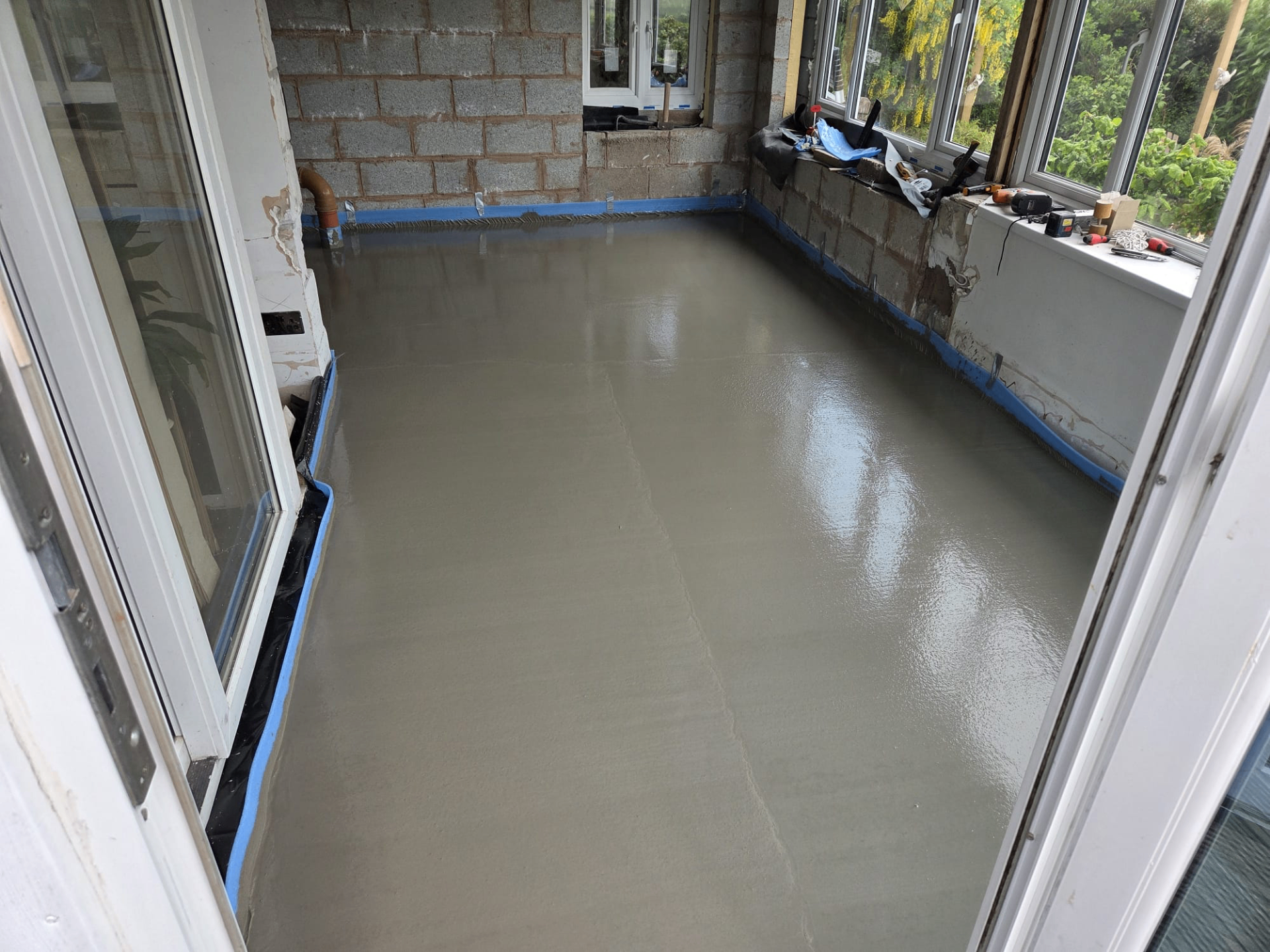
A flatness check carried out once the screed has hardened, with the gap under the straightedge measured and recorded, is the only way to show the agreed SR class was met.
Doing this before the flooring contractor arrives means any high or low spot can still be corrected while it is only screed, not a finished floor.
Protecting a flat surface before the finish goes down
An SR1 or SR2 surface is easy to mark with dropped tools or dragged boarding, and a scuffed screed can fail a flatness check for the wrong reason if debris has been ground into it.
Naming who boards the floor, and by when, keeps a carefully achieved flatness result from being undone by the next trade through the door.
Wording an SR clause — the points that decide it
- State the required SR class explicitly (for example SR1 or SR2) with reference to BS 8204.
- Match the SR class to the flooring finish that will be laid, since some finishes are far less tolerant of unevenness than others.
- Specify how flatness will be checked — typically using a straightedge over a stated length, per BS 8204 method.
- Note any areas requiring particularly tight tolerance, such as beneath large-format tiling or resin coatings.
- Avoid vague wording such as 'level finish' without a stated class and check method.
- Consider stating who is responsible for remedial work if the finished surface does not meet the agreed SR class.
Wording an SR clause — your questions
In short
Practical wording guidance for surface regularity clauses, so the requirement is checkable on site rather than a subjective description.
Need an SR clause tailored to your finish?
Tell us the floor finish you're planning and we will help specify an appropriate SR class.