
Specification
Acceptable depth tolerances for liquid screed
A plain explanation of how depth tolerance works in practice, what causes deviation, and how it should be checked and recorded.
Even a well-designed self-levelling screed does not achieve a mathematically perfect, uniform depth across an entire floor. Substrate undulation, pipe layout and pour sequencing all introduce some variation, which is why depth is specified with a tolerance rather than a single fixed number.
Understanding what tolerance is reasonable, and how it is checked, helps set realistic expectations before the pour and gives a clear basis for resolving any dispute if a floor is later found to fall outside it. This page focuses specifically on tolerance, separate from the level and flatness (surface regularity) tolerances covered elsewhere.
It is aimed at anyone drafting or reviewing a screed specification who wants to understand what 'depth tolerance' actually commits the installer to.
What a depth tolerance actually commits to
A specification that states a depth of, say, 65mm nominal with a stated tolerance is not promising exactly 65mm at every point on the floor. It is promising that the installer will work to a set-out that targets that figure, checked against datums, with reasonable allowance for the practicalities of substrate variation and pour sequencing.
Where minimum cover over pipework or a minimum structural thickness applies, that minimum — not the nominal average — is usually the figure that actually matters for performance, and it should be stated explicitly if it differs from the average tolerance.
Checking and recording depth before it disappears
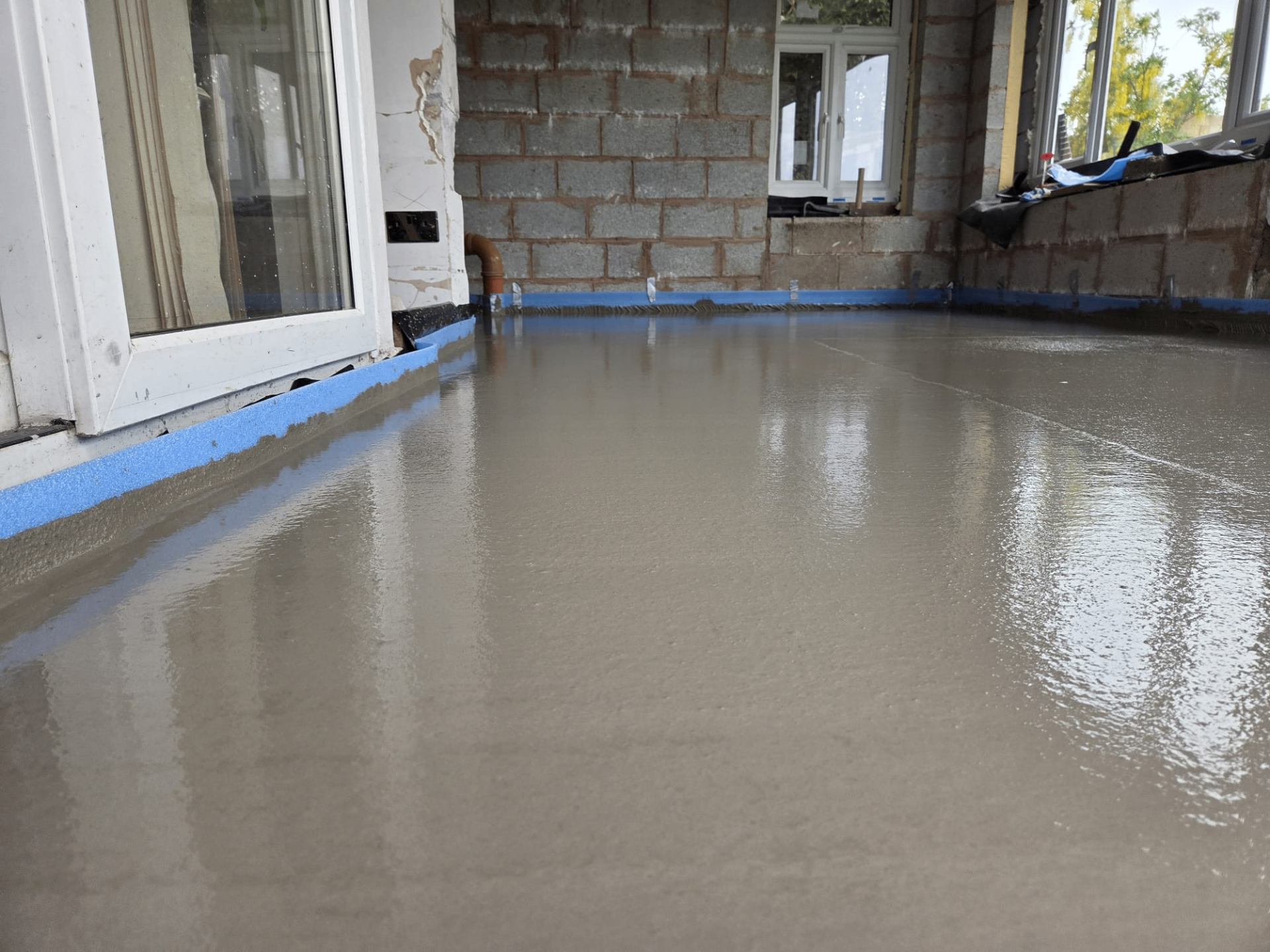
Because screed depth becomes invisible once the floor is finished, checks need to happen before and during the pour. Datum pins set to finished floor level, combined with spot checks against the substrate, give a defensible record of intended depth at the point the screed is placed.
Where a floor is later suspected of being under-depth — for example, if it feels unusually flexible — coring is the usual way to confirm actual thickness, though this is destructive and should be a last resort.
Tolerance differs between cementitious and anhydrite mixes
Anhydrite screed tends to self-level to a flatter finish straight off the pump than a cementitious mix, which can justify a tighter depth and SR tolerance being agreed for that specific product.
Naming the formulation in the tolerance clause avoids a cementitious product being priced against figures that were really written with an anhydrite pour in mind.
A damp base can throw tolerance checks off
If the damp-proof membrane beneath a floating screed is punctured or lapped badly, residual moisture can cause localised swelling in the insulation, which shows up later as a depth anomaly nobody planned for.
Checking the membrane before the insulation goes down is cheap compared with digging up a screed later to find the cause of an unexplained dip.
Depth tolerances — the points that decide it
- 1Depth tolerance is usually expressed as a permitted variation either side of the specified nominal depth.
- 2Substrate flatness has a direct effect on achievable depth tolerance — an uneven base will produce more variable screed thickness.
- 3Minimum depth at any point is usually the more critical figure than average depth across the floor.
- 4Depth checks are typically taken before the pour, using datum pins or laser levels referenced to finished floor level.
- 5A record of pre-pour checks provides evidence of the intended depth if a dispute arises later.
- 6Tolerance requirements can tighten where underfloor heating pipe cover is a controlling factor.
Want depth tolerances clearly stated in your spec?
We can help draft or review depth tolerance wording for your project specification.
Or call our landline on 01392 237700
Depth tolerances — your questions
In short
A plain explanation of how depth tolerance works in practice, what causes deviation, and how it should be checked and recorded.
Want depth tolerances clearly stated in your spec?
We can help draft or review depth tolerance wording for your project specification.