
Pour day
What to expect on pour day, hour by hour
A practical, hour-by-hour picture of how a liquid screed pour day usually unfolds, distinct from the general stage-by-stage pour timeline.
Want to know what to expect on your pour day?
Ask us for a walk-through of the plan for your specific site before the day itself.
Or call our landline on 01392 237700
Clients and other trades on site often want to know what they'll actually see happening through the day, rather than a general description of the process — particularly if they need to plan their own work around the pour or keep an area clear.
Timings vary with floor area, access and the specific screed used, but the rough shape of the day tends to follow a similar pattern: arrival and setup, boundary and level checks, the pour and finishing pass itself, then clear-up and a handover conversation.
Knowing roughly what to expect at each stage also makes it easier to spot if something is running unusually late, and to ask the crew directly rather than guessing whether a delay is normal or a sign of a problem.
Why setup often takes longer than the pour itself
On many jobs, positioning the pump, routing hoses safely through the building and protecting finishes along the way takes as long as, or longer than, the actual pumping. This is normal and reflects the care needed to avoid damage elsewhere in the building.
Clients sometimes expect the whole day to be dominated by the visible act of pouring, when in fact a significant proportion of the time is spent on preparation that directly affects how smoothly the pour itself goes.
What's happening during the finishing pass
Once the material has reached a workable consistency, finishing tools are used to close the surface and remove minor undulations. Timing this correctly is a matter of experience and site conditions rather than a fixed clock time after pouring.
The finishing pass is one of the more skilled parts of the day, since judging the right moment depends on how the specific screed and site temperature are behaving, rather than following a rigid schedule regardless of conditions.
What clients and other trades should avoid during the day
Access through the pour area needs to be kept clear throughout pumping and finishing, and ideally for some time afterwards while the surface is still soft enough to be marked by foot traffic.
Other trades working nearby should be made aware of the pour schedule in advance so they can plan around restricted access, rather than needing to pass through the area unexpectedly during the pour itself.
The handover conversation at the end of the day
Before leaving, the crew typically talks through immediate next steps — when ventilation should begin, how long before the area can be walked on carefully, and any specific notes relevant to that pour.
This is a good opportunity to ask any remaining questions about the drying period ahead, since the crew will have direct knowledge of how that specific pour went and any factors that might affect drying on that day.
Pour day hour by hour — the points that decide it
- Early morning: crew arrival, unloading pumping equipment, and a final walk of the area to confirm it matches the survey and schedule.
- Hose routing and pump setup: connecting hose runs from the wagon or silo to the pour area, protecting doorways and finishes along the route.
- Boundary and level checks: confirming datum levels and placing any level pins or laser reference before pumping starts.
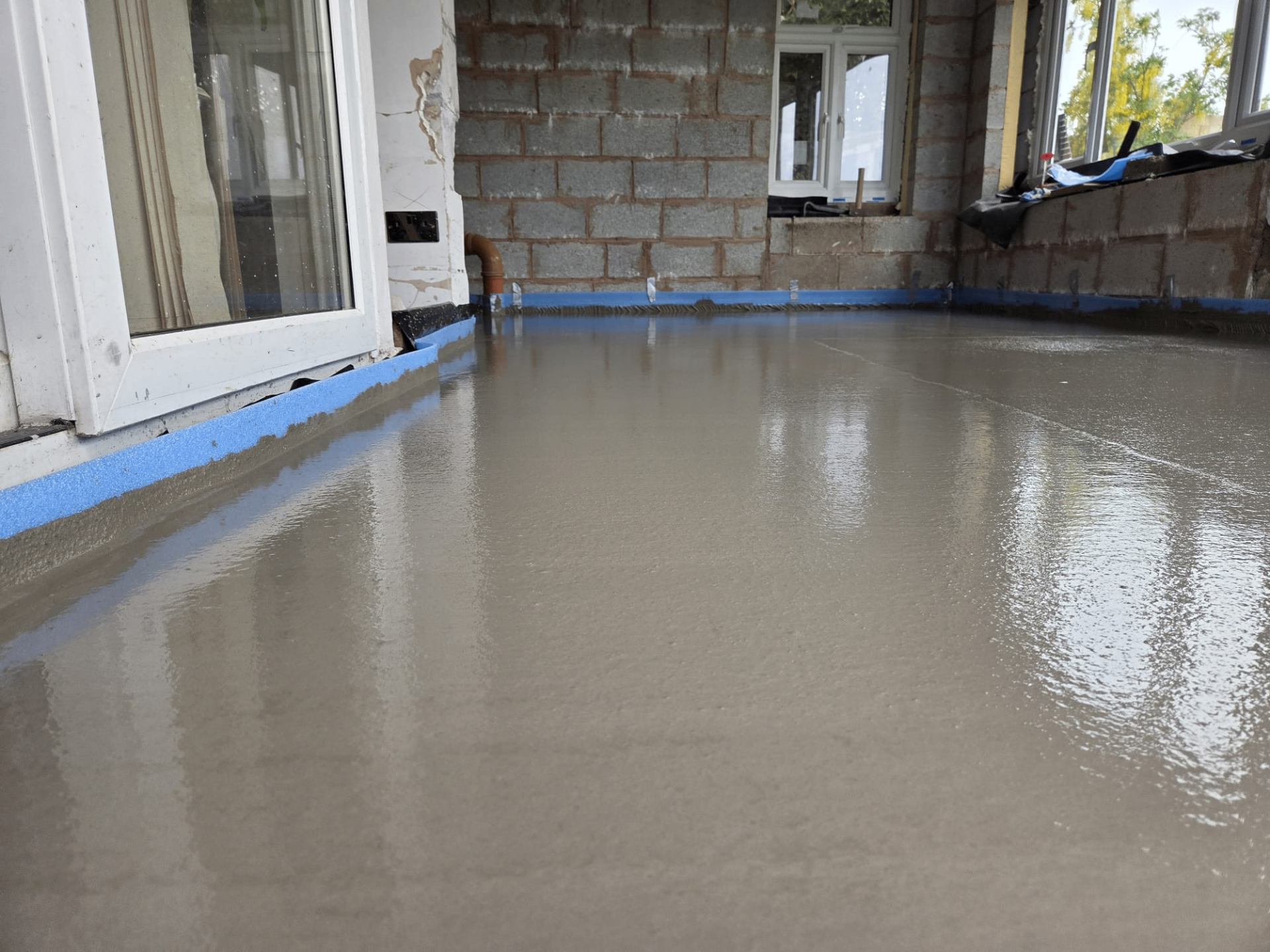
- Pumping and pouring: the screed is pumped in and spread to the required depth, usually working across the area in a planned sequence.
- Finishing pass: surface finishing tools are used to close the surface and achieve the required flatness once the material has reached the right consistency.
- Clear-up and initial protection: hoses and equipment are cleared, and the poured area is closed off with appropriate signage or barriers.
- Handover conversation: a brief discussion on site about curing, ventilation and when the area can next be accessed.
- Documentation: photographs of the finished pour and any relevant notes are often kept as a record for the project file.
Want to know what to expect on your pour day?
Ask us for a walk-through of the plan for your specific site before the day itself.
Or call our landline on 01392 237700
Other pages that answer this properly
Process & decision guides
Pre-pour checklist ownership
Process & decision guides
Hose routes & pumping logistics
Process & decision guides
Curing & early protection regime
Process & decision guides
Wagon & pump site access
Process & decision guides
Ready-mix delivery scheduling
Building types & floor performance
Student accommodation
Pour day hour by hour — your questions
In short
A practical, hour-by-hour picture of how a liquid screed pour day usually unfolds, distinct from the general stage-by-stage pour timeline.
Want to know what to expect on your pour day?
Ask us for a walk-through of the plan for your specific site before the day itself.