Surface preparation
Unsanded Laitance on Anhydrite Screed — Why It Matters
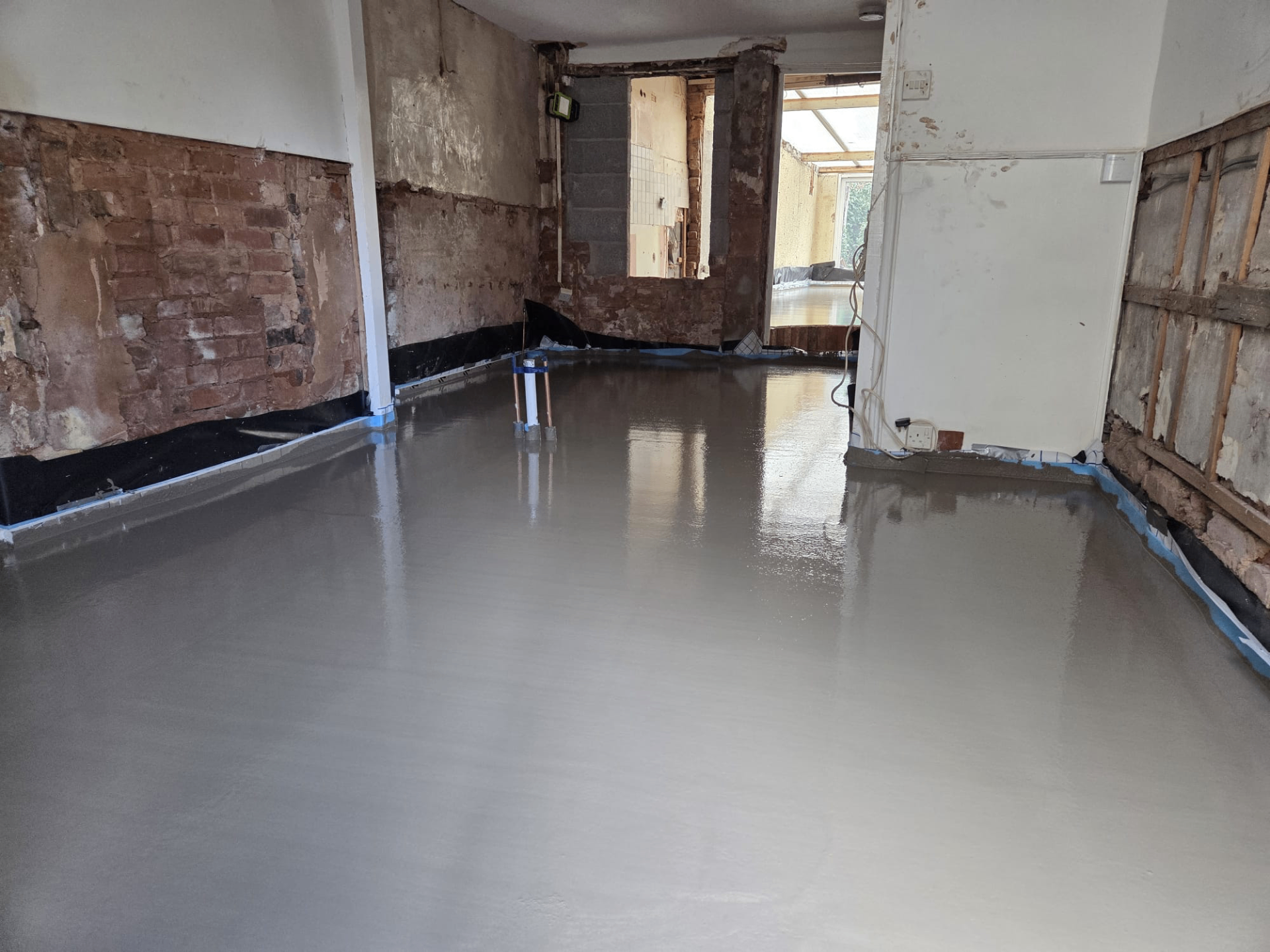
Every calcium-sulphate screed forms a weak, powdery laitance skin as it cures — leave it on the surface and any tile or LVT adhesive bonded to it is really only bonded to dust.
Not sure your screed was sanded properly?
Name, phone, email — we'll reply the same working day with a fixed price.
Or call our landline on 01392 237700
Laitance is a thin layer of fine particles that rises to the surface of an anhydrite screed as it cures. It's a normal, expected part of the chemistry, not a fault — the problem only starts if it's left on the floor when a bonded covering goes down.
We see this most often on jobs where a different trade handed over the screed and the sanding step was missed, forgotten, or done too lightly to actually reach a sound surface.
This page explains what laitance is, why it has to come off before tiling or LVT, and how we check and correct it before covering.
Why laitance defeats an adhesive bond
Tile and LVT adhesives are designed to key into a sound, mechanically stable surface. A laitance layer is neither — it's a loosely bound skin that can be lifted with a fingernail in places, so the adhesive ends up gripping the laitance rather than the structural screed underneath.
The failure this causes doesn't always show up immediately. It's common for tiles to debond months later once foot traffic and thermal cycling have worked the weak layer loose.
How we check whether laitance has actually been removed
- Scratch and scrape test across multiple points, not just the middle of the room
- Visual check for the characteristic pale, chalky residue laitance leaves behind
- Confirming sanding dust has been fully vacuumed, not just brushed aside
- Checking edges and corners, which are the areas most often under-sanded
Not sure your screed was sanded properly?
We'll check the surface, confirm whether laitance has genuinely been removed, and sand and prime it properly if not.
Or call our landline on 01392 237700
Correcting an unsanded or under-sanded floor
- 1
Full re-sand
Mechanical sanding across the whole floor, not spot-patching, to guarantee a consistent surface.
- 2
Industrial vacuum
All dust removed — any residue left behind recreates the same bonding problem.
- 3
Primer
Manufacturer-approved primer applied to the sound, sanded surface.
- 4
Sign-off
Visual and scratch-test confirmation before the tiling or flooring trade starts.
Laitance is the weakest layer on the whole floor. Sand it, vacuum it, prime it — or watch the adhesive fail underneath your tiles a year later.
— Exeter Liquid Screeders
Laitance Not Sanded — questions we get asked
Keep reading across the site
Not sure your screed was sanded properly?
We'll check the surface, confirm whether laitance has genuinely been removed, and sand and prime it properly if not.