
Screed Fault Diagnosis
Screed Lifting at Doorways
Doorways and thresholds are natural stress concentration points, and lifting there is most often linked to missing or poorly positioned movement joints.
Noticed lifting or cracking at a doorway?
Call Exeter Liquid Screeders on 07791 510849 for an assessment of the joint detailing and the right repair approach.
Or call our landline on 01392 237700
Doorway openings interrupt the continuity of a floor slab and, combined with foot traffic wear and often a change of floor finish either side, they're one of the most common locations for visible screed problems. Lifting or cracking at a threshold is frequently traced back to the absence of a movement joint at that junction, or a joint that wasn't correctly positioned relative to the opening.
Doorways between rooms with different heating zones, or between areas poured on different days, add further stress concentration, since each side of the threshold may expand, contract or dry at a slightly different rate.
Because thresholds are also high-traffic, visually prominent locations, even a small amount of lifting tends to be noticed and reported quickly, which is useful for catching and addressing the issue before it worsens.
Screed Lifting at Doorways — the points that decide it
- Doorways are natural stress concentration points in a floor slab
- Missing or misplaced movement joints at thresholds are a common root cause
- Different heating zones either side of a door can create differential movement
- Day joints (where pours were completed on separate days) need particular attention here
- Lifting may present as a raised edge, a crack, or a change in level across the threshold
- Repair usually involves cutting and correctly forming a movement joint if one is missing
- Threshold detailing should be agreed at design stage, not decided after problems appear
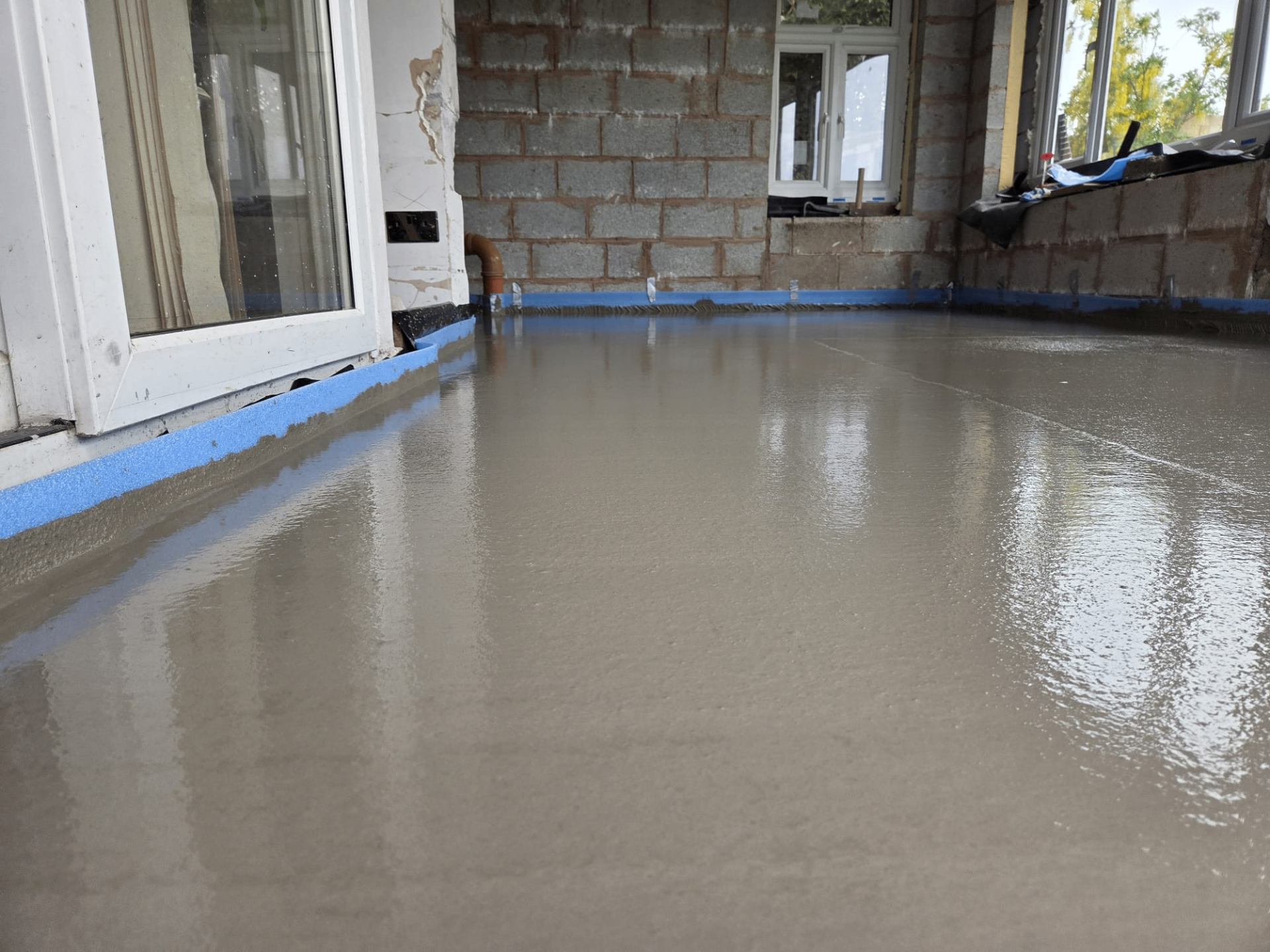
Why thresholds are vulnerable
A doorway naturally breaks up an otherwise continuous slab, and if a movement joint wasn't included at that break, or was positioned slightly off from the actual opening, stress can concentrate at the threshold as the screed dries and later as the building experiences thermal cycling. Where heating zones differ either side of the door, this effect is amplified because the two sides can be drying and expanding at different rates.
Day joints — the line left where one day's pour meets the next — often coincide with doorways for practical site sequencing reasons, and if not properly formed and treated, this line becomes another weak point exactly where lifting is most likely to be noticed.
Correcting lifting at a threshold
Where the cause is a missing movement joint, the repair typically involves cutting a joint line at the correct position, allowing controlled movement, and finishing with an appropriate flexible sealant or threshold strip. Where the day joint itself is the issue, that section may need to be cut back and properly re-formed with correct reinforcement or bonding across the joint.
Preventing recurrence on future projects comes down to agreeing threshold and movement joint detailing at design stage, ensuring pour sequencing and joint positions are coordinated rather than left to be resolved after the fact.
Noticed lifting or cracking at a doorway?
Call Exeter Liquid Screeders on 07791 510849 for an assessment of the joint detailing and the right repair approach.
Or call our landline on 01392 237700
In short
Doorways and thresholds are natural stress concentration points, and lifting there is most often linked to missing or poorly positioned movement joints.
Screed Lifting at Doorways — your questions
Other pages that answer this properly
Noticed lifting or cracking at a doorway?
Call Exeter Liquid Screeders on 07791 510849 for an assessment of the joint detailing and the right repair approach.