
Understanding cracking
Why Screed Cracks (And What's Cosmetic vs Structural)
A crack in a screed isn't automatically a disaster, but it isn't automatically nothing either. Here's how to tell the difference.
Get a crack assessed properly
Name, phone, email — we'll reply the same working day with a fixed price.
Or call our landline on 01392 237700
Finding a crack in a screed a few weeks after pouring is one of the most common causes of anxious phone calls we get, and understandably so, a floor is meant to be the one thing in a build that stays flat and solid. The reality is that hairline cracking is a known and often unavoidable characteristic of cementitious and calcium sulphate materials as they shrink and cure, and not every crack means something has gone wrong.
That said, cracking is also genuinely preventable in most cases when the causes are understood and designed for properly at the outset, which is why it's worth knowing what actually causes it rather than treating every crack as either a non-issue or a catastrophe.
This page covers the real causes of screed cracking, how each one is avoided at the design and installation stage, and a practical way to judge whether what you're looking at is cosmetic or something that needs further investigation.
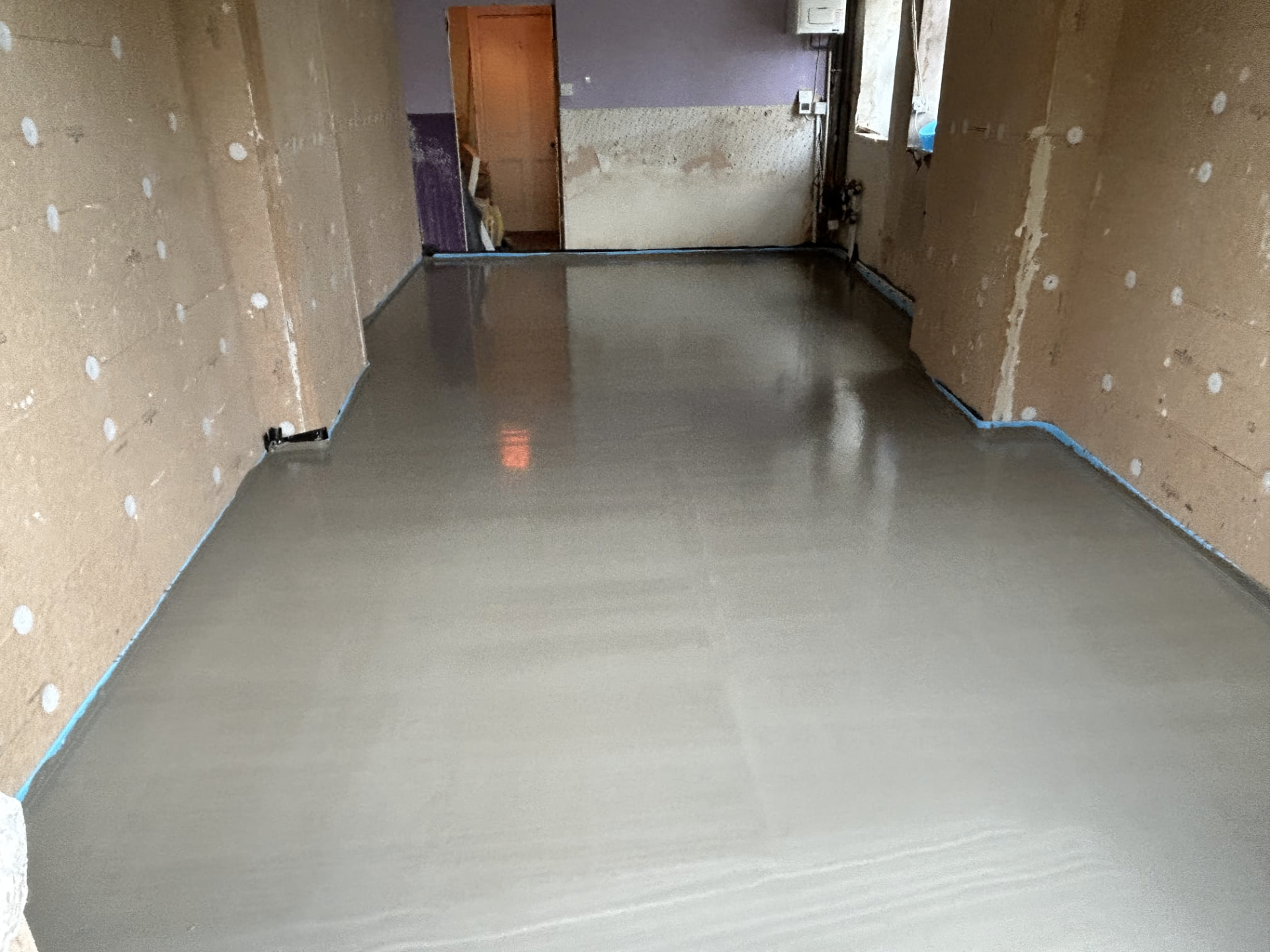
The main causes of screed cracking
- Restraint — the screed is physically prevented from shrinking freely by walls, columns, pipework or door thresholds it's bonded or pinned against
- Curling — the top surface dries and shrinks faster than the base, causing the edges of a bay to lift slightly and stress-crack at the corners
- Missed or poorly positioned movement joints — large open-plan areas, changes in direction, or junctions with existing floors need joints to accommodate shrinkage, and skipping them concentrates stress into random cracks instead
- Rapid or uneven drying — strong sun through glazing, a draught from an open door, or localised heat all dry one area faster than the rest, creating differential shrinkage stress
- Poor or unstable substrate — a base that flexes, an inadequately compacted sub-base, or a damaged insulation layer can allow movement the screed above isn't designed to accommodate
- Overloading before the screed has cured — point loads or heavy trade traffic in the first days, before the screed has reached adequate strength, can crack a floor that would otherwise have been fine
Cause and typical prevention
| Cause | How it's avoided |
|---|---|
| Restraint | Edge insulation strips around perimeters, columns and pipework penetrations to allow free movement |
| Curling | Correct depth for span, adequate curing conditions and avoiding overly rapid surface drying in the first days |
| Missed movement joints | Design of joint layout at the specification stage for large areas, changes of direction and doorway thresholds |
| Rapid or uneven drying | Controlling site conditions in the first week, closing off draughts and glazing, avoiding direct heat too early |
| Poor substrate | Proper compaction, sound insulation with taped joints, and checking the base before pouring, not after |
| Overloading before cure | Restricting site access and heavy trade work until the screed has reached adequate early strength |
Get a crack assessed properly
Send us photos with a scale reference and we'll tell you honestly whether it's cosmetic or worth a site visit.
Or call our landline on 01392 237700
Cosmetic vs structural: a practical guide
Usually cosmetic
- Fine hairline cracks under roughly 0.3mm wide
- Cracking confined to a single bay with no movement underfoot
- Cracks that appeared in the first week and haven't widened since
- Surface crazing with no depth to it
Warrants further investigation
- Cracks wider than a couple of millimetres or with a visible step across them
- Cracking that runs across a missed movement joint line or structural junction
- A crack that continues to widen or move over weeks
- Any cracking accompanied by hollow-sounding or drummy areas
A hairline crack with no movement is a characteristic of the material. A widening crack, a step, or a drummy sound underneath is a reason to call your installer, not wait and see.
— Exeter Liquid Screeders
Why Screed Cracks — questions we get asked
More on costs and planning
Keep reading across the site
Get a crack assessed properly
Send us photos with a scale reference and we'll tell you honestly whether it's cosmetic or worth a site visit.