
Technical guide
Liquid Screed Depth and Cover Guide
Depth isn't just a spec-sheet number — it's the single biggest variable behind both performance and cost. Here's how it's actually set.
Confirm your depth requirement
Name, phone, email — we'll reply the same working day with a fixed price.
Or call our landline on 01392 237700
Every liquid screed job has a minimum depth requirement, and it's set by a combination of factors: whether the screed is bonded or unbonded, whether there's underfloor heating pipework to cover, and the manufacturer's own datasheet for that specific product.
Getting depth right matters for structural performance (a screed poured too thin can crack or fail under load) and for cost (material is bought by volume, so depth drives the bill directly). It's one of the first things we confirm on any survey.
This page sets out the general principles — your exact figure will always be confirmed against the specific product and build-up on your job.
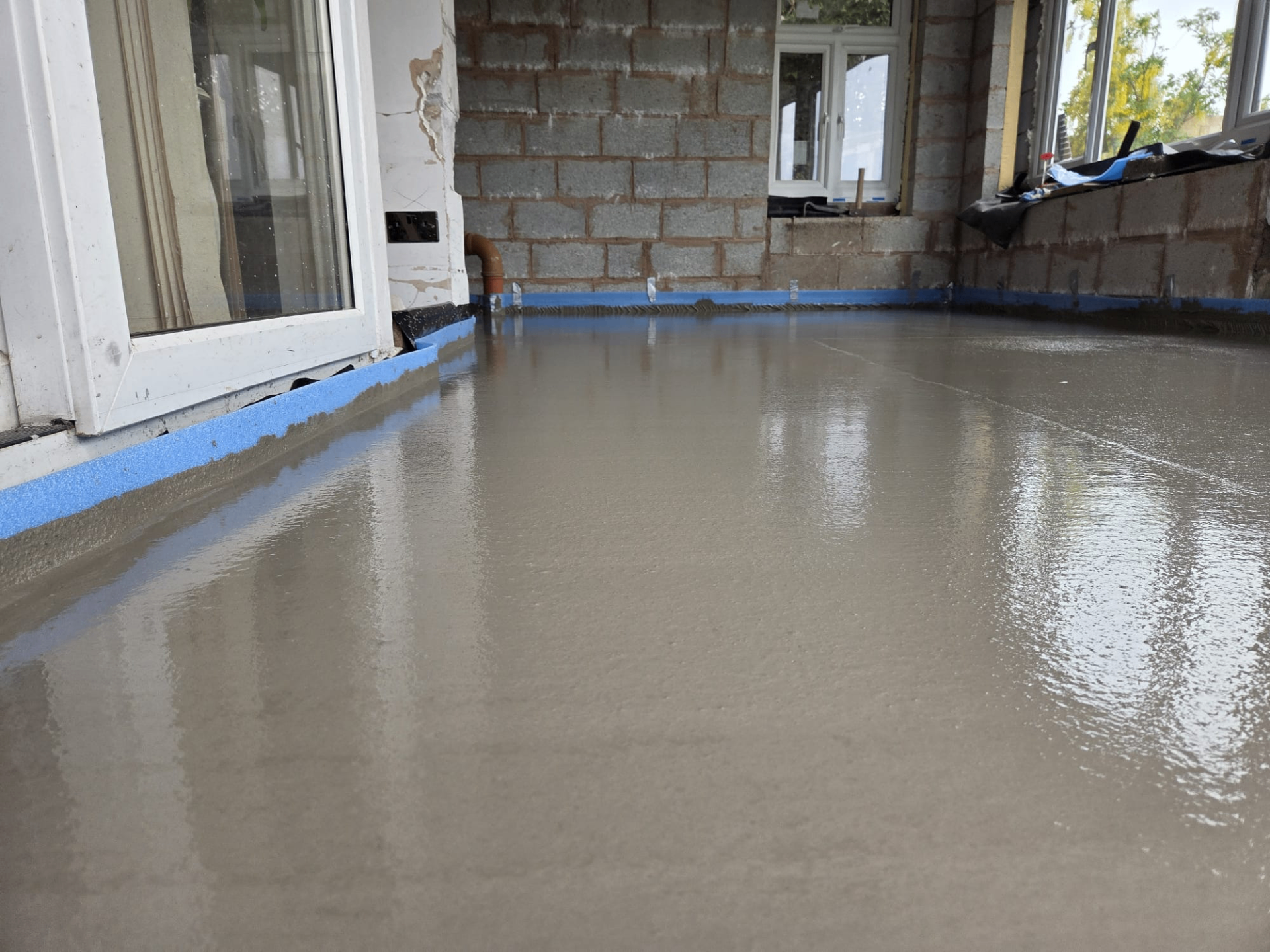
Typical minimum depths (indicative, confirm against product datasheet)
| Build-up type | Typical minimum depth |
|---|---|
| Bonded screed, no UFH | 25–30mm |
| Unbonded screed over insulation, no UFH | 35mm |
| Bonded screed over UFH pipework | 30mm cover to top of pipe |
| Unbonded screed over UFH pipework | 35–40mm cover to top of pipe |
| Floating screed over separating membrane | Typically 40mm+, product-dependent |
Bonded vs unbonded, briefly
A bonded screed is poured directly onto a prepared concrete base with a bonding agent, allowing a thinner depth. An unbonded (or floating) screed sits on an insulation layer or separating membrane, unattached to the base below, and needs greater depth to perform structurally.
Most residential UFH floors are unbonded, floating over PIR or EPS insulation — which is why UFH cover depths tend toward the higher end of the range.
Confirm your depth requirement
Send your build-up details and we'll confirm the minimum depth for your job before quoting material cost.
Or call our landline on 01392 237700
What can push depth above the minimum
- Uneven subfloor requiring extra fill in low spots to reach a level finish
- Heavier loading requirements on commercial floors
- Manufacturer guidance for a specific product varying from generic industry figures
- Design decisions around thermal mass for UFH performance
Depth sets both the structural performance of the floor and the material cost, so it's the first number we lock down on any survey, not the last.
— Exeter Liquid Screeders
Depth & Cover Guide — questions we get asked
Keep reading across the site
Confirm your depth requirement
Send your build-up details and we'll confirm the minimum depth for your job before quoting material cost.