
Understanding the rate
Screed Cost per Square Metre, Explained
A per-m² rate isn't one number — it's several stacked together. Here's what's actually inside it.
See how your job prices
Name, phone, email — we'll reply the same working day with a fixed price.
Or call our landline on 01392 237700
Ask three installers for a price and you'll often get three different per-m² figures, even for what looks like the same job. That's usually because each rate bundles together a different mix of material cost, depth, mobilisation and labour — not because someone is padding the price.
Understanding the components lets you compare quotes properly instead of just picking the smallest number, which is often the one leaving something out.
This isn't a page of fixed prices — every job is priced from survey — but it is the honest mechanics of how that number gets built.
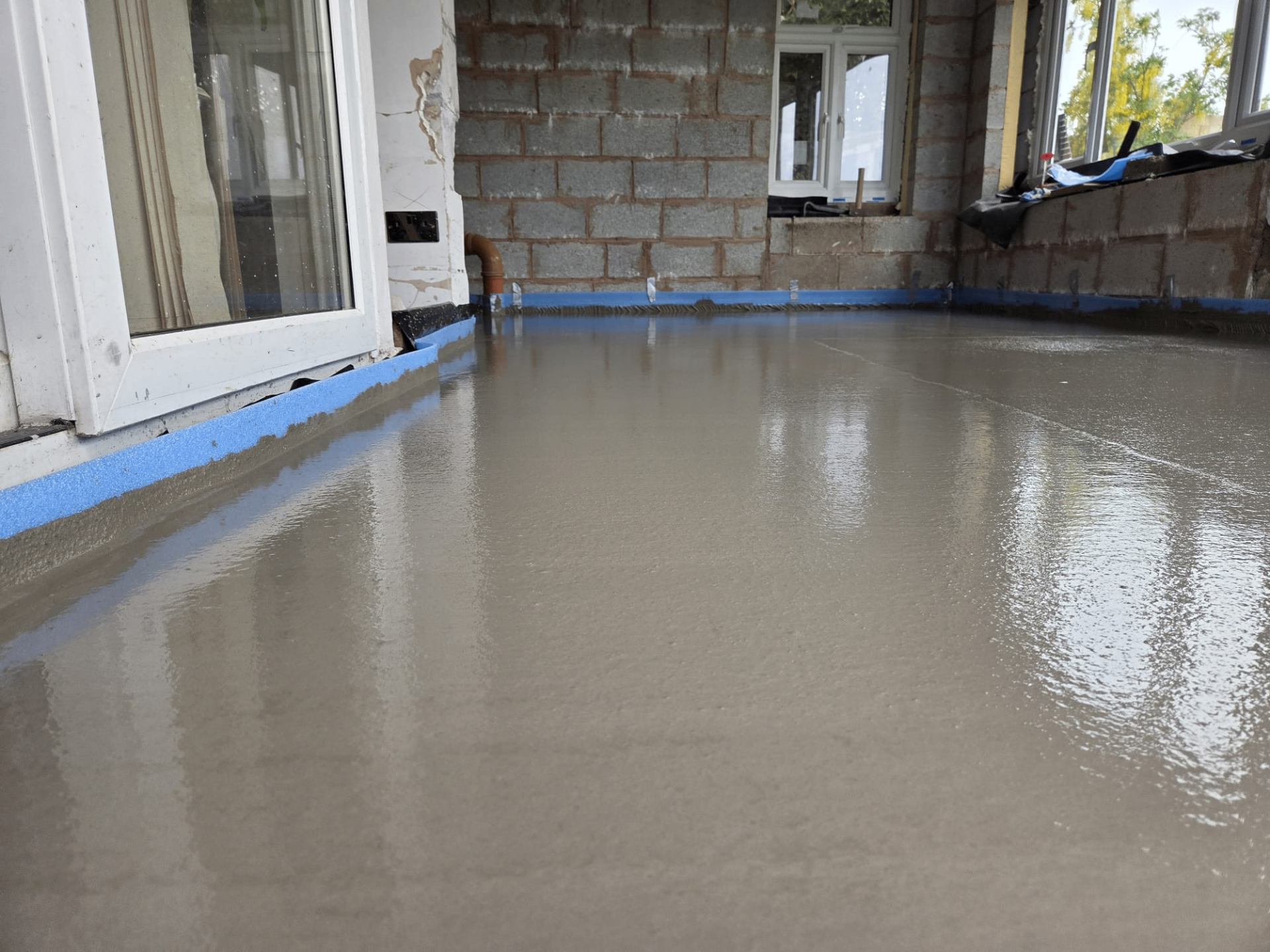
What's inside a per-m² screed rate
- Raw material cost — the screed itself, priced per m³ and converted to m² at your depth
- Pumping cost — plant hire, operator time and hose runs
- Labour — the crew laying, dappling, spike-rolling and finishing the pour
- Mobilisation — getting plant and crew to site, spread thinner on larger jobs
- Ancillaries — edge-strip foam, membrane taping, movement joint detailing if needed
Why depth changes the per-m² figure, not just the total
Material cost scales with volume (m³), not area (m²) — so a 75mm pour costs meaningfully more per m² than a 50mm pour of the same screed, even though labour and pump time barely change.
This is why comparing two quotes purely on a per-m² figure without checking the depth each one assumes is one of the most common ways people get caught out.
See how your job prices
Send us your floor area and target depth and we'll show you exactly how the figure is built, line by line.
Or call our landline on 01392 237700
Roughly how m³ scales with depth (indicative only)
| Depth | m³ per 100m² |
|---|---|
| 35mm | 3.5m³ |
| 50mm | 5.0m³ |
| 65mm | 6.5m³ |
| 75mm | 7.5m³ |
A per-m² price only means something once you know the depth, the product and what's included. Ask for all three before you compare anything.
— Exeter Liquid Screeders
Liquid Screed Cost per Square Metre: A Reality Check
Search for liquid screed cost per square metre and you'll find plenty of confident-sounding single figures. The uncomfortable truth is that almost none of them mean much on their own, because a per-m² rate is a compressed summary of several genuinely variable costs, and quoting it as one number hides which of those costs applies to your job.
We're not going to add another fixed figure to that pile. Instead, this page sets out exactly what a per-m² rate is built from, why the same screed product can price very differently on two jobs, and why every quote we give follows a survey rather than a postcode and a guess.
If you want the mechanics of how the rate itself gets calculated line by line, our cost per m² explained page covers that in more depth. This page is specifically about why treating that rate as a fixed, comparable figure across jobs is the mistake.
What's genuinely folded into a per-m² figure
Screed product and mix design, which varies between Cemfloor, standard anhydrite and enhanced thermal-conductivity products
Depth of the pour, since material is bought by volume and a deeper floor costs more per m² even at the same product cost
Site access and hose run length, which change crew time independently of the screed itself
Job size, since mobilisation is a largely fixed cost spread thinly on a big pour and heavily on a small one
Underfloor heating presence, which adds pipework checks and careful edge detailing
Subfloor condition and preparation, since a level, correctly insulated base pours differently to one needing remedial work first
Why the same headline rate can mean two different totals
Imagine two jobs both quoted at what looks like the same per-m² rate. One is a 100m² new-build slab at 65mm depth with clear access and no UFH; the other is a 25m² extension at 75mm depth with a long, awkward hose run and underfloor heating pipework to work around. Even at an identical headline rate, the total cost per m² that actually lands on the second job's invoice, once mobilisation and access are accounted for properly, is very likely to be meaningfully higher.
This is exactly why a single number published on a website, ours or anyone else's, can never responsibly claim to be your price. It can only ever be an illustrative range, and any legitimate installer should say so clearly rather than implying certainty.
What tends to push a per-m² figure up or down
Pushes the figure up — Small job size, difficult access, greater depth, UFH pipework, poor subfloor prep
Keeps the figure efficient — Larger single-visit pours, clear confirmed access, standard depth, prep already completed correctly
Cost per m² Explained — questions we get asked
Keep reading across the site
See how your job prices
Send us your floor area and target depth and we'll show you exactly how the figure is built, line by line.