Substrates & Preparation
Protecting Adjoining Finishes During Liquid Screed Works
Where a liquid screed pour sits next to finished or sensitive areas, protection measures reduce the risk of splashes, dust and accidental damage during the works.
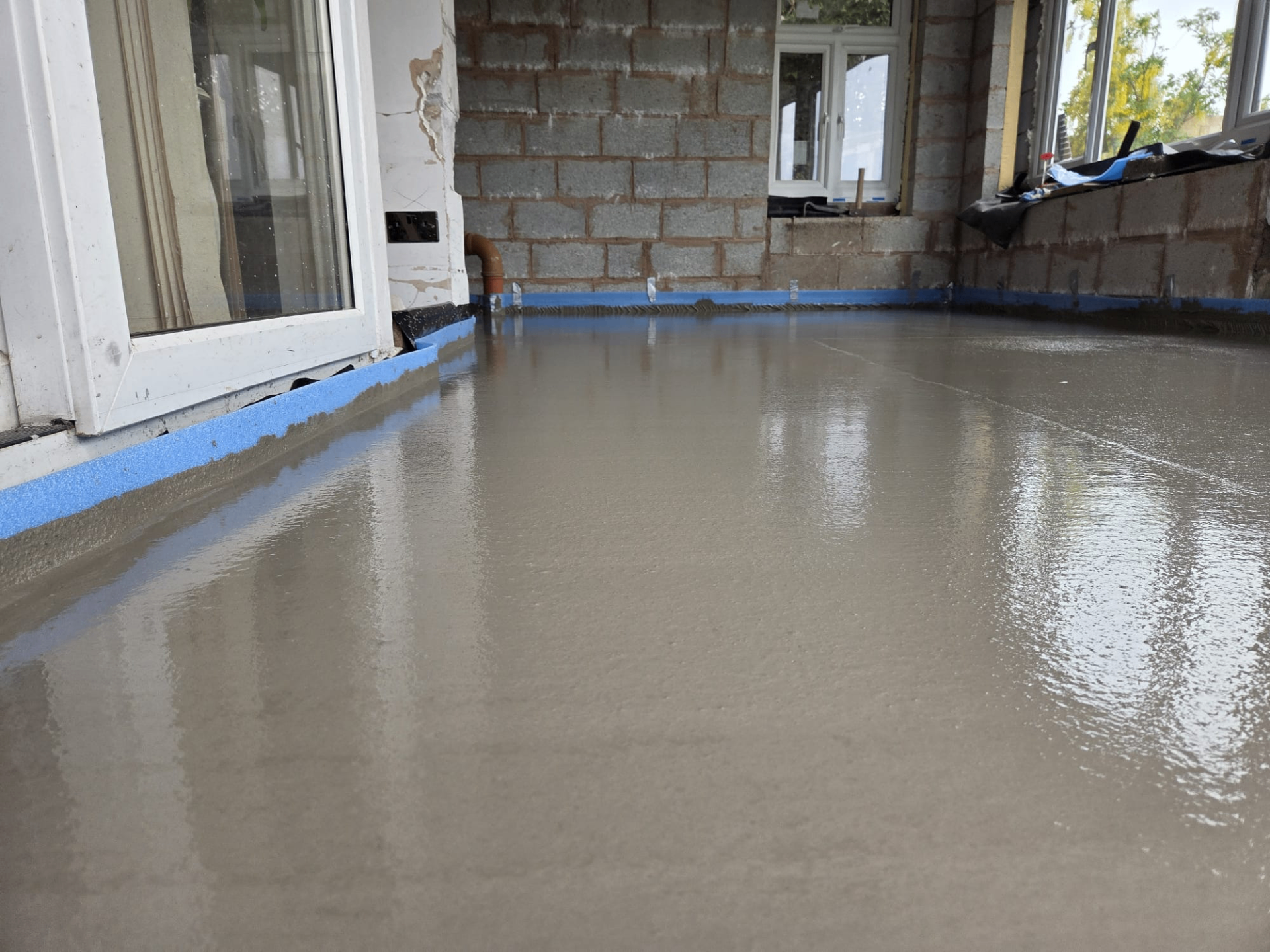
Not every liquid screed pour happens in a bare shell. On extensions, renovations and phased projects, the pour area often sits directly next to finished rooms, existing floor coverings, staircases, kitchens already fitted, or skirtings and joinery that have already gone in. Protecting these adjoining finishes is a practical part of planning the pour, separate from the screed installation itself.
Because liquid screed is pumped and self-levels, there's more material movement across the floor during the pour than with a hand-applied product, which makes boundary protection at doorways and thresholds particularly important. A wet, mobile material finds gaps at skirtings and thresholds that a stiffer, trowelled screed simply wouldn't reach.
Planning protection properly is also about sequencing — deciding what gets covered before substrate preparation begins, what needs re-checking immediately before the pump arrives, and what can be safely removed once the screed has cured enough to take light traffic.
Protecting Adjoining Finishes — the points that decide it
- Doorways and thresholds into the pour area are usually dammed or boarded to stop material tracking through to adjoining rooms
- Skirtings, door linings and staircase stringers within the pour area may need masking or covering from splashes during pumping
- Existing floor coverings in adjoining rooms benefit from protective sheeting where foot traffic will pass close to the wet edge
- Kitchen units, sanitaryware or other fitted items installed ahead of the floor need covering from dust generated by any substrate prep beforehand
- Hose routes through the building to reach the pour area should avoid dragging equipment across finished surfaces
- Any existing damage to adjoining finishes is worth noting and photographing before work starts, so it isn't confused with anything arising during the screed works
- Protective coverings should be robust enough to withstand foot traffic from the pump crew, not just light dust sheeting
- A plan for when protective coverings can be safely removed avoids either premature exposure of a soft finish or unnecessarily prolonged disruption
Boundary protection at thresholds
Where a liquid screed pour finishes at a doorway into a room that isn't being screeded, a dam board or similar barrier is normally used to hold the wet material back and give a clean edge once it's cured. Getting this in the right place, and at the right height for the intended screed depth, avoids both material escaping into the next room and an uneven step once it's dry.
On larger or more complex layouts with several rooms leading off the pour area, it's worth mapping out every threshold in advance rather than relying on protection being added as the pour progresses.
Protecting fitted items and finishes installed early
It's increasingly common for kitchens, staircases or other fitted joinery to go in before the final floor finish, particularly where a screed with underfloor heating needs to go down as one of the last wet trades. In this sequence, protecting the base of units, staircases and any exposed timber from dust during substrate preparation, and from splashes during the pour itself, avoids unnecessary cleaning or remedial work afterwards.
Sanitaryware and other fitted items in adjoining rooms that share a wall or an open threshold with the pour area can also pick up airborne dust from grinding or preparation work, so a covering plan for these items is worth agreeing alongside the direct threshold protection.
Protecting the route to the pour area
Beyond the immediate pour area, the route the crew and hose take through the building deserves its own protection plan. Hallways, staircases and any finished rooms along the route can pick up scuffs, splashes and dust simply from equipment and personnel passing through repeatedly during a pour.
Laying temporary protection boards or heavy-duty sheeting along this route, and agreeing where the hose itself will run so it doesn't need repositioning mid-pour, reduces incidental damage that has nothing to do with the screed itself but still needs remedying if it's overlooked.
Removing protection once the floor is ready
Protective coverings shouldn't be removed the moment the screed looks dry on the surface, particularly around thresholds where dam boards may still be preventing accidental contact with a floor that hasn't reached full early strength. Agreeing a removal point with the screed contractor, based on when the floor can safely take the relevant level of traffic, avoids either premature exposure or unnecessarily prolonged disruption to adjoining rooms.
Where protection has been in place for some time, it's also worth a final check underneath it before removal, since trapped moisture or debris under sheeting can occasionally affect an adjoining finish if left unnoticed for too long.
Pouring screed close to finished areas of your project?
We plan protection for adjoining finishes as part of every pour we carry out across Exeter and the South West.
Or call our landline on 01392 237700
Protecting Adjoining Finishes — your questions
In short
Where a liquid screed pour sits next to finished or sensitive areas, protection measures reduce the risk of splashes, dust and accidental damage during the works.
Other pages that answer this properly
Pouring screed close to finished areas of your project?
We plan protection for adjoining finishes as part of every pour we carry out across Exeter and the South West.