
Verification
Moisture Testing Methods and Acceptance Criteria for Liquid Screed
Moisture testing confirms a liquid screed has dried sufficiently for the specified floor finish, using recognised RH probe or carbide methods rather than guesswork.
Need moisture testing guidance for your screed?
We can advise on realistic drying and testing timelines for liquid screed installations across Exeter and the South West.
Or call our landline on 01392 237700
Before any floor covering, adhesive or heating system is committed to a liquid screed, the moisture content of the slab needs to be verified rather than assumed. Calcium sulfate and cement-based screeds both release residual construction moisture over time, and laying a moisture-sensitive finish too early is one of the most common causes of costly failures on site.
Two testing methods dominate UK practice: in-situ relative humidity (RH) testing using probes inserted into the screed, and the carbide bottle (CM) method which chemically reacts a crushed sample with calcium carbide to measure moisture release. Each has its place depending on the floor finish specified and the screed type installed.
Specifiers should agree the test method, number of test points and acceptance criteria before installation begins, not after a covering has already failed. This avoids disputes about whether a floor was 'dry enough' and gives a documented, defensible record for the project file.
Moisture Testing — the points that decide it
- RH testing follows the principles set out in BS 8203 and BS 5325 for the specific floor finish being laid
- Carbide (CM) testing gives a percentage moisture content and is common for calcium sulfate screeds
- Test point numbers and locations should relate to floor area, not be arbitrary
- Ambient conditions (temperature, ventilation) affect drying rates and should be recorded alongside results
- Acceptance criteria differ by covering — timber, resin and vinyl are typically more sensitive than ceramic tile
- Testing too early gives a false sense of security and can mask ongoing moisture migration
- Results should be recorded in writing and retained as part of the handover documentation
- Where heating is present, commissioning should generally precede final moisture testing
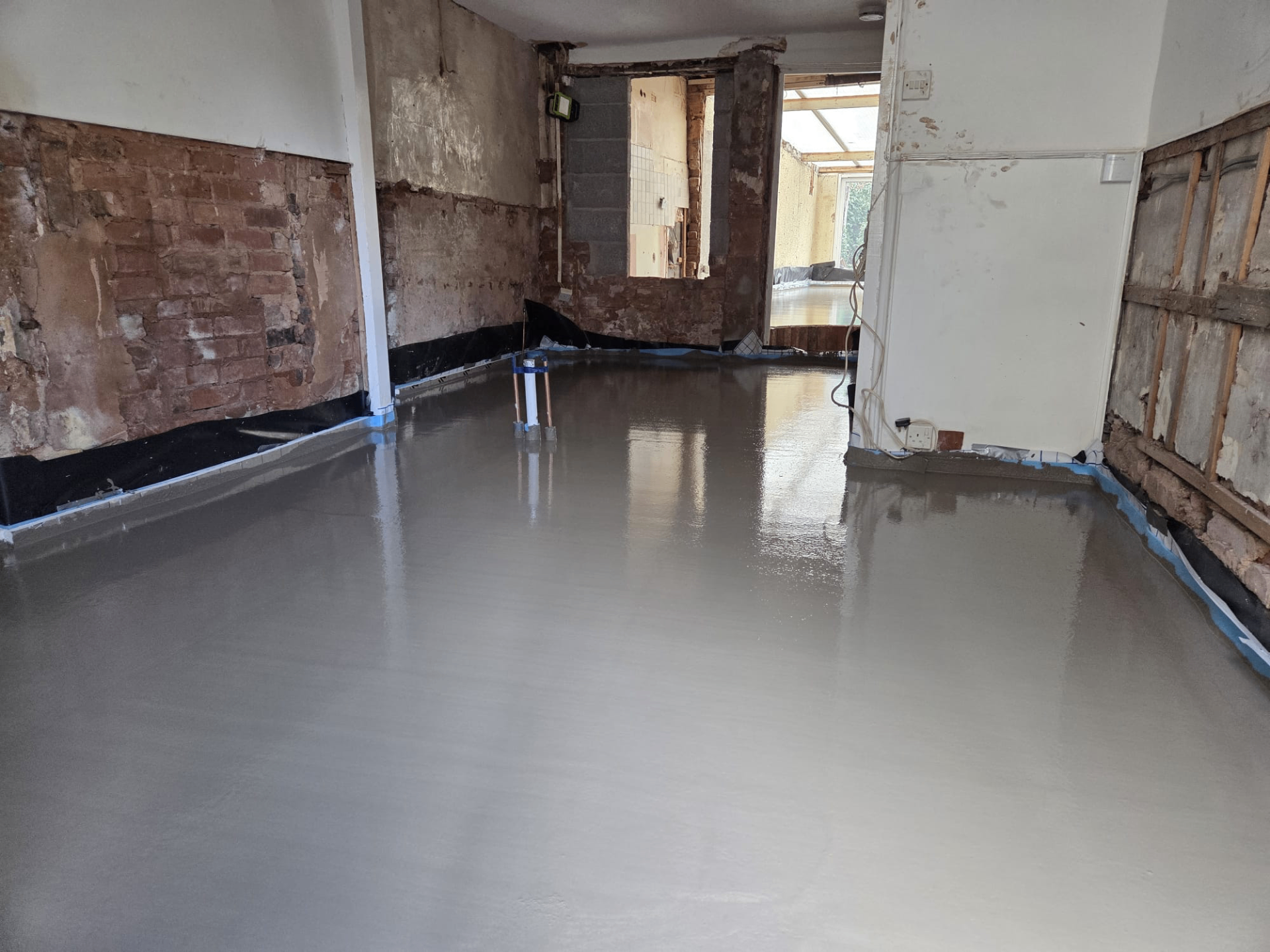
Reference points for moisture testing
| Common RH threshold (general flooring) | Typically around 75% RH — confirm against finish manufacturer |
|---|---|
| Typical carbide threshold (calcium sulfate) | Often below 0.5% CM — confirm against manufacturer data |
Choosing between RH and carbide testing
RH probe testing measures the humidity of air trapped within a sealed hole drilled into the screed, left to equilibrate before a reading is taken. It is widely used because it is non-destructive beyond the small drilled hole and gives a reading that correlates well with moisture-sensitive finishes such as timber and resin.
The carbide method involves extracting a small sample of screed, crushing it and reacting it with calcium carbide reagent in a sealed pressure vessel; the pressure generated is converted to a moisture percentage. It is quick to perform on site and is commonly specified for calcium sulfate screeds where manufacturers publish percentage thresholds for particular finishes.
Setting sensible acceptance criteria
Acceptance criteria should be agreed with reference to the flooring manufacturer's requirements and the screed manufacturer's data sheet, since these can differ. A resin flooring specification may demand a materially lower moisture reading than a ceramic tile installation on the same screed.
Where results are borderline, it is more sensible to extend drying time and retest than to proceed and risk delamination, blistering or mould growth beneath an impermeable covering. Building this contingency into the programme early avoids pressure to skip or shortcut testing later.
In short
Moisture testing confirms a liquid screed has dried sufficiently for the specified floor finish, using recognised RH probe or carbide methods rather than guesswork.
Need moisture testing guidance for your screed?
We can advise on realistic drying and testing timelines for liquid screed installations across Exeter and the South West.
Or call our landline on 01392 237700
Moisture Testing — your questions
Need moisture testing guidance for your screed?
We can advise on realistic drying and testing timelines for liquid screed installations across Exeter and the South West.
Comparing moisture testing methods for liquid screed
Several methods exist for assessing whether a screed is dry enough for floor coverings, and they don't all measure the same thing or offer the same reliability — a quick surface reading and an in-situ probe test can give very different pictures of the same floor.
Choosing the right method — and understanding what it actually tells you — matters more than simply picking whichever is quickest, since a flooring failure caused by residual moisture is far more costly to put right than the time saved by skipping a proper test.
This page sets out how the main methods differ, so a sensible choice can be made based on the flooring being installed and how much confidence is needed in the result, rather than defaulting to whichever test happens to be to hand.
Moisture testing methods compared — key points
Surface hygrometer readings are quick but only assess conditions at the surface, not moisture content through the depth of the screed.
Relative humidity (in-situ probe) testing measures conditions within the depth of the screed and is widely regarded as a more reliable method for flooring decisions.
Carbide bomb (calcium carbide) testing gives a direct moisture content reading from a sample but is destructive and less commonly used for calcium sulfate screeds.
Manufacturer-specific guidance for the flooring adhesive or covering being used should always be checked, as acceptable moisture thresholds vary by product.
Testing location and number of test points matters, since moisture content can vary across a floor, particularly near external walls or over UFH pipework.
Results should be interpreted alongside drying conditions and elapsed time, not read as a single pass/fail number in isolation.
Test equipment needs to be calibrated and used correctly, since a poorly conducted test can give misleading results regardless of the method chosen.
The stage at which a screed is tested relative to any heating being run matters, since heating can affect readings if not paused correctly beforehand.
Repeat testing may be needed if initial results are close to the required threshold, rather than proceeding on a borderline reading.
Why surface readings alone can be misleading
A screed can feel and read dry at the surface while retaining significant moisture deeper in the section, particularly at greater depths. This is why in-situ probe testing, which assesses conditions within the depth of the material, is generally preferred ahead of sensitive floor coverings.
Surface readings still have a role as an early, low-cost indicator during the drying period, giving a rough sense of progress before committing to a more formal in-situ test closer to the intended covering date.
Matching the test to the flooring being installed
Different floor coverings and adhesives have different moisture tolerance, so the acceptable threshold for one covering may not apply to another. The appropriate test and threshold should be confirmed against the specific flooring manufacturer's requirements.
Resilient coverings such as LVT and certain adhesive systems can be particularly sensitive to residual moisture, so it is worth checking requirements before assuming a threshold that may have applied to a previous, different flooring type.
Preparing the floor correctly before testing
In-situ probe testing typically requires drilling into the screed to the correct depth and allowing conditions to stabilise before taking a reading, so testing too soon after drilling, or in a draught, can distort results.
Where underfloor heating is present, guidance usually calls for the heating to be switched off for a period before testing, since running heating can artificially lower a surface reading without the underlying moisture content having actually changed.
Interpreting borderline or inconsistent results
A single reading close to the threshold, or results that vary noticeably between different points on the same floor, are usually worth investigating further rather than accepted as a pass on the strength of one favourable test point.
Where results vary across the floor, this can point to uneven drying conditions — perhaps near an external wall, over pipework, or in a poorly ventilated corner — which may need addressing before retesting rather than simply averaging the readings.