
Getting started
How booking and site survey works with a liquid screed installer
A clear run-through of the steps between first contact and a confirmed booking, including what a survey typically covers.
Ready to start the conversation?
Call 07791 510849 or send us your plans and we'll talk through the next steps for your project.
Or call our landline on 01392 237700
Most enquiries start with a phone call, an email, or a handful of photos of the site, but a firm price and a workable programme date usually depend on a proper look at the project first. Understanding the sequence — enquiry, information gathering, survey where needed, quotation, booking — helps builders and homeowners plan around it rather than being caught out by delays later in the process.
The initial conversation is largely about gathering enough detail to know whether a physical visit is worthwhile, or whether the job can be reliably priced from plans, photographs and a short description. Simple domestic rooms with clear drawings often fall into the second category, while larger, unusual or multi-phase projects almost always benefit from someone walking the site before a number is put on paper.
Once enough information is in hand, the process moves through a quotation, a period where the figure and scope are checked against what's needed, and finally a booking once both sides are comfortable with the price and the likely pour date. None of these stages need to take long individually, but skipping or rushing one of them is usually where later misunderstandings come from.
Booking & survey process — the points that decide it
- 1Initial enquiries are usually assessed from plans, photos or a description before deciding whether a physical site visit is needed.
- 2Straightforward domestic jobs can often be quoted from good information without a visit; larger or unusual projects typically warrant a survey.
- 3A survey looks at access, floor area, insulation and membrane arrangements, and any features that affect the pour such as steps, doorways or manifolds.
- 4Provisional programme dates are usually held pending confirmation of site readiness rather than fixed indefinitely.
- 5Booking is normally confirmed once the quotation is accepted and a realistic pour date within the build programme is agreed.
- 6Lead time between booking and pour date varies with workload and season, so early contact gives more flexibility on dates.
- 7Photos taken at enquiry stage are most useful when they show the whole room, doorways and any visible insulation or membrane edges.
- 8A written quotation usually sets out assumptions made from the information supplied, so any gap between assumption and reality can be spotted quickly.
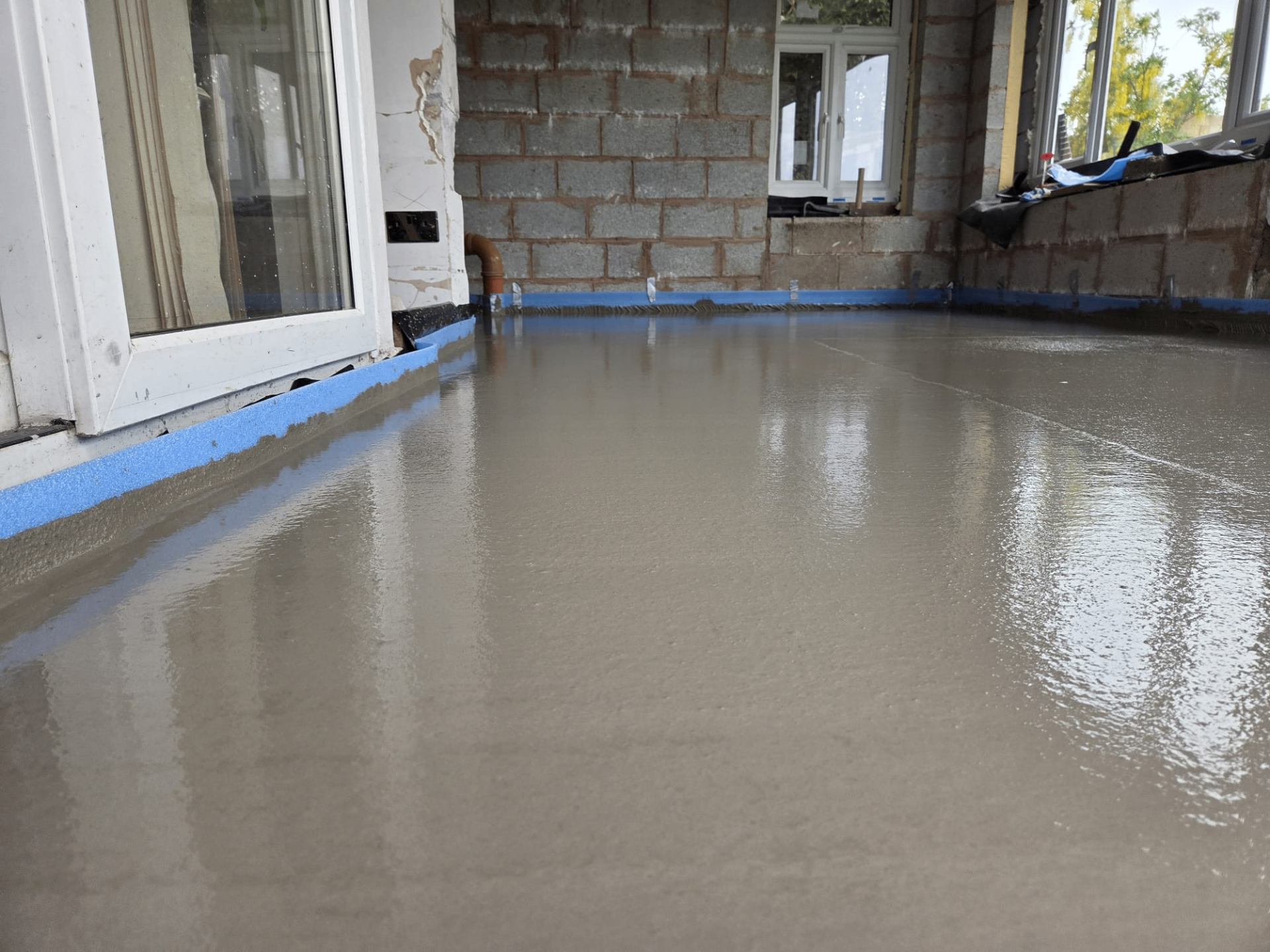
What triggers a physical survey
A visit is more likely where the floor area is large, the layout is complex, access is restricted, or the drawings don't give enough detail to confirm depth, insulation type and membrane arrangement with confidence. Unusual features such as split levels, multiple manifold positions or phased pours across a build also tend to push a job towards a survey rather than a desk-based quote.
For simple domestic rooms with clear plans and photos, a desk-based assessment is often sufficient to produce a reliable quotation, though this is judged case by case rather than assumed. Where there's genuine doubt about ground conditions, existing damp issues or the practicality of pump access, a short visit is usually worth the time it takes, since it removes guesswork that would otherwise sit as a caveat in the quotation.
Turning a survey into a booking
Once the survey findings and quotation are agreed, a provisional date is usually pencilled in against the build programme, with the final commitment depending on the site reaching the agreed state of readiness beforehand. This provisional stage matters because it lets both sides plan without pretending a date is fixed when several other trades still need to finish first.
It's worth flagging any programme uncertainty at this stage — a date that depends on other trades finishing on time is different from a fixed date, and being upfront about this avoids later disappointment. Confirming the booking usually involves a short exchange close to the pour date to check nothing on site has changed since the survey.
Who is usually involved in this stage
On a domestic project it's often just the homeowner or their builder having the initial conversation, whereas on a larger contract the enquiry might come from a main contractor, architect or quantity surveyor, each with slightly different information available to them at the outset.
Whoever raises the enquiry, it helps if they can speak to the practical details of the floor build-up, since a quotation based on secondhand or incomplete information is more likely to need revisiting once the survey or pour-booking stage is reached.
What can delay this stage
The most common delay at this point is incomplete information — drawings without depth or insulation detail, or a description that doesn't mention underfloor heating until later in the conversation. Chasing these details early avoids a quotation that has to be reworked once a survey uncovers a different picture.
Availability can also be a factor: if a survey is genuinely needed but the site isn't yet accessible, or the right people aren't available to answer questions on the day, the whole sequence from enquiry to booking is pushed back accordingly.
Ready to start the conversation?
Call 07791 510849 or send us your plans and we'll talk through the next steps for your project.
Or call our landline on 01392 237700
In short
A clear run-through of the steps between first contact and a confirmed booking, including what a survey typically covers.
Booking & survey process — your questions
Ready to start the conversation?
Call 07791 510849 or send us your plans and we'll talk through the next steps for your project.