
Pre-tiling levels
Uneven Floor Levels Before Tiling — Getting a True Datum
If a spirit level or a laser rocks or shows daylight across a room, the floor underneath your new tiles or LVT isn't flat enough — and covering it up won't fix the problem, it'll just show it later.
Get your floor surveyed before tiling starts
Name, phone, email — we'll reply the same working day with a fixed price.
Or call our landline on 01392 237700
Most existing floors, whether old sand-and-cement, chipboard or a tired concrete slab, are out of true level by more than people expect. Tile and floor-covering manufacturers all specify a flatness tolerance, and an out-of-level substrate is one of the most common reasons a finish looks wrong or fails early.
A self-levelling liquid screed poured as a levelling layer over the existing floor is usually the quickest, least disruptive way to correct this — far less upheaval than breaking out and re-forming a slab.
This page covers how we measure existing floor levels, what tolerance different floor coverings actually need, and how a levelling pour is specified and installed.
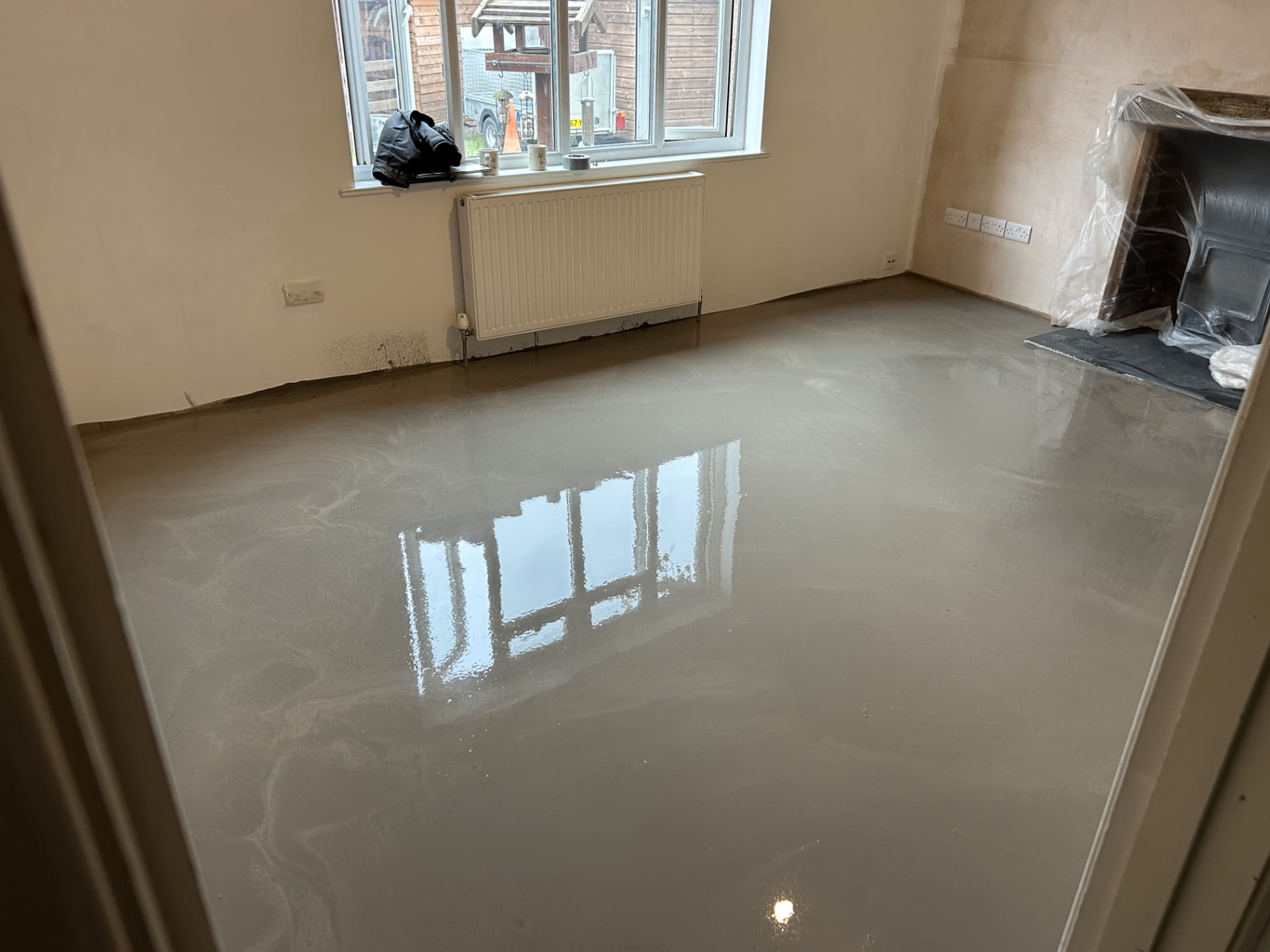
Flatness tolerance by floor covering
| Floor covering | Typical tolerance needed |
|---|---|
| Small-format tile (under 300mm) | SR2 acceptable, SR1 preferred |
| Large-format tile / porcelain (600mm+) | SR1 essential — ±2mm over 2m |
| LVT / vinyl | SR1 — any dip telegraphs through |
| Engineered wood | SR2 workable with underlay |
| Natural stone | SR1, often tighter locally |
How we get from uneven to level
- 1
Laser survey
We grid the room and log the high and low points to build a level map.
- 2
Agree finished floor level
We set the datum against door thresholds, skirtings and adjoining rooms.
- 3
Prime the substrate
Existing floor primed to bond the new pour and control absorption.
- 4
Level pour
Liquid screed poured to the agreed thickness, self-levelling to SR1.
- 5
Final check
Laser re-check across the room confirms the floor is within tolerance before tiling starts.
Signs a floor is out of level worse than it looks
- A tile spirit level rocks when placed anywhere in the room
- Skirting boards show a visible gap that changes along their length
- Doors that were fine before now catch on one side after new flooring
- Furniture consistently rocks in the same corner of a room
Get your floor surveyed before tiling starts
We'll laser-survey the room, tell you the true extent of the unevenness, and quote a levelling pour that gets you to SR1.
Or call our landline on 01392 237700
If we're not confident a floor will read flat under large-format tile or LVT, we say so before the pour — not after the tiler's called us back.
— Exeter Liquid Screeders
Uneven Floor Levels — questions we get asked
Keep reading across the site
Get your floor surveyed before tiling starts
We'll laser-survey the room, tell you the true extent of the unevenness, and quote a levelling pour that gets you to SR1.