Flatness & tolerance
Screed Not Level Enough for Large-Format Tiles
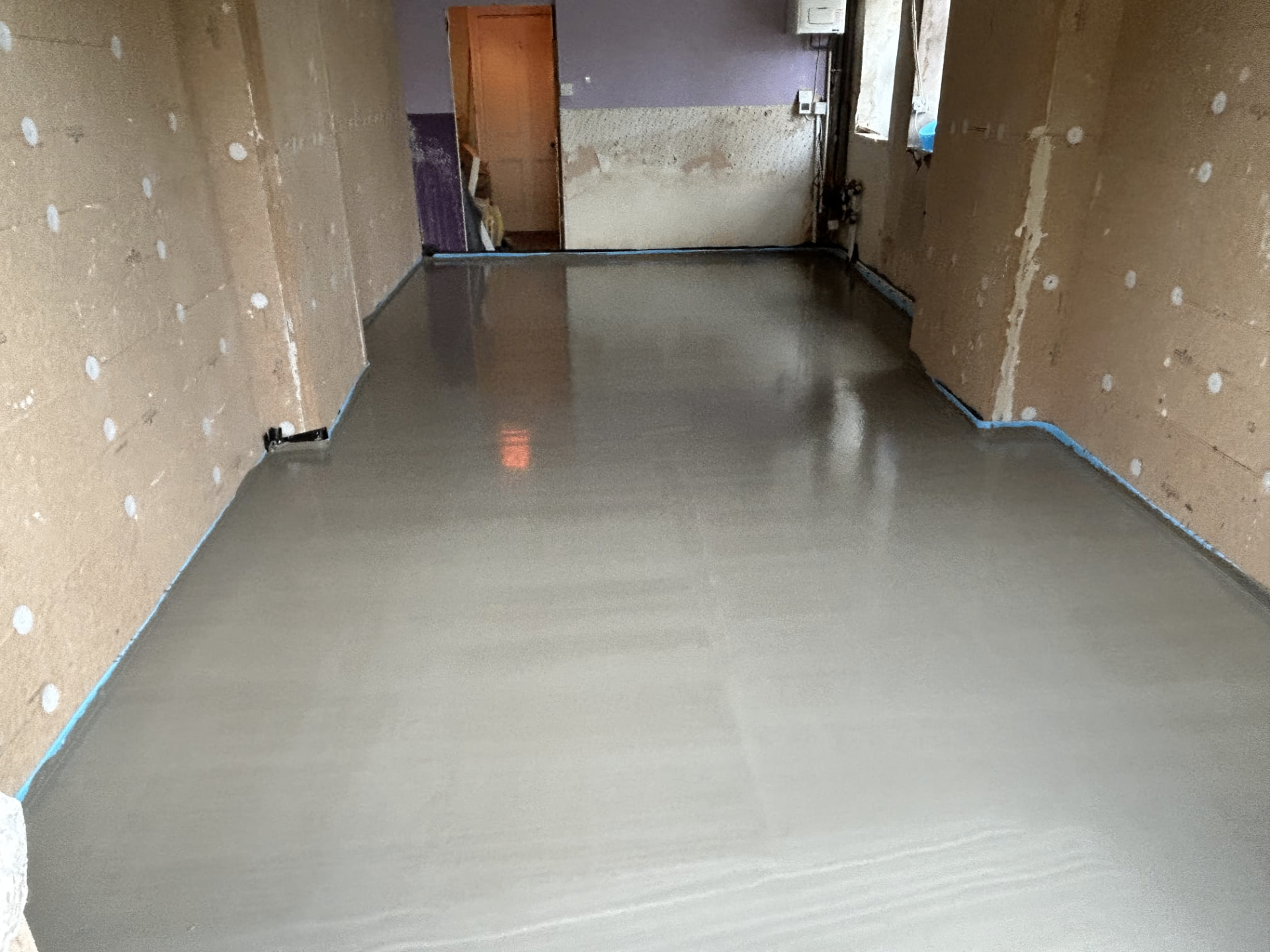
Big tiles forgive nothing. A 3mm dip that a mosaic would hide shows up as a trip hazard under a 1200mm porcelain slab.
Get your floor checked against tile tolerance
Name, phone, email — we'll reply the same working day with a fixed price.
Or call our landline on 01392 237700
Large-format tiles — anything from 600x600mm up to 1200x2400mm slabs — need a flatter floor than smaller tiles ever did. A deviation that would disappear under a run of 150mm mosaic can leave a visible, feelable step (lippage) between two neighbouring 900mm porcelain tiles.
This isn't usually a screed failure in the structural sense. It's a tolerance mismatch: the screed was poured to a standard that suited an older tiling spec, and the tiler's format has moved on faster than the site brief.
We get called in at two points — before the tiler starts, when someone runs a straightedge and doesn't like what they see, or after the fact, when a laid floor is showing lippage and everyone's trying to work out whose tolerance failed.
The tolerance large tiles actually need
±3mm / 2m
Standard screed (SR2)
±2mm / 2m
Liquid screed (SR1)
±2mm / 2m, no local dips
Large-format tile spec
≤600mm
Max recommended tile size on SR2
What actually causes the dips
- Screed poured to SR2 by a different trade, spec written after the pour
- Laser level knocked or not re-checked mid-pour on a large open floor
- Local low spots at door thresholds or around columns not screeded out
- Substrate deflection under a thin screed that telegraphs through
- Self-levelling compound applied unevenly as an afterthought fix
Get your floor checked against tile tolerance
Send us your tile format and we'll survey the existing screed against the flatness it actually needs, then quote the fix.
Or call our landline on 01392 237700
How we confirm and fix it
- 1
Straightedge and laser survey
We run a 2m straightedge and laser level across the whole floor and mark every deviation over 2mm, not just the obvious ones.
- 2
Decide: skim or re-pour
Shallow, localised dips take a latex self-levelling skim. Widespread SR2-level unevenness usually needs grinding back and a fresh liquid screed pour.
- 3
Level to SR1
A liquid screed re-pour or skim is finished to SR1 (±2mm/2m), the tolerance large-format tiling actually needs.
- 4
Sign-off before tiling
We re-survey and hand the tiler a floor that meets the tile manufacturer's flatness requirement in writing.
Don't let a tiler start on a floor you haven't checked with a straightedge yourself. Large tiles don't forgive, and the fix afterwards is far more disruptive than a levelling pour before.
— Exeter Liquid Screeders
Screed Not Level for Large-Format Tiles — questions we get asked
Keep reading across the site
Get your floor checked against tile tolerance
Send us your tile format and we'll survey the existing screed against the flatness it actually needs, then quote the fix.