Deep-pour drying
Screed Poured Too Deep — Managing the Extended Dry Time
A screed poured deeper than the design depth — often to make up for an uneven substrate — doesn't just cost more material, it dries dramatically slower, and that has a direct knock-on effect on your programme.
Get a realistic drying timeline
Name, phone, email — we'll reply the same working day with a fixed price.
Or call our landline on 01392 237700
Drying time in a liquid screed isn't linear with depth — it's closer to exponential once you go beyond the specified thickness, because moisture has to travel further to reach the surface and evaporate.
It usually happens for understandable reasons: an existing slab that's more uneven than the drawings suggested, or a decision on site to pour to the highest point rather than create a stepped floor. But the drying consequence needs planning for, not discovering three weeks before the flooring trade turns up.
This page explains the maths behind deep-pour drying, what you can realistically do to speed it up, and how we test to confirm it's actually ready before covering it.
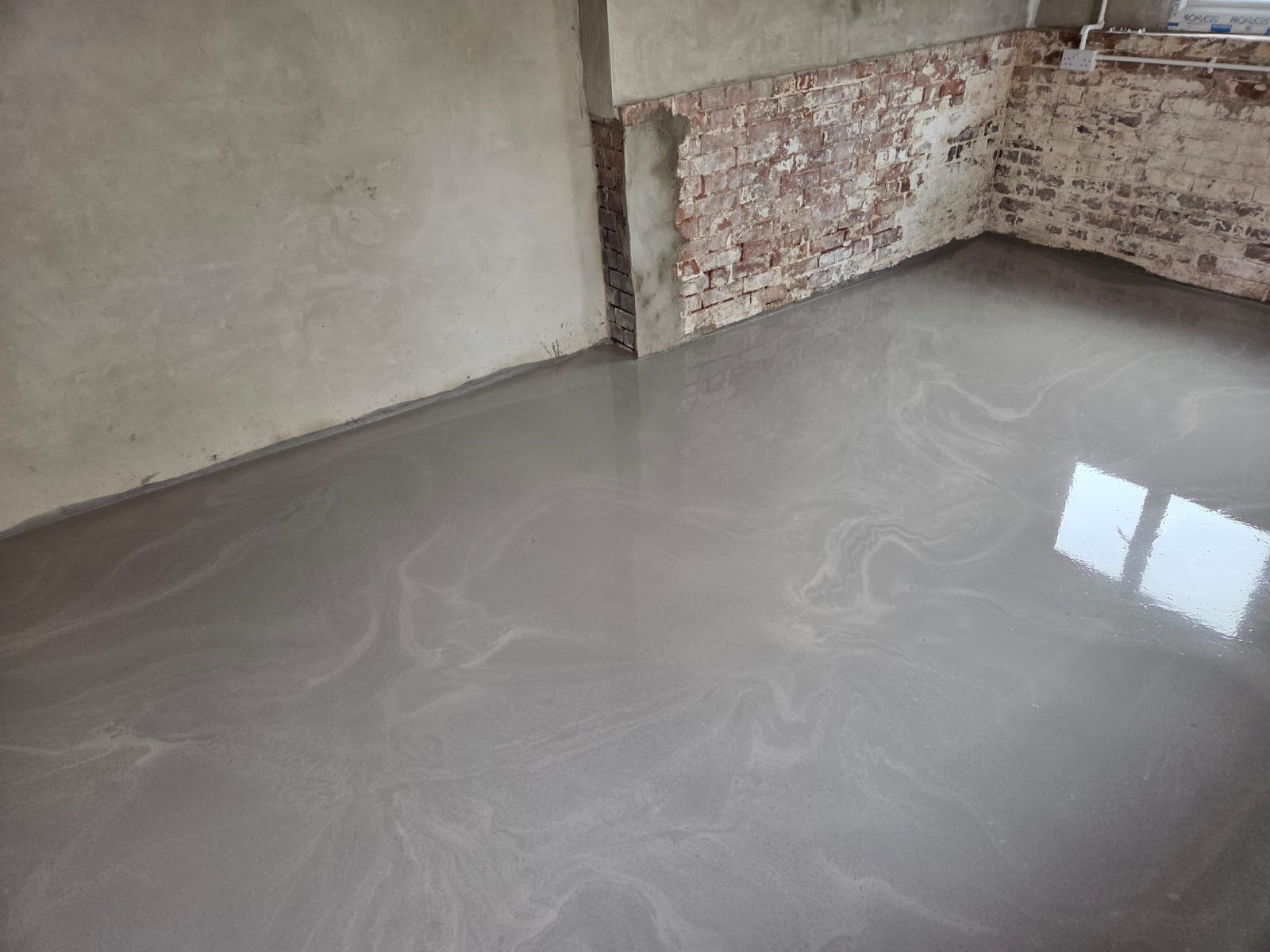
Approximate dry time by pour depth (normal ambient conditions)
| Pour depth | Typical dry time to <75% RH |
|---|---|
| 40mm | 2–3 weeks |
| 60mm | 4–6 weeks |
| 80mm | 8–10+ weeks |
| 100mm+ | Several months without intervention |
Why depth affects dry time so heavily
- Moisture has a longer path to travel from the core of the slab to the surface
- The lower half of a deep pour stays wetter for much longer than the top, even when the surface looks and feels dry
- Standard rule-of-thumb rates (roughly 1mm/day for the first 40mm) slow down considerably beyond that depth
- Poor ambient ventilation compounds the effect far more in a deep pour than a shallow one
How we manage a deeper-than-planned pour
- 1
Recalculate the programme early
As soon as depth is confirmed, we give you a realistic dry-time estimate, not the standard one.
- 2
Ventilation and airflow
Controlled cross-ventilation moves moist air out rather than letting it sit and re-absorb.
- 3
Dehumidification if the programme demands it
Forced dehumidification can meaningfully cut dry time on deep pours when managed correctly.
- 4
Test, don't guess
A calcium carbide or hygrometer test at multiple depths confirms readiness before covering.
Get a realistic drying timeline
Tell us your pour depth and target flooring date and we'll give you an honest programme, including whether dehumidification makes sense.
Or call our landline on 01392 237700
If the substrate means we're pouring deeper than the datasheet's default depth, we say so up front and give you a drying estimate you can actually plan a programme around.
— Exeter Liquid Screeders
Screed Too Deep — Drying — questions we get asked
Keep reading across the site
Get a realistic drying timeline
Tell us your pour depth and target flooring date and we'll give you an honest programme, including whether dehumidification makes sense.