
Seasonal drying delay
Screed Drying Times in Winter
The '1mm per day' rule assumes decent ambient conditions. A cold, damp winter site can push drying times out by weeks, not days.
Worried about a winter drying programme?
Name, phone, email — we'll reply the same working day with a fixed price.
Or call our landline on 01392 237700
Screed dries by evaporation — moisture has to leave the surface and be carried away by air movement. Evaporation is driven by temperature and humidity, both of which work against you through a Devon winter: cold air holds less moisture but also doesn't encourage evaporation the way warm air does, and a wet building site is often more humid than people expect.
The commonly quoted 'one millimetre per day' drying guideline for the first 40-50mm applies in reasonable ambient conditions — roughly 20°C with decent ventilation. Drop that to a cold, unheated shell in January, and the same screed can take twice as long to reach the moisture content flooring needs.
This matters because laying flooring onto a screed that reads dry on paper but hasn't actually reached target moisture content is one of the most common causes of expensive floor covering failures.
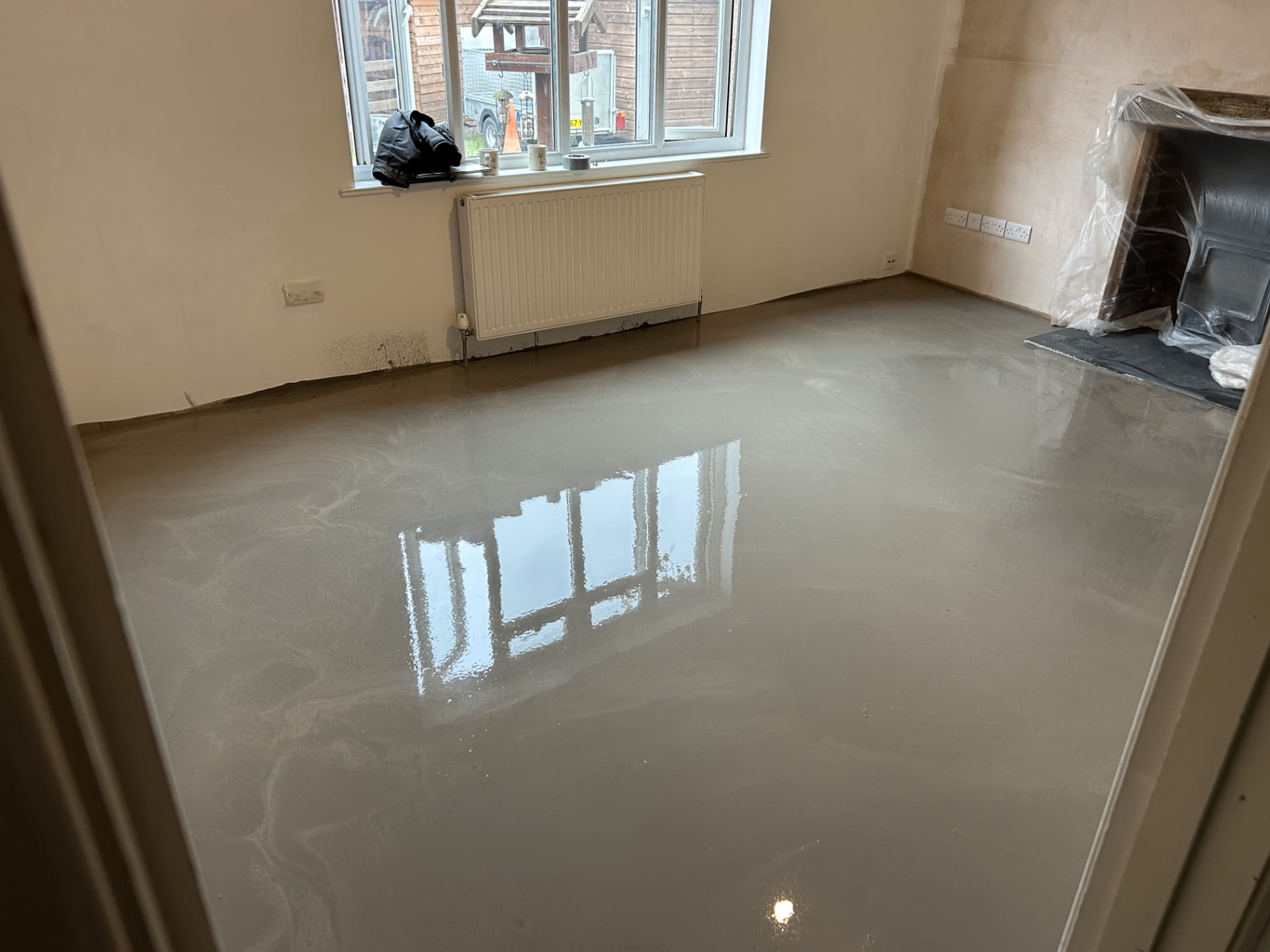
What affects winter drying speed
| Factor | Effect on drying time |
|---|---|
| Low ambient temperature | Slows evaporation significantly |
| High relative humidity | Reduces the air's capacity to carry moisture away |
| Poor ventilation / sealed building | Traps moisture-laden air near the floor |
| No background heat | Removes the single biggest accelerant available |
| Screed depth | Deeper pours always take proportionally longer |
What actually speeds winter drying up safely
- Background heating kept low and constant, not blasted intermittently
- Cross-ventilation — windows or trickle vents open where weather allows
- Dehumidification once the screed has passed its initial cure period
- Avoiding plastic sheeting or sealed rooms that trap humidity at floor level
- Not covering the screed with materials or boxes that block air movement
How we assess whether a winter-dried screed is ready
- 1
Moisture testing, not calendar counting
We test with a hygrometer or carbide method rather than assuming a fixed number of weeks means the floor is ready.
- 2
Compare against the flooring's requirement
Different coverings need different maximum RH readings — timber is stricter than tile, for instance.
- 3
Advise on acceleration if the programme is tight
If the programme can't absorb a slow winter dry, we'll recommend dehumidification rather than guessing.
Worried about a winter drying programme?
Tell us your pour date, screed depth and target flooring date, and we'll give you a realistic drying estimate for the conditions, not the textbook one.
Or call our landline on 01392 237700
Never trust a drying calendar over a moisture test in winter. The only number that matters is what the hygrometer says on the day flooring is due to go down.
— Exeter Liquid Screeders
Screed Drying in Winter — questions we get asked
Keep reading across the site
Worried about a winter drying programme?
Tell us your pour date, screed depth and target flooring date, and we'll give you a realistic drying estimate for the conditions, not the textbook one.