
Cement vs anhydrite liquid screed
Cemfloor vs Gyvlon: Which Liquid Screed Wins?
Two of the most-specified liquid screeds in the South West, built on entirely different chemistry. Here's how they actually compare on site, not just on the datasheet.
Not sure which screed your build needs?
Name, phone, email — we'll reply the same working day with a fixed price.
Or call our landline on 01392 237700
Cemfloor and Gyvlon both get poured through a hose, both self-level to SR1, and both look near-identical once they've gone off. But underneath, they're chemically nothing alike — one is a cement-based screed, the other is calcium-sulphate (anhydrite) — and that single fact drives almost every practical decision on your project.
We install both, so this isn't a sales page for one over the other. It's the comparison we actually walk clients through on site before a pour is booked.
If you take one thing away: Cemfloor wins where water and tile adhesive are involved, Gyvlon wins on pure UFH thermal performance in a dry residential build at a lower material cost.
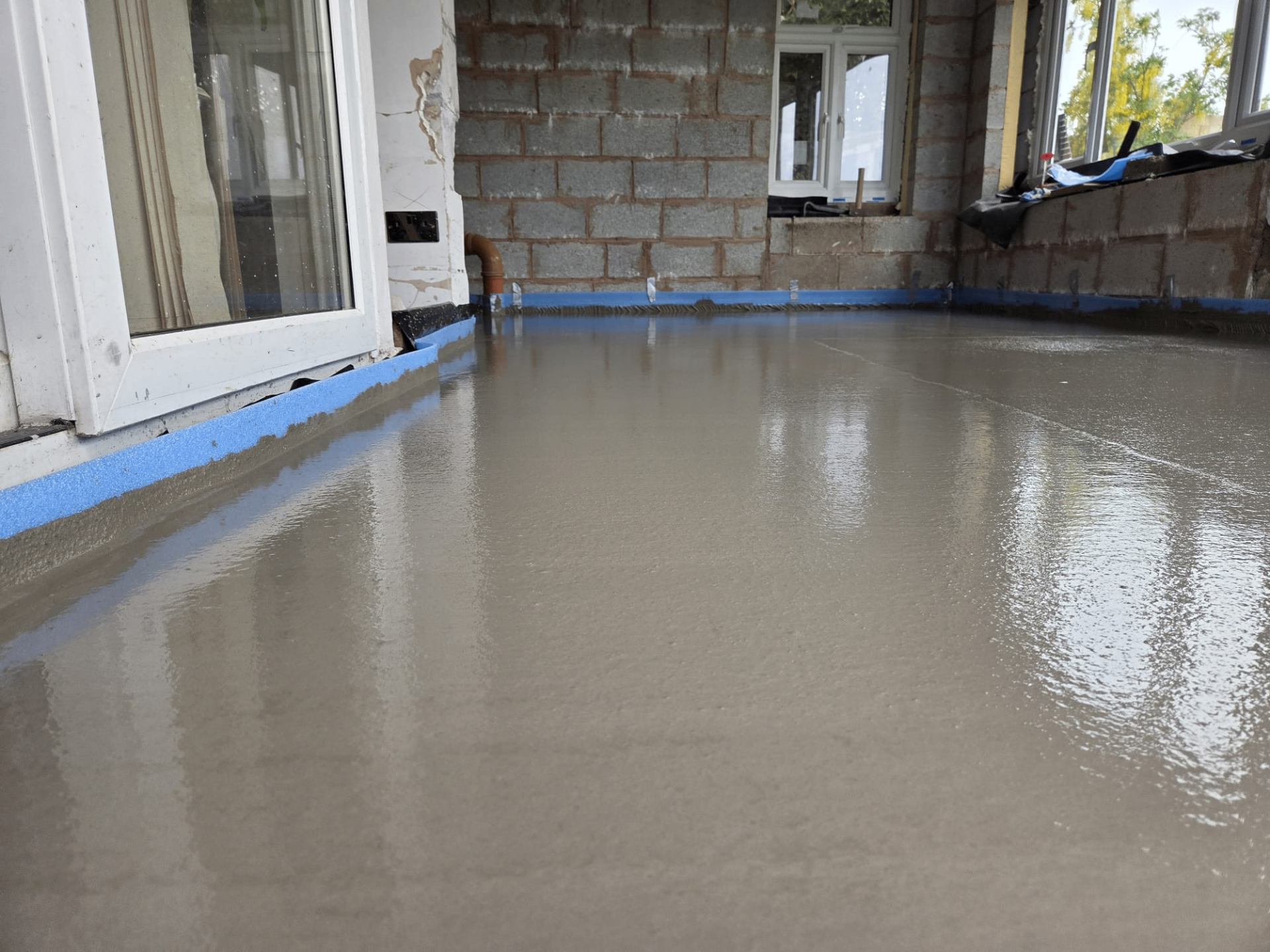
Cemfloor vs Gyvlon at a glance
| Property | Cemfloor / Gyvlon |
|---|---|
| Chemistry | Cement-based / Calcium-sulphate (anhydrite) |
| Wet-area suitability | Excellent / Needs tanking, riskier long-term |
| Laitance sanding before tiling | Not usually required / Mandatory |
| Thermal conductivity | ~2.0 W/mK / up to ~2.4 W/mK (Thermio+) |
| Typical foot traffic | 24–48h / 48h |
| Material cost per m² | Higher / Typically 8–15% cheaper |
Which one does your build actually need?
Choose Cemfloor when…
- Tiles or stone are the finished floor
- A kitchen, bathroom or wet room is in the pour
- Epoxy or polished-concrete coating follows
- You want to skip the sanding visit
Choose Gyvlon when…
- Dry residential build with UFH only
- Engineered wood or LVT on foam underlay
- Cost per m² is the deciding factor
- No wet-area exposure anywhere in the pour
Not sure which screed your build needs?
Send us your drawings and finish schedule and we'll tell you honestly whether Cemfloor or Gyvlon is right — then quote both if you want to compare.
Or call our landline on 01392 237700
Where the two are genuinely interchangeable
- Living rooms, bedrooms and hallways with no water exposure
- Standard depth pours between 30–50mm over UFH
- New-build slabs on a well-detailed DPM
- Programmes with 3+ weeks available for natural drying
If your build has a wet room or the floor is going straight under tile, we'll spec Cemfloor without hesitation. If it's a dry residential floor with UFH and the budget is tight, Gyvlon does the job for less.
— Exeter Liquid Screeders
Cemfloor vs Gyvlon — questions we get asked
Keep reading across the site
Not sure which screed your build needs?
Send us your drawings and finish schedule and we'll tell you honestly whether Cemfloor or Gyvlon is right — then quote both if you want to compare.