Screed chemistry explained
Calcium Sulphate vs Cement Screed: The Chemistry
Every liquid screed on the market is either calcium-sulphate or cement-based. That one fact decides more about your floor than any brand name does.
Get the chemistry right first time
Name, phone, email — we'll reply the same working day with a fixed price.
Or call our landline on 01392 237700
Brands like Cemfloor, Gyvlon and Gypsol get discussed as if they're competing products doing the same job. Strip away the branding and there are really only two chemistries: calcium sulphate (anhydrite) and Portland cement. Every practical difference you'll read about — sanding, wet-room suitability, tile compatibility, drying rate — comes down to which of these two a given product is.
Understanding the chemistry rather than the brand names means you can specify correctly even when a supplier substitutes one product for another of the same type.
This page is the chemistry primer we send to architects and self-builders before the brand conversation even starts.
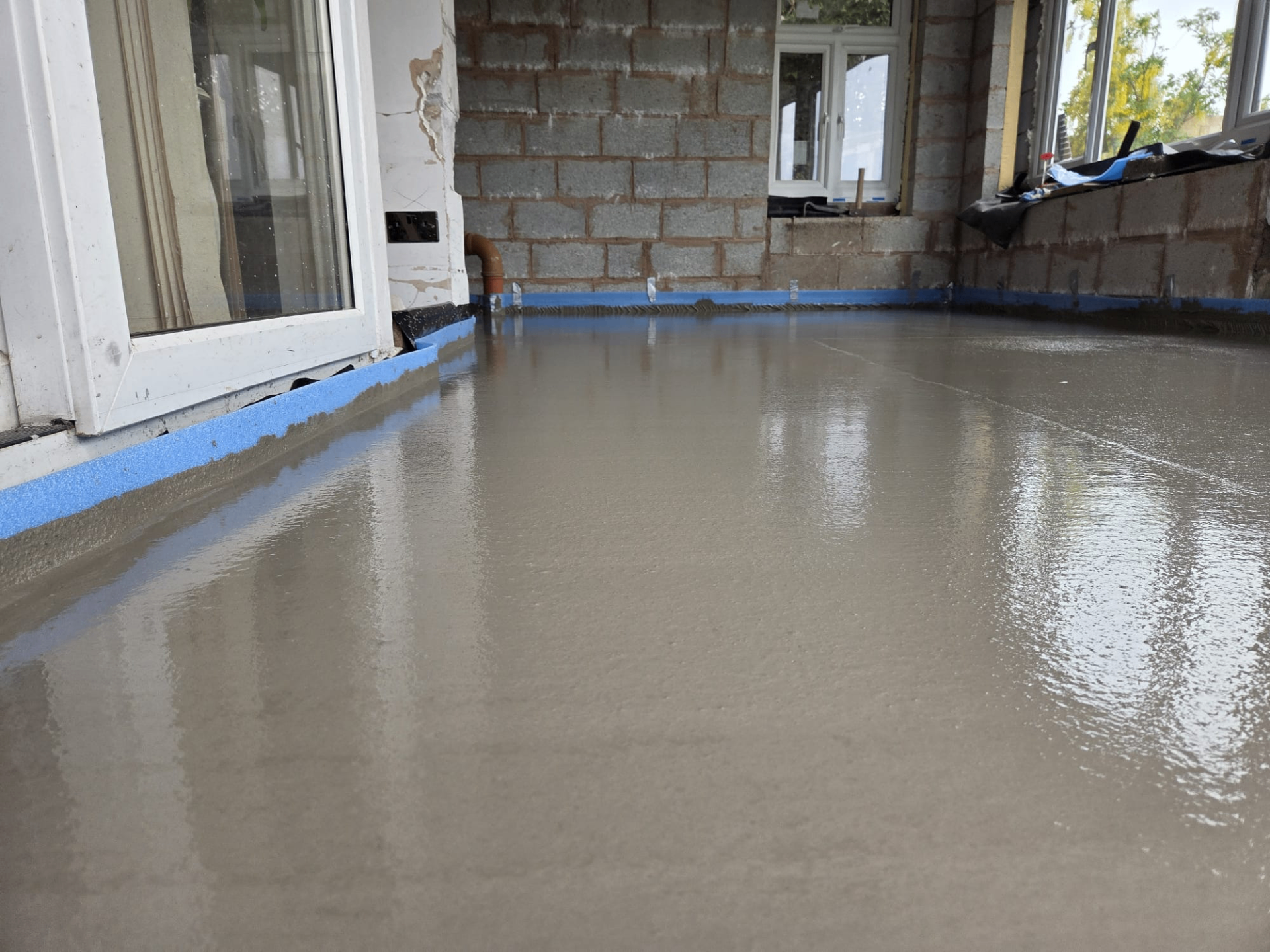
Calcium sulphate vs cement — the chemistry
| Factor | Calcium sulphate / Cement |
|---|---|
| Binder | Gypsum-derived anhydrite / Portland cement |
| Water sensitivity | Degrades with repeated saturation / Stable when wet |
| Surface laitance | Forms, must be sanded before adhesives / Minimal, rarely needs sanding |
| Shrinkage | Very low / Low but slightly higher than anhydrite |
| Typical brands | Gyvlon, Gypsol / Cemfloor |
Why the chemistry decides tile adhesive choice
- Cement-based adhesives bond naturally to a cement screed
- Anhydrite screeds need a primer to isolate the gypsum surface before cement-based adhesive is used
- Getting this step wrong is one of the most common causes of tile debonding on new floors
- Cement screeds are compatible with epoxy and resin coatings without special isolation
Get the chemistry right first time
Tell us what's going in each room and we'll confirm the correct screed chemistry before we quote a single product name.
Or call our landline on 01392 237700
Why this isn't just semantics
We've surveyed floors where a specifier wrote 'liquid screed' on the drawings without naming a chemistry, and the installer defaulted to whichever was cheapest that week. In a dry bedroom, that's harmless. In a wet room or under a resin floor, it can mean a full floor replacement within a couple of years.
If you only remember one rule: cement chemistry for anywhere water touches the floor repeatedly, calcium sulphate for everywhere else where cost and UFH thermal performance matter more.
Calcium sulphate vs cement: the decision test
Choose calcium sulphate when…
- The build is dry throughout — no wet rooms, no basements
- UFH thermal response and low cost per m² are the priority
- Engineered wood or LVT is going down over an isolating underlay
- Depths of 50mm+ are needed and drying time isn't critical
Choose cement (Cemfloor) when…
- Any wet room, kitchen or basement is in the pour area
- Tiles, epoxy or polished concrete are the finish
- You need SR1 flatness with minimal cover over UFH
- The programme demands the fastest safe drying window
Cement-Based vs Calcium Sulphate Liquid Screed: The Chemistry
Liquid screeds fall into two binder families covered by BS EN 13813: cementitious (CT) screeds and calcium sulphate (CA) screeds, often referred to by trade names in the anhydrite category. Both can be pumped and self-level, but the chemistry underneath drives very different behaviour on site, from how long you wait before walking on the floor to how the surface needs preparing for flooring.
Cementitious screeds cure through hydration of Portland cement, a reaction that continues over weeks and is sensitive to water content, temperature and ventilation. Calcium sulphate screeds set through a different hydration route, generally produce a very flat, low-shrinkage slab, and tend to have a laitance-free surface that still needs light preparation before most floor coverings.
Choosing between the two isn't purely a chemistry question — it depends on the substrate, moisture exposure, underfloor heating design and the flooring finish planned above. We'll talk through the trade-offs relevant to your project rather than assume one system suits everything, and explain how binder choice interacts with admixtures, curing regime and the strength class you actually need.
Cement vs Calcium Sulphate Chemistry — key points
CT (cementitious) screeds are compatible with damp conditions and areas with intermittent water exposure, subject to design
CA (calcium sulphate) screeds typically achieve very low shrinkage and excellent flatness in large open areas
Both are classified under BS EN 13813 by compressive (C) and flexural (F) strength
CA screeds generally need a mechanical sanding pass to remove surface laitance before flooring
Drying rates differ and both depend on thickness, ventilation, heating and ambient conditions — always follow the datasheet
CT screed is often preferred in wet areas and where design calls for SR1/SR2 moisture resistance
Site storage, mixing water ratios and pump plant differ between the two binder types
Admixture packages (plasticisers, retarders, fibres) are tailored differently for each binder chemistry
Curing behaviour affects how soon protective coverings, screens or partitions can go in around the floor
How the two binders behave differently
Cementitious liquid screed uses a modified cement binder with plasticisers and often synthetic fibres, giving it good compressive and flexural performance and reasonable tolerance of residual dampness in the substrate. It's frequently specified in commercial builds, on grade slabs and anywhere splashing or occasional wetting is likely.
Calcium sulphate screed uses anhydrite or hemihydrate binders which react with water in a way that leaves minimal internal stress, so cracking and curling risk is generally lower across large bay sizes. It's a common choice for domestic underfloor heating installations because of its flow characteristics and thermal contact with pipework.
What this means for your programme
Because the chemistry differs, drying times, moisture testing (RH or CM) and priming requirements are not interchangeable between the two systems — a drying schedule written for one won't apply to the other. Your screeder should confirm which binder is specified and set expectations early rather than mid-project.
Where a project has mixed requirements — say, a wet room needing CT screed and adjoining living space on CA screed — junction detailing and movement joints need particular attention. We can talk through which binder suits each zone of your build.
Admixtures and mix design differences
Cementitious mixes commonly include superplasticisers to achieve a flowable consistency without excess mixing water, since too much water weakens the cured screed and slows drying. Retarders or accelerators may also be used depending on ambient temperature and pump run length on larger pours.
Calcium sulphate mixes are formulated by the manufacturer as a proprietary package, generally supplied ready-mixed from a dedicated screed lorry, with less scope for on-site adjustment than a traditional cement mix. This consistency is part of why CA screeds achieve such reliable flatness across a floor.
Surface preparation and compatible finishes
CA screed's laitance layer is a natural by-product of the calcium sulphate reaction and needs mechanical sanding to expose a sound, receptive surface before tiling, adhesive fixing or resin coatings are applied — skipping this step is a common cause of adhesion failure.
CT screed can usually accept a wider range of finishes with less mandatory preparation, though moisture testing before covering remains essential for both binder types, since trapping residual moisture beneath an impermeable floor covering is a leading cause of later flooring failures.
Calcium Sulphate vs Cement Screed — questions we get asked
Keep reading across the site
Get the chemistry right first time
Tell us what's going in each room and we'll confirm the correct screed chemistry before we quote a single product name.