
Cement vs anhydrite liquid screed
Cemfloor vs Gypsol: Choosing the Right Screed
Gypsol is the anhydrite screed most regional housebuilders specify by default. Cemfloor is the cement-based alternative that changes the answer once tiling or wet areas are involved.
Get both options priced
Name, phone, email — we'll reply the same working day with a fixed price.
Or call our landline on 01392 237700
Gypsol turns up on more South West housebuilder drawings than almost any other liquid screed, largely because Saint-Gobain's UK batching network makes it easy to source. That doesn't make it the automatic right answer for every room in the house.
Cemfloor is the product we reach for when the same project has a kitchen, utility room or bathroom in the mix, or when the finished floor is tile, stone or a resin coating rather than carpet or engineered wood.
This page sets out the practical differences so you can see which one your specific rooms actually need — because on a mixed-use project, the honest answer is sometimes both.
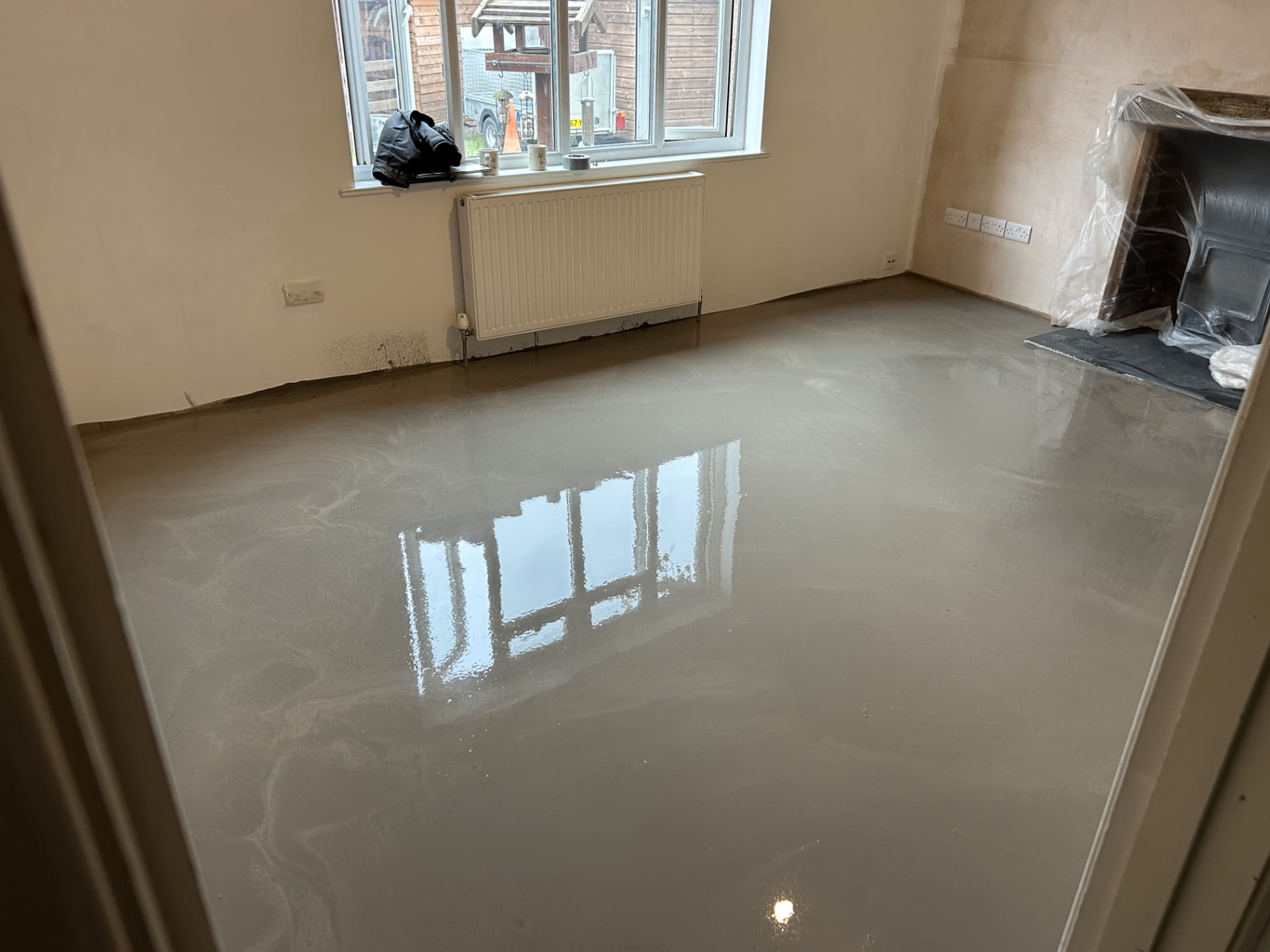
Where Gypsol is the sensible default
- Bedrooms, living rooms and circulation areas with UFH
- New-build plots where Gypsol is already the housebuilder's standard spec
- Engineered wood or carpet as the final floor covering
- Tight budgets where material cost per m² is the deciding line
Cemfloor vs Gypsol — the numbers that matter
| Metric | Cemfloor / Gypsol |
|---|---|
| Chemistry | Cement / Calcium-sulphate |
| Sanding before tiling | Not usually required / Required |
| Wet-room suitability | Yes / Needs tanking, added risk |
| Typical dry time to <75% RH (50mm) | ~3 weeks / ~3–4 weeks |
| Suitable under epoxy or resin | Yes / Not recommended without primer |
Why the finish schedule decides it, not the brand
Most confusion between Cemfloor and Gypsol comes from treating it as a brand loyalty question. It isn't. The chemistry difference is the whole story: cement-based screeds are compatible with almost every wet trade and tile adhesive that follows, anhydrite screeds are not built for repeated wetting.
On a typical extension with a kitchen and a bathroom off an open-plan living space, we'll often pour Cemfloor throughout for consistency, rather than mixing two chemistries across one continuous slab.
Get both options priced
Tell us your finish schedule room by room and we'll quote Cemfloor and Gypsol side by side so you can compare on your own numbers.
Or call our landline on 01392 237700
How we decide which one to spec
- 1
Check the finish schedule
Tile, stone or resin anywhere in the pour area pushes the decision toward Cemfloor.
- 2
Check for wet trades
Kitchens, utility rooms and bathrooms are treated as wet areas even without a shower.
- 3
Check the programme
If Gypsol's sanding visit doesn't fit the build schedule, Cemfloor's no-sand finish can save a week.
- 4
Check the budget
If none of the above apply, Gypsol's lower material cost usually wins by default.
Cemfloor vs Gypsol — questions we get asked
Keep reading across the site
Get both options priced
Tell us your finish schedule room by room and we'll quote Cemfloor and Gypsol side by side so you can compare on your own numbers.