
Screed installation methods
Bonded vs Unbonded Screed: Which Build-Up Do You Need?
Bonded and unbonded aren't product choices — they're two different ways of attaching the same screed to what's underneath it, and getting it wrong causes cracking.
Get your build-up assessed
Name, phone, email — we'll reply the same working day with a fixed price.
Or call our landline on 01392 237700
Every liquid screed pour is installed in one of three ways: bonded directly to the sub-base, unbonded over a separating membrane, or floating over insulation. Bonded and unbonded are the two most commonly confused, because both can look identical once cured.
The difference is about how the screed is designed to move — or not move — relative to what's beneath it, and it drives minimum depth, crack-control detailing and suitability for the existing sub-floor.
Get the wrong build-up over a poor sub-base and you'll see debonding, curling at the edges, or cracking that reappears after the first heating season.
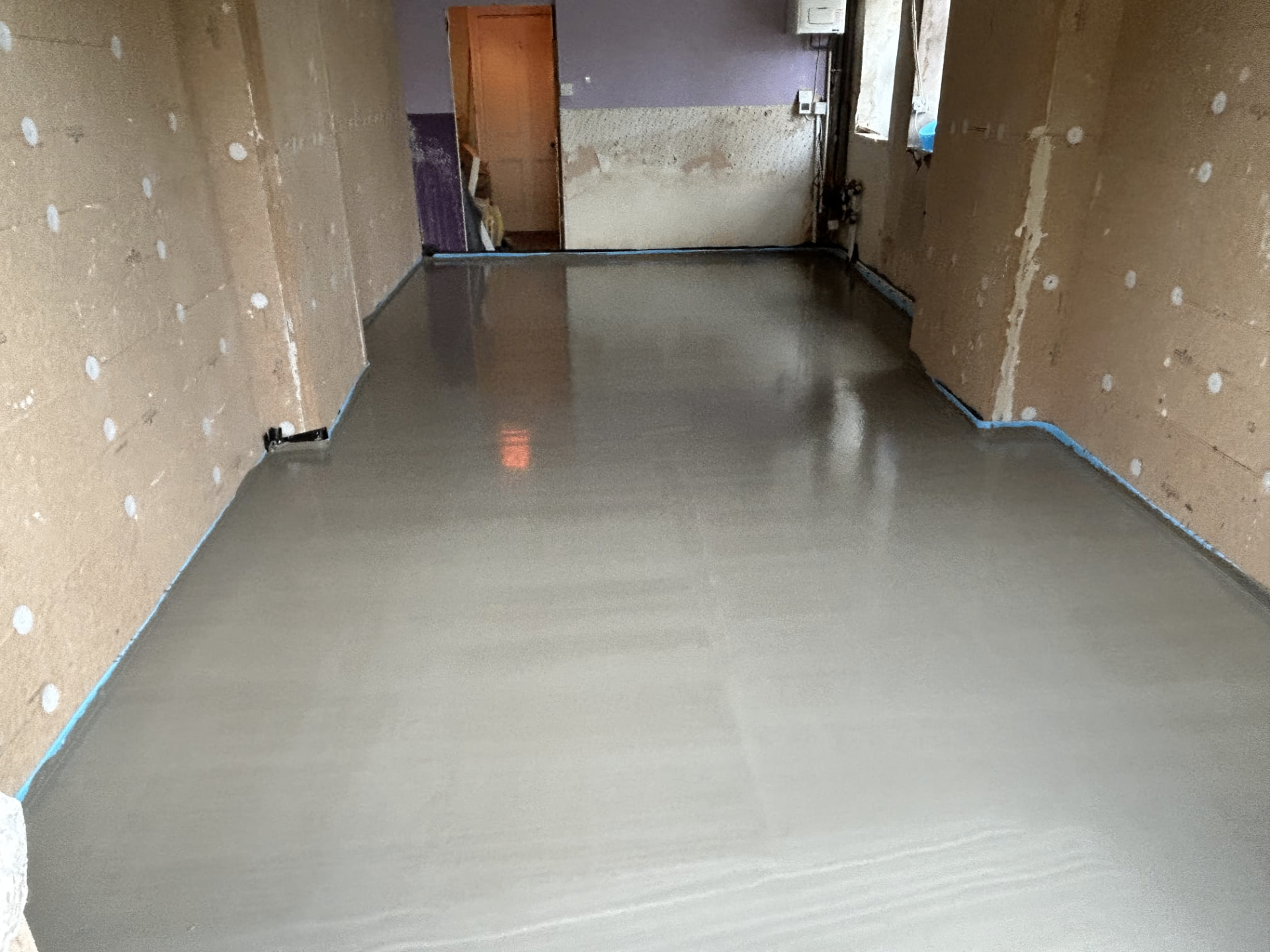
How we decide bonded vs unbonded on site
- 1
Assess the sub-base
A sound, clean, mechanically-prepared concrete slab can usually take a bonded screed.
- 2
Check for damp-proofing needs
If a DPM is required over the slab, that automatically makes the pour unbonded.
- 3
Confirm minimum depth
Bonded pours can go as thin as 25–30mm; unbonded typically needs 35–40mm minimum.
- 4
Check for movement risk
Where the slab itself may move or has existing cracks, unbonded isolates the new screed from that risk.
Bonded vs unbonded — the trade-offs
Bonded screed
- Thinner pour possible (25–30mm)
- Requires a sound, prepared sub-base
- No membrane between screed and slab
- Higher risk if slab has existing defects
Unbonded screed
- Membrane isolates screed from sub-base
- Needed wherever a DPM is present
- Slightly greater minimum depth (35–40mm+)
- Tolerates a less-than-perfect existing slab
Get your build-up assessed
We'll survey your sub-base and confirm whether a bonded or unbonded screed is right before we quote depth and product.
Or call our landline on 01392 237700
Where we default to unbonded regardless of the slab
- Ground-bearing slabs needing a damp-proof membrane
- Renovation floors where the existing slab condition is unknown or suspect
- Any build-up incorporating a separate insulation layer (technically floating, but detailed like unbonded)
- Commercial floors where slab movement joints don't align with the new screed layout
Bonded vs unbonded, at a glance
25–40mm
Bonded min. depth
50mm over membrane
Unbonded min. depth
Full mechanical prep + primer
Bonded substrate prep
Clean, sound slab only
Unbonded substrate prep
Bonded vs Unbonded Screed — questions we get asked
Keep reading across the site
Get your build-up assessed
We'll survey your sub-base and confirm whether a bonded or unbonded screed is right before we quote depth and product.