
Substrates & Preparation
Moisture Risk Assessment of an Existing Floor Before Screeding
An existing floor being overlaid or replaced needs a moisture risk assessment, since ground moisture, past leaks or a missing DPM behave differently to a new slab.
Unsure about moisture risk on an existing floor?
We can help assess an existing floor's moisture risk before specifying the right screed build-up for your renovation across Exeter and the South West.
Or call our landline on 01392 237700
New-build slabs generally come with a designed DPM and a known construction history, but an existing floor being renovated or overlaid often doesn't. Older buildings may have no damp-proof membrane at all, a membrane of unknown condition, or a history of leaks, rising damp or ground moisture that has never previously caused a visible problem simply because the original floor finish tolerated it.
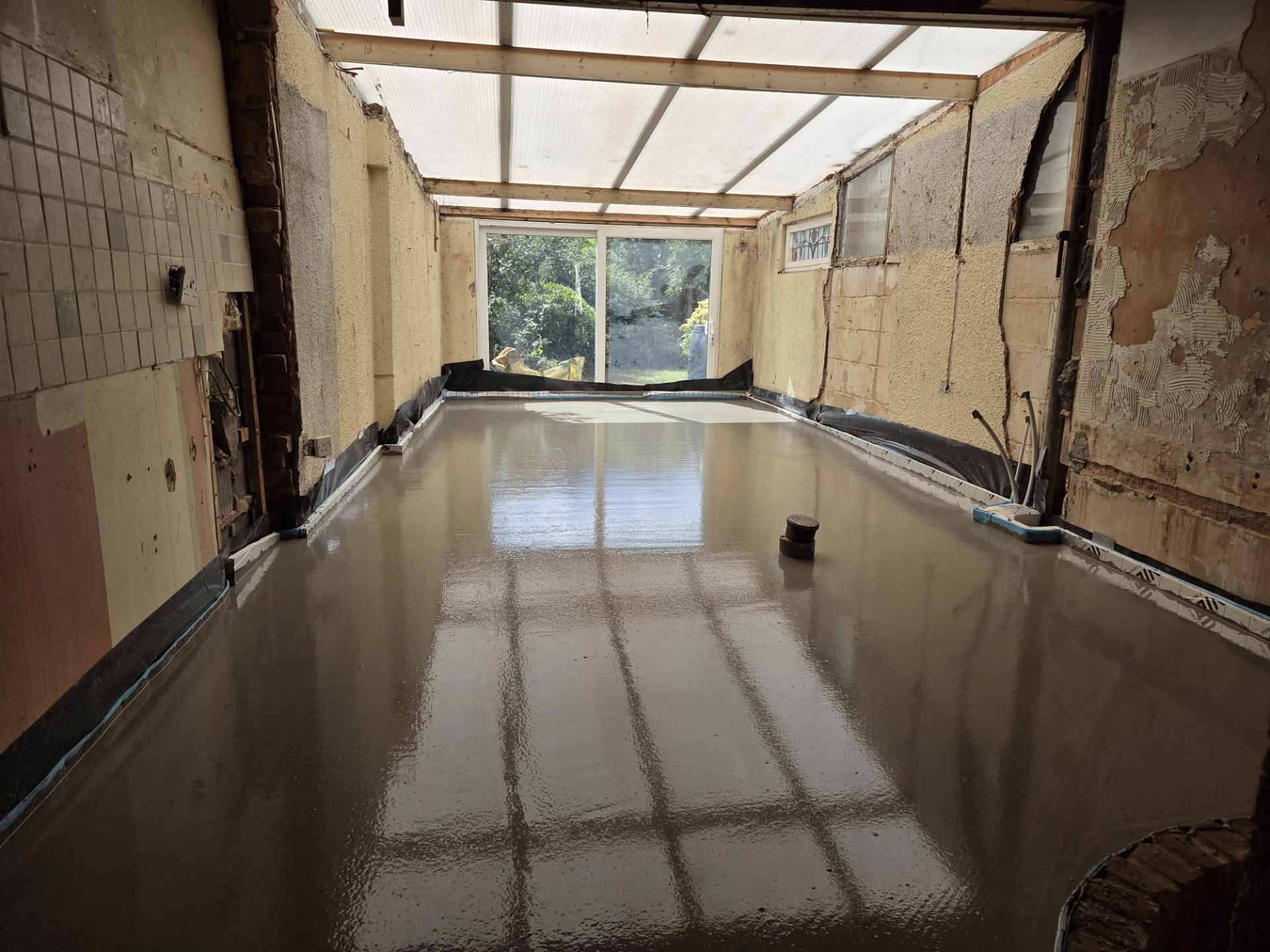
Assessing moisture risk before installing a liquid screed over an existing floor is about understanding what's happening beneath the surface, since a self-levelling screed and any floor finish above it may behave very differently to whatever was there before.
This assessment is worth carrying out early enough to influence the specification, since the findings can affect whether a bonded or floating screed system is appropriate, whether a new membrane is needed, and what floor finish above the screed is realistic given the underlying conditions.
Unsure about moisture risk on an existing floor?
We can help assess an existing floor's moisture risk before specifying the right screed build-up for your renovation across Exeter and the South West.
Or call our landline on 01392 237700
Why existing floors carry different assumptions to new slabs
A new-build slab is generally cast with a DPM specified and installed as part of the design, so its baseline moisture protection is known. An existing floor in a renovation project may predate current DPM standards altogether, or have a membrane that's degraded, been penetrated by later works, or was never designed with the intended new floor finish in mind. None of this is unusual in older housing stock, but it does mean the moisture risk has to be actively assessed rather than assumed.
This is particularly relevant where a liquid screed is being introduced as part of upgrading an older solid floor, since the finished build-up may behave differently to the original construction.
Building a picture before specifying the screed build-up
A sensible moisture risk assessment usually combines a visual inspection of the existing floor and surrounding walls, an understanding of the building's history and location, and appropriate testing suited to the substrate. The findings then feed into decisions about whether a DPM needs adding or renewing, whether a floating screed system with its own separating layer is preferable to a bonded approach, and what floor finish above the screed is realistic.
Getting this right at the assessment stage avoids specifying a screed build-up that looks correct on paper but doesn't suit the actual moisture conditions of the specific floor.
Sealing penetrations and perimeters in a renewed DPM
Where the assessment leads to introducing or renewing a damp-proof membrane, the detailing at the edges and around any penetrations — pipework, service entries, or steps between rooms — matters as much as the membrane material itself. A well-specified DPM can still let moisture through at an unsealed lap or an unrecorded penetration, undermining the protection the rest of the floor relies on.
Taking time to identify every penetration through the existing floor before the membrane goes down, rather than working around them as they're discovered, gives a far more reliable result than trying to retrofit a seal once the screed is already scheduled.
Using building age and local context alongside testing
On-site testing gives a snapshot of current conditions, but it's usefully read alongside context — the building's age, any known history of dampness or flooding, and local ground conditions in the area. A property with a known history of groundwater issues, for instance, may warrant a more cautious approach than a straightforward reading would suggest on its own.
This wider context is particularly useful in older Devon and Somerset housing stock, where construction methods and DPM standards varied considerably over different eras and aren't always documented in any surviving paperwork.
Moisture Risk Assessment — the points that decide it
- Existing solid floors without a known or intact DPM carry a different moisture risk profile to a new slab built with one
- Visual signs — staining, efflorescence, damp odours or previous flooring failure — are useful starting indicators worth noting before more detailed checks
- Moisture testing methods vary depending on the substrate and are best matched to the specific floor type rather than applied as a single generic check
- Suspended timber floors carry their own separate moisture considerations relating to underfloor ventilation rather than ground moisture directly
- Where moisture risk is identified, remedial options range from allowing more time for drying, to introducing a new DPM or membrane system before screeding
- The intended floor finish above the screed also affects how much residual risk is acceptable, since some finishes are more tolerant of moisture than others
- A building's age and known local ground conditions are useful context alongside on-site testing, particularly in older housing stock with no construction records
- Sealing the perimeter and any penetrations through a new or renewed DPM is as important as the membrane material itself, since a small gap can undermine an otherwise sound system
Moisture Risk Assessment — your questions
In short
An existing floor being overlaid or replaced needs a moisture risk assessment, since ground moisture, past leaks or a missing DPM behave differently to a new slab.
Next, people usually look at
Unsure about moisture risk on an existing floor?
We can help assess an existing floor's moisture risk before specifying the right screed build-up for your renovation across Exeter and the South West.