
Specification
Specifying movement and construction joints
A guide to specifying the different joint types a liquid screed floor may need, and how to word this clearly rather than leaving it to site judgement.
Joints are one of the parts of a screed specification most often left vague, with a general note to 'provide joints as necessary' rather than a defined layout. Liquid screed's continuous pour reduces the need for some joint types compared with traditional screed, but movement, isolation and construction joints still matter, particularly on larger floors or where underfloor heating zones are involved.
This page sets out the main joint types relevant to liquid screed and how to specify them clearly, so the joint layout is agreed on paper before the pour rather than decided informally on site.
Where joints are not clearly specified, there is a real risk of inconsistent placement between different areas of a large floor, or of joints being omitted where they are genuinely needed.
The main joint types and what they do
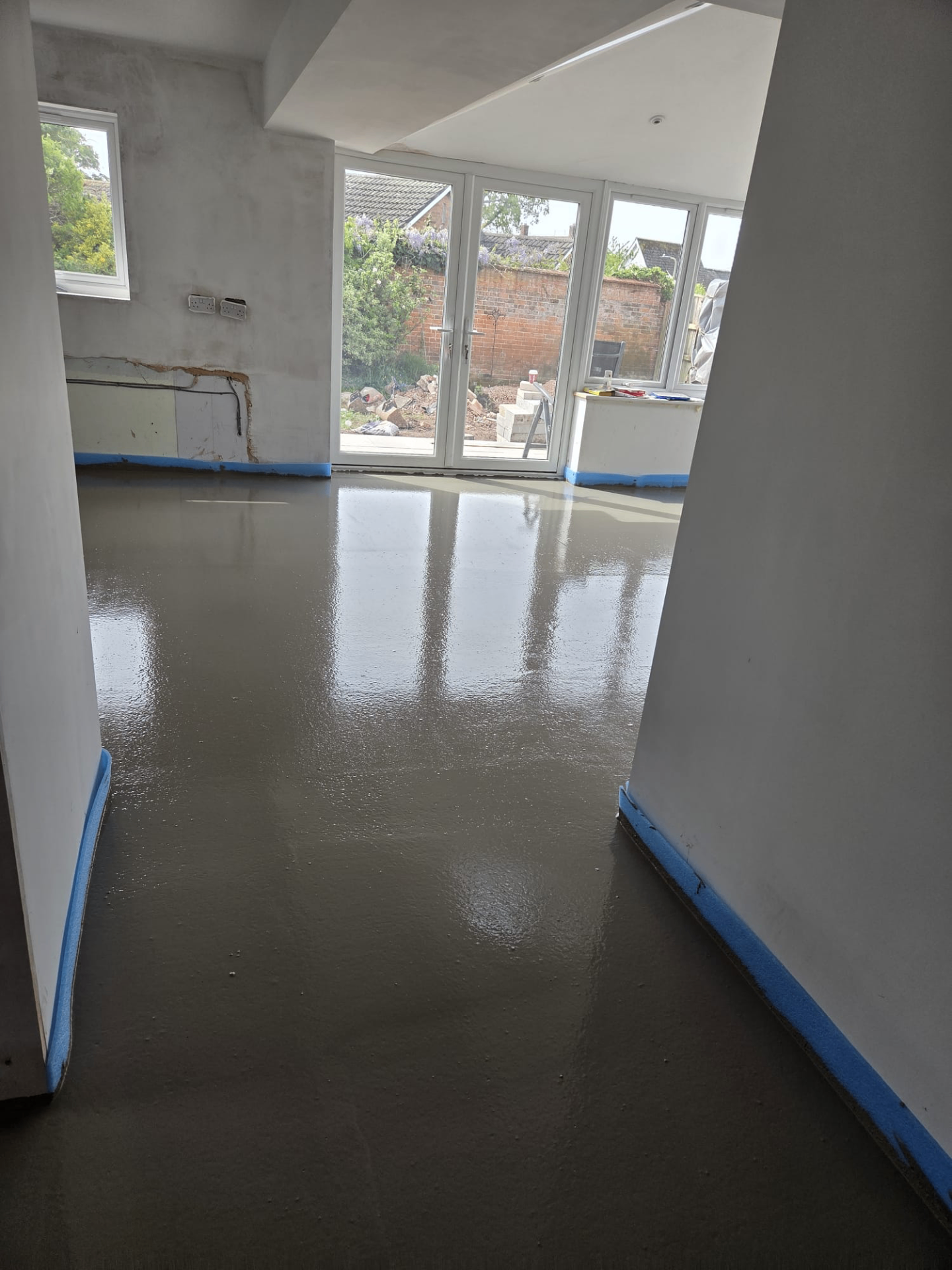
Isolation joints, typically a compressible strip around the floor's perimeter and around columns or fixed items, allow the screed to move slightly without transferring stress into walls or structure. Movement joints divide a large floor area into manageable sections, reducing the risk of uncontrolled cracking as the screed shrinks slightly during drying. Construction joints mark where a pour was interrupted, for example between different days' work on a large floor.
Liquid screed's ability to be poured in large continuous areas without the frequent bay joints associated with some traditional screeds does reduce the overall joint count on many projects, but it does not remove the need for perimeter isolation or for movement joints on genuinely large or thermally zoned floors.
Putting joint layout on paper before the pour
The clearest way to specify joints is with a marked-up plan showing intended joint positions and types, referenced by the written specification rather than described only in words. This is particularly important on larger commercial or open-plan domestic floors, and where underfloor heating zones create natural boundaries that often align with movement joint positions.
Agreeing this layout with the installer before the pour, rather than after, avoids joints being placed reactively during the pour itself, which can produce an inconsistent or poorly considered layout.
Joints and the trades that come afterwards
A movement joint left unfilled or unprotected can catch a trolley wheel or a dropped tool during the fit-out, so the sequence for filling and covering joints should sit in the same clause as their layout.
Flooring contractors need the joint positions marked up before they start, since some finishes require their own break at the same point rather than running straight over it.
Joint spacing differs by screed type
Anhydrite screed's lower drying shrinkage generally means fewer movement joints are needed across a large floor compared with a cementitious pour of the same area.
A joint layout copied from a cementitious project onto an anhydrite job can end up over-specified, adding unnecessary breaks the material didn't actually need.
Specifying joints — the points that decide it
- Isolation joints separate the screed from walls, columns and other fixed elements to allow independent movement.
- Movement joints may be needed at large area breaks or where the floor crosses different structural zones.
- Construction (day) joints occur where a pour is interrupted or split across multiple stages.
- Liquid screed's continuous pour and self-levelling nature generally reduce, but do not eliminate, the need for some traditional joint types.
- Joint positions should be shown on a plan referenced in the specification, not left as a general note.
- Underfloor heating zone boundaries are a common location for movement joints and should be coordinated with the heating design.
Specifying joints — your questions
Need a joint layout agreed before pouring?
We will work through joint positions with you before the pour so nothing is decided reactively on site.
Or call our landline on 01392 237700
In short
A guide to specifying the different joint types a liquid screed floor may need, and how to word this clearly rather than leaving it to site judgement.
Need a joint layout agreed before pouring?
We will work through joint positions with you before the pour so nothing is decided reactively on site.