
UFH cover specification
Specifying screed depth over underfloor heating pipes
Cover depth over UFH pipes is a distinct figure from overall screed depth and must satisfy both the pipe manufacturer's and screed manufacturer's requirements.
Coordinating UFH and screed depth?
We regularly work alongside heating installers to confirm pipe cover and overall depth before the pour.
Or call our landline on 01392 237700
Depth over underfloor heating pipes is often confused with overall screed depth, but they are two related, not identical, figures.
The specification needs to state minimum cover above the pipe as well as the overall depth from the insulation or base to the finished surface, since both affect how the floor performs thermally and structurally.
Pipe cover is easy to confuse with overall depth, so the schedule should give both figures separately, along with the pipe diameter assumed, so nobody has to reverse-engineer the intended cover from a single combined number.
Depth over UFH pipes — the points that decide it
- Minimum cover above the pipe crown should be confirmed against both the pipe system's guidance and the screed manufacturer's datasheet, using whichever is more conservative.
- Pipe diameter directly affects the practical minimum overall depth, since larger pipes need proportionally more cover to avoid a thin, crack-prone layer above them.
- Clip and fixing systems that hold the pipe in place should not project above the level needed to achieve the specified cover.
- Manifold zones and pipe crossovers often need locally increased depth, which should be shown on the screed schedule rather than left to the installer to resolve on site.
- Cover depth interacts with thermal response time: thinner cover generally responds faster to heating input, within the limits the manufacturer allows.
- Testing and pressurising the UFH system before the pour, and keeping it under pressure during the pour, is standard practice to help confirm pipe integrity and depth is being achieved without pipe flotation.
Reading cover figures correctly
Cover is normally expressed as the minimum thickness of screed above the top of the pipe, not the total floor build-up depth. When reviewing a specification or datasheet, it is worth confirming which figure is being described, since mixing the two up can lead to a floor that is thinner than intended above the pipework.
Coordinating with the heating designer
The underfloor heating design and the screed specification should be coordinated, particularly around manifold positions, pipe centres and any areas where pipes cross or run close together, since these are the points most likely to need a locally adjusted depth.
Vapour control beneath a floating, heated floor
A damp-proof membrane beneath the insulation stops ground moisture reaching the underfloor heating pipes and the floating screed sitting above them.
Compressible insulation and a taped vapour layer both need to be detailed together, since a puncture at a lap can undo the benefit of either.
Evidence for a UFH pour
Where UFH is embedded, an insurance-backed warranty will usually depend on the pipe pressurisation and pour records matching the manufacturer's method statement.
Photographs of pipe pressure gauges during the pour, alongside batch numbers, give a traceable record specific to the UFH installation.
Coordinating UFH and screed depth?
We regularly work alongside heating installers to confirm pipe cover and overall depth before the pour.
Or call our landline on 01392 237700
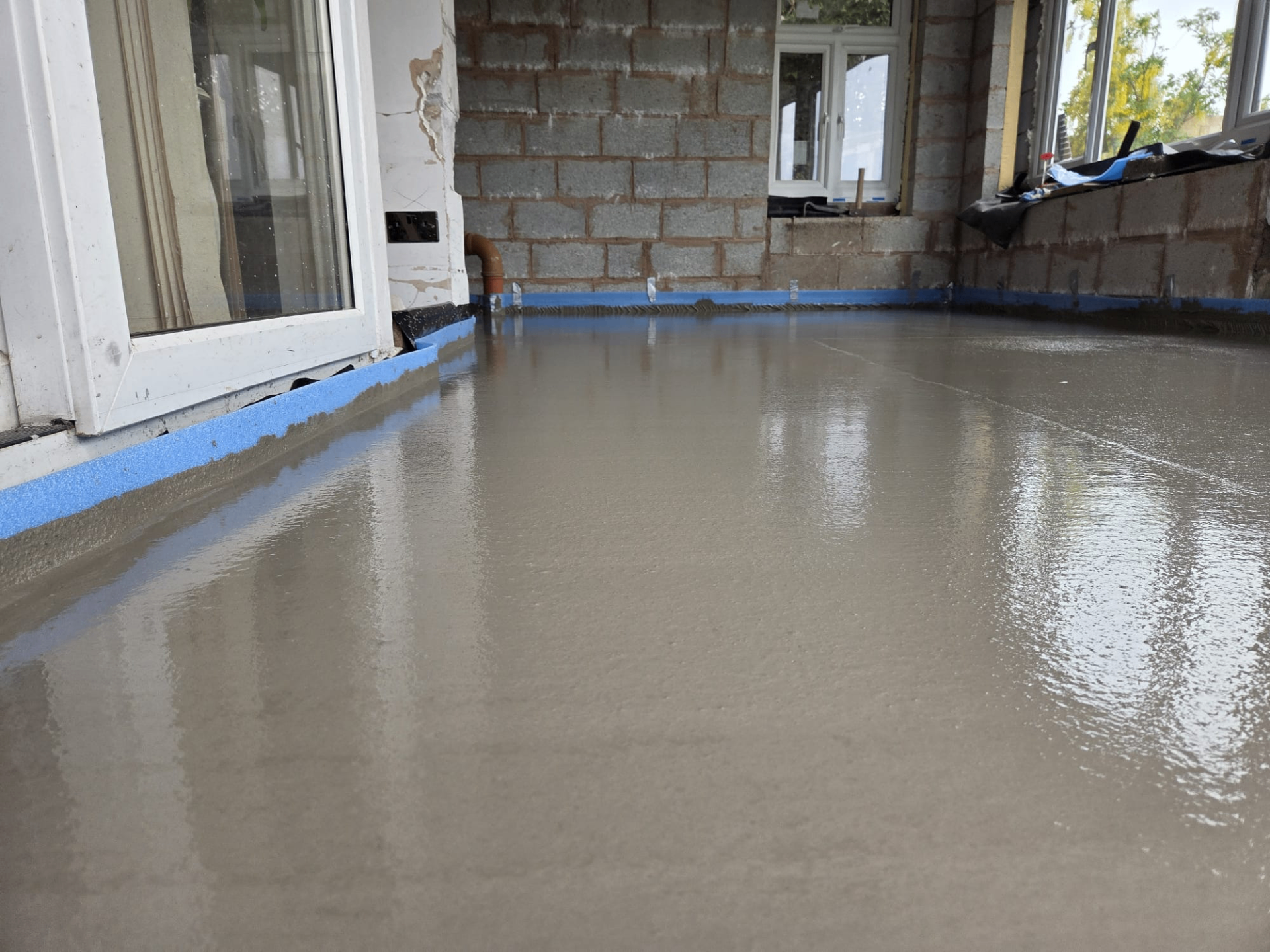
Depth over UFH pipes — your questions
In short
Cover depth over UFH pipes is a distinct figure from overall screed depth and must satisfy both the pipe manufacturer's and screed manufacturer's requirements.
Coordinating UFH and screed depth?
We regularly work alongside heating installers to confirm pipe cover and overall depth before the pour.