
Site logistics & risk management
Pouring Screed on a Restricted-Access Site
Liquid screed's biggest advantage — it can be pumped almost anywhere — is also what makes it the right answer on sites where a mixer lorry simply can't get near the door.
Got a difficult-access site?
Name, phone, email — we'll reply the same working day with a fixed price.
Or call our landline on 01392 237700
Not every site has a driveway wide enough for a mixer or space for a pour to happen in the room being screeded. Terraced houses on narrow Exeter streets, rural Devon lanes, listed buildings with restricted vehicle access, and upper-floor apartment pours all present the same underlying challenge: getting a liquid screed mix from a pump to a floor that a normal delivery vehicle can't reach.
This is one of the areas where liquid screed genuinely outperforms sand-and-cement, because it can be pumped through hose rather than barrowed by hand. But restricted access still needs proper planning — hose run length, pump siting, parking, and neighbour consideration all have to be worked out before the pour date, not on the morning of it.
This page covers how we approach a restricted-access site survey and what options exist when access is genuinely difficult.
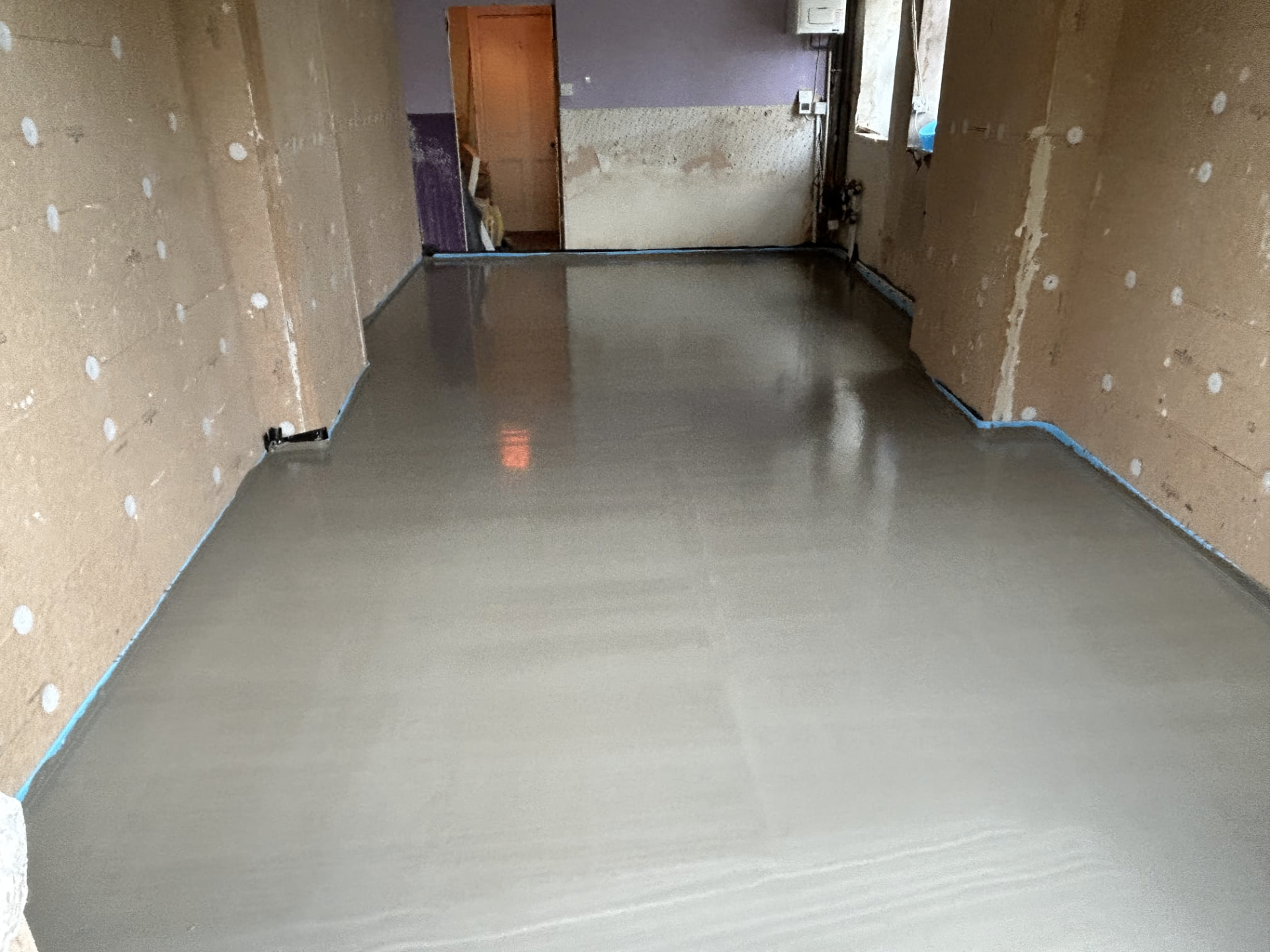
What we check on a restricted-access site visit
- Where the pump itself can realistically be sited — road, driveway or neighbouring land
- Total hose run distance and whether it needs boosting for longer runs
- Vertical lift required for upper-floor or multi-storey pours
- Any parking suspension or access permit needed from the local authority
- Protection needed for existing finishes the hose route passes through
What liquid screed pumping typically manages
up to 150m+
Typical horizontal hose run
multiple storeys, pump-dependent
Vertical lift
roughly one car parking space
Pump footprint needed
standard van/lorry width
Access width needed for the pump vehicle
Got a difficult-access site?
Tell us about the property and we'll arrange a site visit to work out pump siting, hose runs and any permissions needed before we quote.
Or call our landline on 01392 237700
How we plan a difficult-access pour
- 1
Site survey
We walk the route from likely pump position to the pour area and measure the actual hose run and any lift required.
- 2
Confirm parking and permissions
For street parking or narrow lanes, we advise early on any council permit or resident liaison needed.
- 3
Protect the route
Existing floors, doorways and stairwells along the hose route are protected before the pour begins.
- 4
Sequence the pour
On tight sites we sequence room by room to manage hose repositioning without disrupting the whole pour.
We've poured through terraced houses, over garden walls and up three storeys of hose. Difficult access is rarely a reason liquid screed can't work — it's a reason to plan the day properly.
— Exeter Liquid Screeders
Screed Pours on Restricted-Access Sites — questions we get asked
Keep reading across the site
Got a difficult-access site?
Tell us about the property and we'll arrange a site visit to work out pump siting, hose runs and any permissions needed before we quote.