
UFH handover
Commissioning Underfloor Heating After a Screed Pour
Turning the heating on too soon, or too fast, is one of the few ways a well-poured screed can still fail — commissioning has its own strict sequence.
Get a commissioning plan for your UFH
Name, phone, email — we'll reply the same working day with a fixed price.
Or call our landline on 01392 237700
A liquid screed can be poured perfectly, dry within programme, and still crack or debond if the underfloor heating is switched on the wrong way afterwards. Commissioning isn't a formality — it's a controlled heat-up curve that lets the screed adjust to heat gradually rather than being shocked into rapid expansion.
Manufacturer commissioning requirements vary slightly by product, but the underlying principle is the same everywhere: a slow start, a controlled ramp, and never before the screed has reached the required moisture content, regardless of how dry it looks on the surface.
This page sets out the commissioning sequence we specify, how it's recorded, and why skipping it risks both cracking and your product warranty.
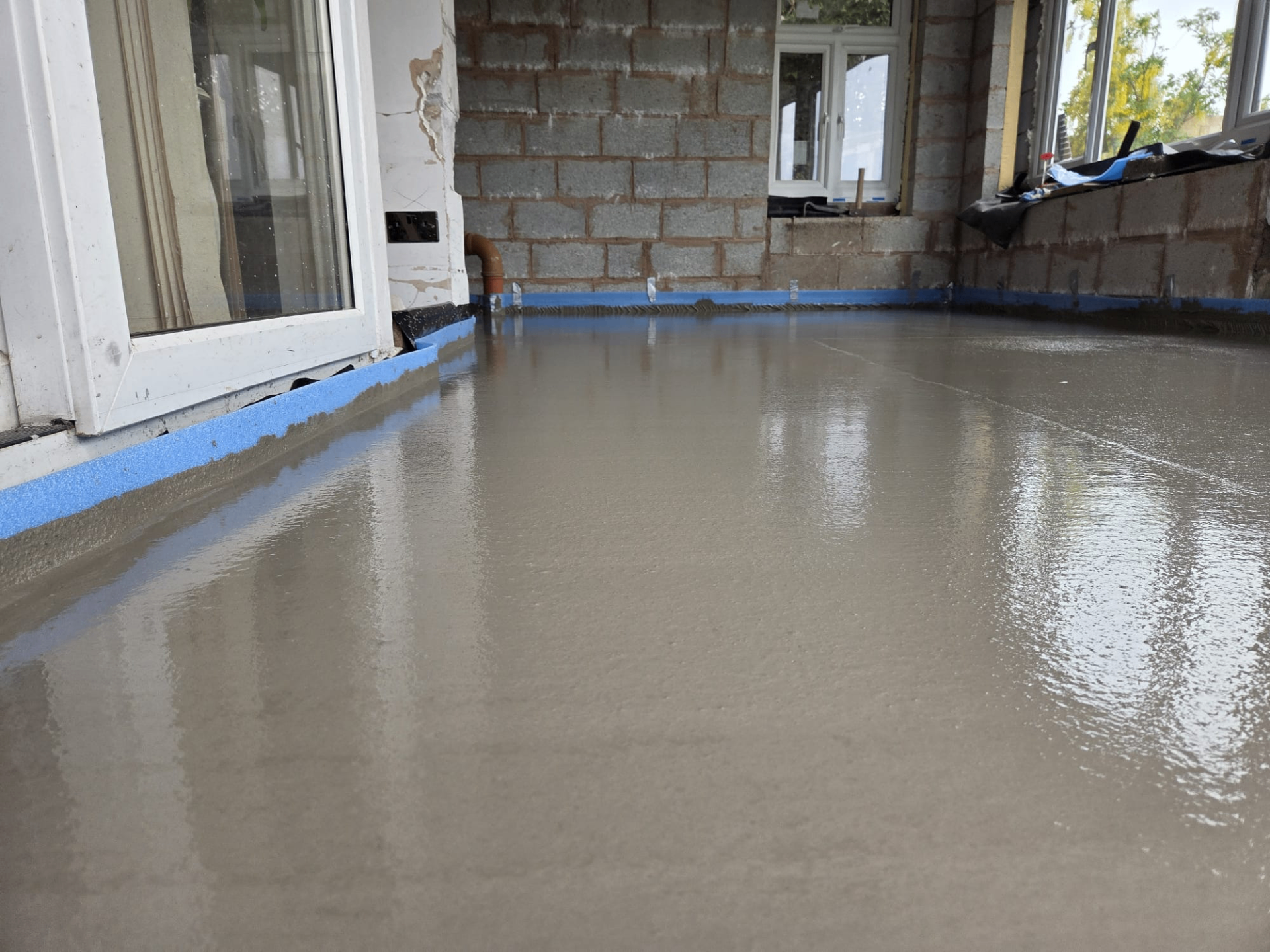
The standard commissioning sequence
- 1
Confirm moisture content
The screed is tested (hygrometer or carbide method) to confirm it's below the manufacturer's threshold before heat-up starts, not just visually dry.
- 2
Initial low-temperature start
Flow temperature starts low, typically 20–25°C, held for several days to begin drawing out residual moisture gently.
- 3
Stepped ramp-up
Flow temperature is increased in small steps, usually 5°C every 24 hours, up to the design operating temperature.
- 4
Hold at design temperature
The system runs at full design flow temperature for a set period to fully condition the screed before floor coverings are laid.
- 5
Controlled cool-down before flooring
Temperature is stepped back down before floor coverings go in, then the heating is reintroduced gradually once they're installed.
Typical commissioning figures
20–25°C
Initial flow temp
~5°C per day
Ramp rate
several days minimum
Hold at max design temp
full commissioning log
Record kept
Get a commissioning plan for your UFH
Tell us the screed type and UFH manifold spec and we'll provide the correct heat-up curve and a commissioning log template.
Or call our landline on 01392 237700
Why skipping steps causes real damage
- Rapid heat-up expands the screed quickly and unevenly, risking cracking
- Heating before moisture content is confirmed can trap residual moisture under floor coverings
- Missing the pre-flooring heat-and-cool cycle can cause movement after coverings are laid, telegraphing through finishes
- Manufacturers typically require a documented commissioning log to maintain the product warranty
- An uncontrolled first heat-up is one of the few post-pour actions that can undo an otherwise perfect installation
The commissioning record isn't paperwork for its own sake — it's the evidence that the screed was brought up to temperature correctly, which is exactly what a warranty claim will ask for if anything goes wrong later.
— Exeter Liquid Screeders
Commissioning UFH — questions we get asked
Keep reading across the site
Get a commissioning plan for your UFH
Tell us the screed type and UFH manifold spec and we'll provide the correct heat-up curve and a commissioning log template.