
Acoustic performance
Acoustic Screed and Flanking Noise Explained
A failed Part E sound test often isn't a screed problem at all — it's noise flanking around the edges through a gap the screed detail was supposed to close.
Get your acoustic floor build-up reviewed
Name, phone, email — we'll reply the same working day with a fixed price.
Or call our landline on 01392 237700
Acoustic floors in flats, conversions and party-wall builds depend on more than just an acoustic mat and a floating screed layer above it. If sound tests fail, the cause is very often flanking transmission — noise travelling around the isolated floor through a rigid bridge somewhere at the perimeter — rather than a fault in the screed itself.
This is a genuinely common misdiagnosis. A contractor sees a failed test, assumes the screed build-up is wrong, and specifies a change that doesn't address the actual leak path. Understanding flanking transmission first saves time and cost.
This page covers where flanking paths typically occur around a screed, how we detail against them, and what to check if a test has already failed.
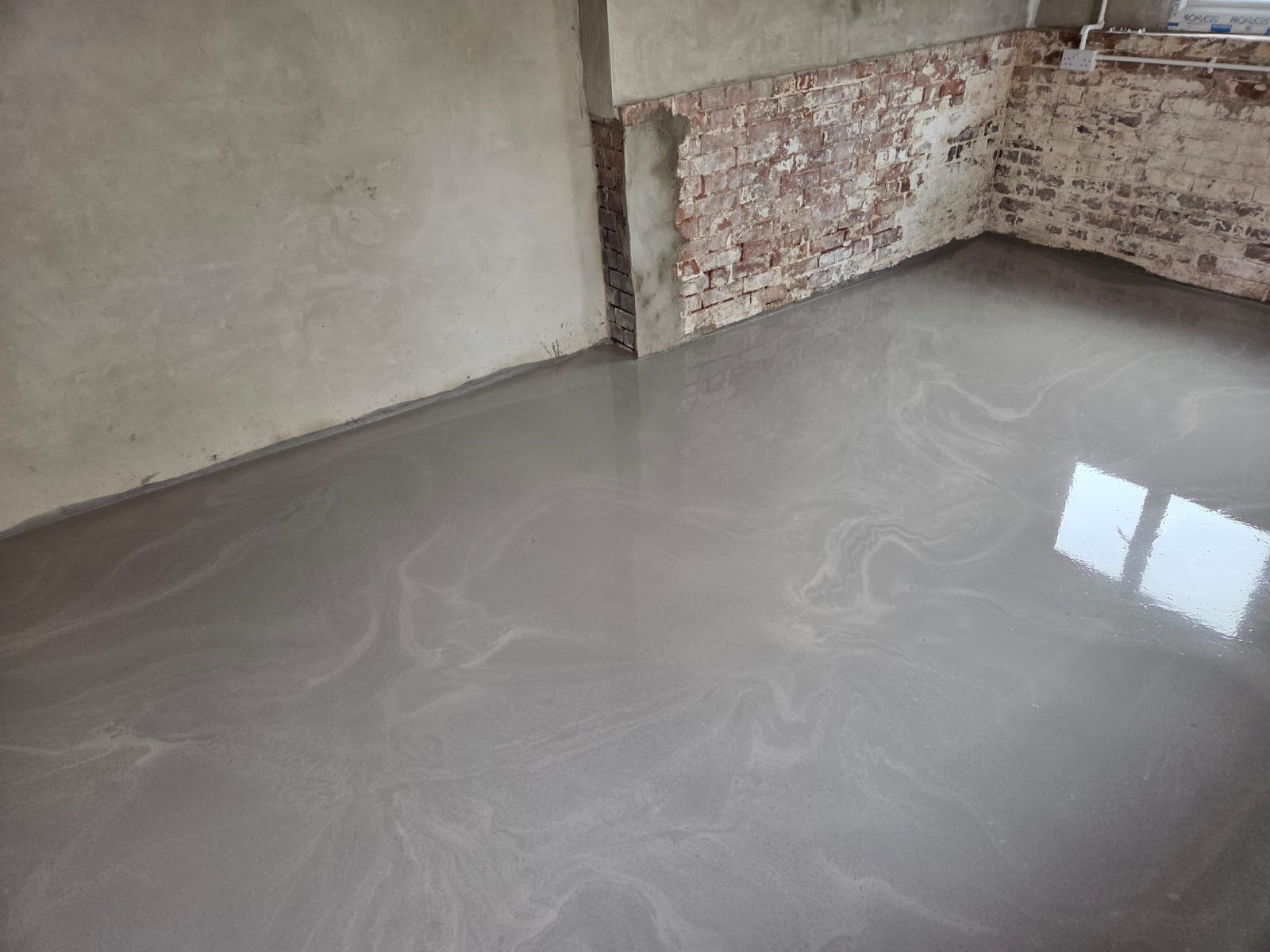
Common flanking paths around an acoustic screed
- Screed bridging the perimeter isolation strip and touching the wall directly
- Skirting fixed through the floating layer into the structural slab below
- Services (pipes, cables) passing rigidly through the isolation layer without a sleeve
- Door thresholds detailed without a break in the floating system
- Acoustic mat compressed or torn during the screed pour, losing its isolating properties
How we detail against flanking transmission
- 1
Continuous isolation strip
A perimeter isolation strip runs unbroken around every wall and column the floating floor meets.
- 2
Mat protection during pour
The acoustic mat is protected from puncture and compression while insulation and reinforcement go down.
- 3
Service sleeving
Any pipe or cable crossing the isolation layer is sleeved so it doesn't create a rigid bridge.
- 4
Skirting detail check
Skirtings are specified to fix to the wall only, never through the floating screed into the slab.
- 5
Threshold detailing
Door thresholds maintain the isolation gap rather than closing it with a rigid strip.
Symptom vs likely cause
| Test result | Likely cause |
|---|---|
| Failed impact sound test, screed itself correct depth | Perimeter isolation bridged somewhere on site |
| Failed airborne sound test | Often relates to the wall/floor junction, not the screed layer |
| Inconsistent results across rooms | Localised bridging — a single skirting fixing or service penetration |
| Consistent failure across all rooms | Systemic detailing issue — isolation strip type or mat spec |
Get your acoustic floor build-up reviewed
Send us the acoustic system spec and any test results and we'll help identify whether the issue is the screed or a flanking path.
Or call our landline on 01392 237700
Before anyone touches the screed spec, walk the perimeter and check every place the floating layer meets something rigid. That's where flanking noise almost always gets in.
— Exeter Liquid Screeders
Acoustic & Flanking Noise — questions we get asked
Keep reading across the site
Get your acoustic floor build-up reviewed
Send us the acoustic system spec and any test results and we'll help identify whether the issue is the screed or a flanking path.