
Structural cracking
Screed Cracking Across a Doorway or Threshold
A crack that runs neatly across a doorway or narrow opening is one of the most predictable places for a screed to crack — and one of the easiest to prevent at design stage.
Get a doorway crack assessed
Name, phone, email — we'll reply the same working day with a fixed price.
Or call our landline on 01392 237700
Doorways and narrow openings between rooms are structurally the weakest point in a screed pour. The floor necks down to a narrow section, which concentrates any shrinkage or thermal movement stress right where the crack width is smallest and least able to spread that stress out — so it cracks in a straight line, usually right across the opening.
This is a well-understood behaviour in the industry, and a good screed design anticipates it with movement joints. When we're called out to a doorway crack, it's almost always because a joint wasn't included, wasn't positioned correctly, or was designed for a different room layout than what actually got built.
Here's what causes it, how we assess whether it's cosmetic or structural, and the repair options depending on which flooring is going over it.
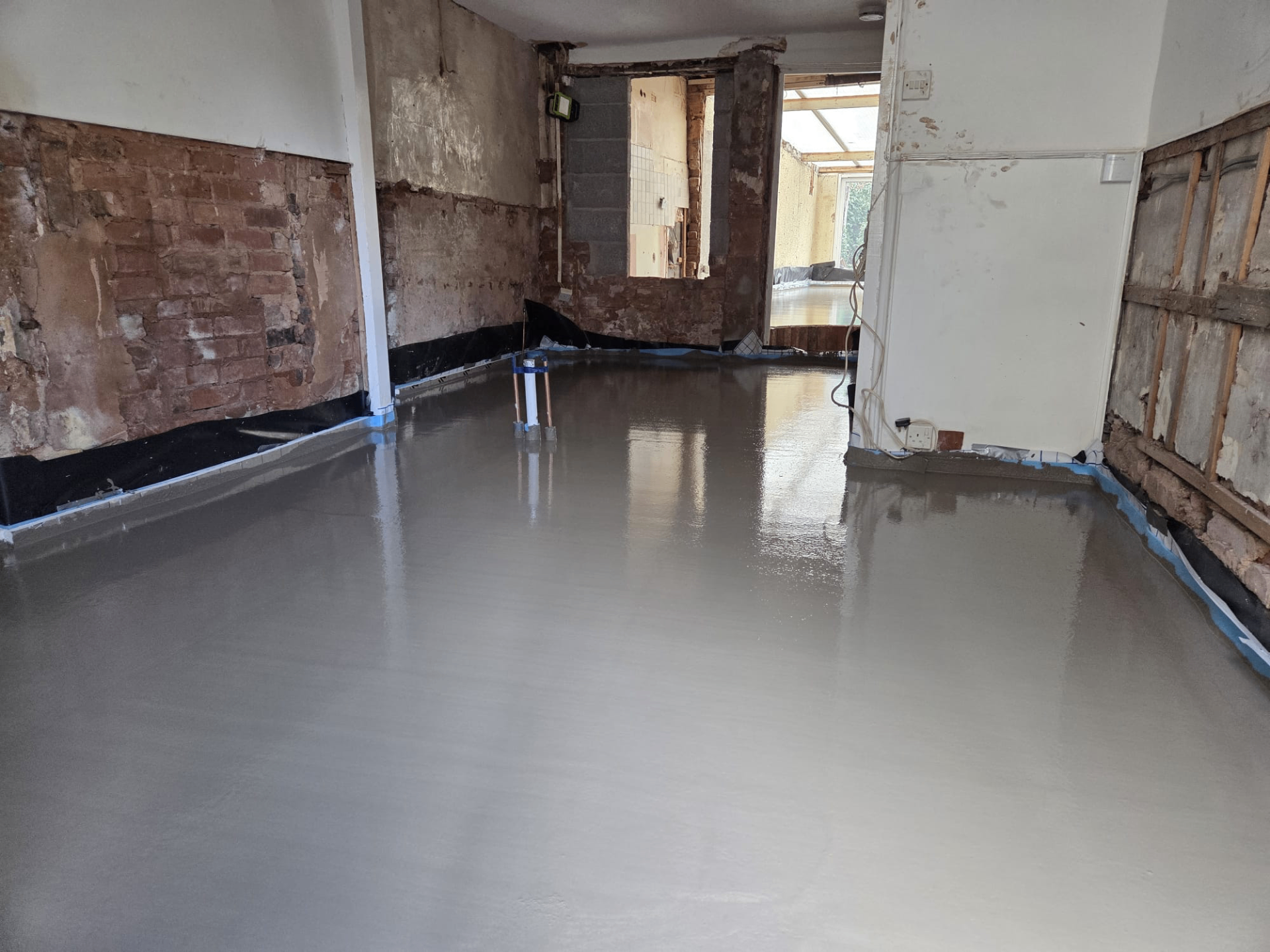
Why doorways crack more than open floor
- The floor area necks down, concentrating shrinkage stress in a narrow band
- No movement joint installed at the opening during the original pour
- Different room temperatures either side causing differential movement
- Door thresholds and adjoining slabs restraining the screed unevenly
- Two separate pours meeting at the doorway without a proper joint detail
Cosmetic hairline vs structural crack
Cosmetic hairline
- Hairline width, no movement underfoot
- Consistent width along its length
- No debonding either side of the crack
Structural / active crack
- Visible width, edges lippage under load
- Widens or changes with temperature
- Hollow sound either side when tapped
Get a doorway crack assessed
Send a photo and we'll tell you whether it's cosmetic or needs a movement joint before you cover the floor.
Or call our landline on 01392 237700
How we repair a doorway crack
- 1
Assess movement
We check whether the crack is stable or still active before choosing a repair method.
- 2
Rout and fill
Stable hairline cracks are routed out and filled with a flexible resin to prevent recurrence.
- 3
Install a retrofit movement joint
For active cracks, a proper movement joint is cut and fitted to take future stress instead of the screed.
- 4
Reinstate the finish
The repair is finished flush and ready for whatever flooring is specified over it.
A movement joint at every doorway isn't optional extra — it's standard good practice on any screed over about 40m² or with a change in room shape. We flag this at quote stage, every time.
— Exeter Liquid Screeders
Screed Cracks Over Doorway — questions we get asked
Keep reading across the site
Get a doorway crack assessed
Send a photo and we'll tell you whether it's cosmetic or needs a movement joint before you cover the floor.