
Fault Diagnosis
Frost Damage to Freshly Poured Liquid Screed
Freezing conditions acting on a liquid screed before it has gained sufficient strength can disrupt the hydration process and cause surface weakness, scaling or a general failure to achieve proper strength.
Poured during cold weather and worried about the result?
Share your pour date and any site temperature records you have and we can help assess whether frost damage is a concern.
Or call our landline on 01392 237700
Cementitious and calcium sulfate liquid screeds both rely on a chemical hydration reaction to gain strength, and that reaction is temperature-dependent: it slows significantly in cold conditions and can be seriously disrupted if the mix freezes before it has developed enough early strength to resist ice formation within its pore structure. On a site without adequate temperature control during a cold snap, this is a genuine risk rather than a theoretical one.
Frost damage typically shows up as a soft, friable, or dusting surface, sometimes with visible scaling or flaking where ice crystals have disrupted the surface layer as they formed and later thawed. In more severe cases, strength development across the whole depth of the screed can be affected, not just the surface.
Because the risk window is specifically the early curing period before adequate strength has developed, site temperature records for the days immediately following a pour are the key piece of evidence when frost damage is suspected.
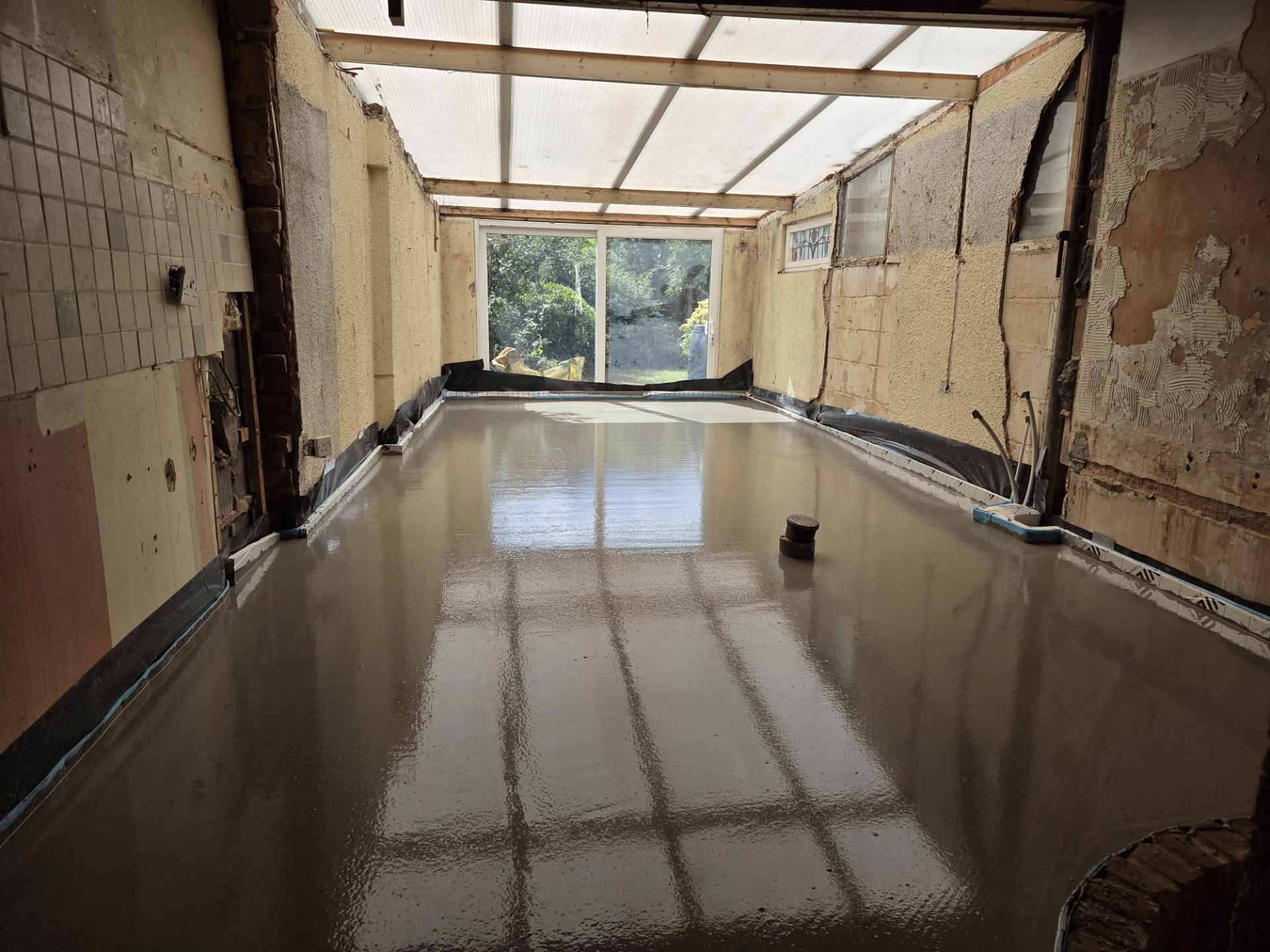
Why cold weather is a genuine risk during curing
As a liquid screed hydrates, the reaction generates a limited amount of heat and gradually builds a strong internal structure, but this process needs the mix to stay above a minimum temperature to proceed at a reasonable rate. If ambient and material temperatures drop towards freezing before sufficient strength has developed, water within the mix can begin to freeze and expand, physically disrupting the developing structure at exactly the wrong stage of its formation.
This is why cold-weather pours are treated with particular caution, often requiring the site to be enclosed and heated, or the pour to be timed and monitored more closely than in milder conditions.
Recognising and addressing frost damage
A frost-damaged surface often looks and feels noticeably different from a correctly cured screed — softer underfoot, prone to dusting when rubbed, or showing visible flaking or scaling in patches. Tapping the surface can also reveal a hollow or less dense sound in affected areas compared with sound screed nearby.
The appropriate response depends on how deep the damage extends: surface-only disruption may be addressed by removing the compromised layer and reinstating it, while damage through the full depth of the screed generally means the affected area needs to be broken out and replaced, since its long-term strength cannot be relied upon.
Protective measures during cold-weather pours
Enclosing the building and running background heating before, during and for several days after a pour is the most reliable protection, since it keeps both the material and ambient air above the temperature at which hydration effectively stalls. Insulating exposed elevations and covering any openings temporarily can make a meaningful difference even on a site without full heating capability.
Some cementitious screed formulations include additives intended to assist strength gain in cooler conditions, but these are not a substitute for basic temperature protection and should be treated as a supplementary measure rather than the primary defence against frost.
Confirming the diagnosis and next steps
Where frost damage is suspected after the event, gathering whatever site temperature records exist for the pour date and the following days is the most useful evidence, alongside a visual and sounding survey of the affected area to establish how far the damage extends. Core samples can be taken in more serious or disputed cases to assess strength through the depth of the screed.
Once the extent is understood, agreeing a repair scope with the installer or a specialist promptly avoids the damaged area being covered by flooring before it has been properly addressed, since problems are far cheaper to resolve before finishes are committed.
Frost Damage — the points that decide it
- Hydration reactions that give screed its strength slow down significantly in cold weather
- Freezing before adequate early strength is reached can permanently disrupt the screed's structure
- Symptoms include a soft, dusting or scaling surface rather than a hard, sound finish
- Risk is highest during the first 24-48 hours after pouring, though it can extend longer in very cold conditions
- Enclosed, heated site conditions during cold weather pours significantly reduce this risk
- Frost damage affecting only the surface may be addressed by removing the damaged layer
- Damage extending through the full depth generally requires the affected area to be replaced
- Site temperature logs kept during a winter pour are valuable evidence if damage is later suspected
- A screed contractor experienced with cold-weather pours can advise on protection measures before the next one
Poured during cold weather and worried about the result?
Share your pour date and any site temperature records you have and we can help assess whether frost damage is a concern.
Or call our landline on 01392 237700
Frost Damage — your questions
In short
Freezing conditions acting on a liquid screed before it has gained sufficient strength can disrupt the hydration process and cause surface weakness, scaling or a general failure to achieve proper strength.
Poured during cold weather and worried about the result?
Share your pour date and any site temperature records you have and we can help assess whether frost damage is a concern.