
The drying question, answered properly
How Long Does Screed Take to Dry?
This is the question every client asks first, and it deserves more than a one-line answer. Here's the whole picture.
Get a drying timeline for your job
Name, phone, email — we'll reply the same working day with a fixed price.
Or call our landline on 01392 237700
"How long does screed take to dry?" is the single most searched question in the trade, and the honest answer is that it depends on which drying you mean. Walking on a screed, laying a floor covering on it, and turning on underfloor heating are three different milestones with three different timescales, and mixing them up is where most site delays and disputes start.
It also depends heavily on which screed you've got. A calcium sulphate (anhydrite) screed and a cement-based screed such as Cemfloor behave differently as they dry, and a rule of thumb that's roughly right for one can be badly wrong for the other.
This page sets out the real mechanics of screed drying, the rule everyone quotes and where it stops applying, how drying is actually measured, and a realistic timeline you can plan a programme around.
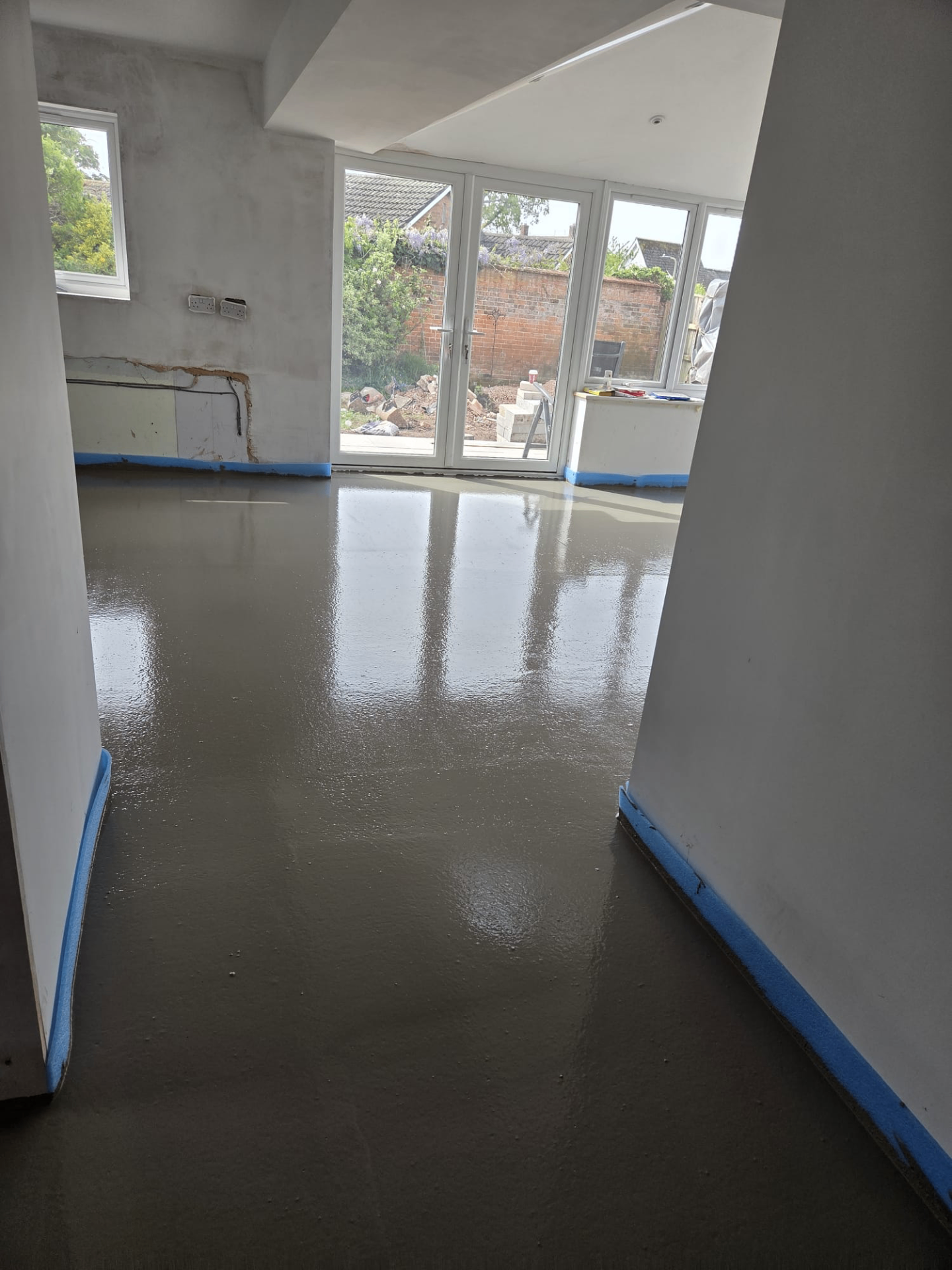
The three different "dry" milestones
- Walk-on / foot traffic — the surface has hardened enough to take careful foot traffic, typically 24 to 48 hours for Cemfloor and around 48 hours for anhydrite
- Trades-ready — other trades can work in the room without damaging the surface, usually a few days after pouring, once directed traffic boards are used
- Dry for coverings — the whole depth has released enough moisture for a specific floor finish, which can be weeks or months depending on depth and screed type
- Ready for UFH commissioning — a separate check, since heating pipework can be tested for leaks early but shouldn't be used to force-dry the slab before roughly seven days
Cement-based vs calcium sulphate: two different drying stories
Cemfloor and other cement-based liquid screeds cure by hydration and then dry by evaporation. They're generally quicker to reach a walkable state and often quicker to reach the 75% relative humidity threshold needed for impermeable coverings, frequently within a similar window to good-quality cement sand screeds but with more consistency because of the flowing application.
Calcium sulphate (anhydrite, including Gyvlon and Gypsol) screeds dry more predictably in some respects because they don't require the same curing regime, but they release water more slowly at depth, need any laitance sanded off before flooring, and are more sensitive to being covered before they've genuinely dried through.
Neither type is simply "faster" or "better" for drying in every case — depth, ventilation and the base build-up matter more than which chemistry is under your feet.
The 1mm-a-day rule, and where it breaks down
The rule most commonly quoted in the industry is roughly 1mm of drying depth per day for the first 40 to 50mm, assuming reasonable ambient conditions with airflow and moderate heat. On that basis a 40mm screed might be broadly dry in around 40 to 50 days under good conditions.
Past that first 40 to 50mm, the rule slows down significantly rather than continuing linearly. Moisture has to migrate further through denser, less porous material to reach the surface, so drying rate roughly halves for material beyond that depth, and a 75mm screed can easily take considerably longer than 75 days to dry through fully rather than the naive 75 implied by a straight 1mm-a-day calculation.
The rule is also only ever a planning guide, never a substitute for testing. Cold, still, humid site conditions can stretch drying times well beyond the rule of thumb, while a well-ventilated, heated site can beat it.
What actually controls drying speed
| Factor | Effect |
|---|---|
| Relative humidity of site air | High RH air can't absorb moisture from the screed; ventilation with drier air is essential |
| Air movement across the surface | Still air lets a saturated boundary layer form at the surface, slowing evaporation dramatically |
| Ambient temperature | Warmer air holds more moisture and speeds evaporation, within sensible limits |
| Screed depth | Moisture has to travel further from the base of a deep pour, so drying time is not linear with depth |
| Membrane or insulation below | A DPM or insulation layer means the screed can only dry upwards, doubling the effective drying path in some builds |
Get a drying timeline for your job
Tell us your screed type, depth and site conditions and we'll give you a realistic drying and testing programme, not a generic guess.
Or call our landline on 01392 237700
How drying is actually measured
- 1
Visual and time-based estimate
Useful for planning only. Never sufficient on its own to hand a floor over to a covering.
- 2
Hygrometer test to BS 8203
A sealed box or probe measures the relative humidity of the air just above the screed surface after equilibration, giving a %RH reading used to judge readiness for impermeable coverings.
- 3
Carbide (CM) test
A crushed sample reacts with calcium carbide to give a moisture content percentage; commonly used for cement screeds against a 1% CM threshold and occasionally specified for anhydrite.
- 4
Written record before covering
Results should be logged against location, date, and covering type before any flooring goes down, protecting everyone if a dispute arises later.
Realistic drying timeline (indicative, site-condition dependent)
| Milestone | Typical timescale |
|---|---|
| Foot traffic, Cemfloor | 24 to 48 hours |
| Foot traffic, anhydrite | Around 48 hours |
| Other trades back on site with protection | 3 to 7 days |
| Ready for force drying to begin (if needed) | Not before 7 days |
| Dry for cement screed under most tiling (1% CM) | Roughly 1mm per day up to 40-50mm depth, then slower |
| Dry for impermeable coverings (75% RH / 0.5% CM) | Often several weeks to a few months depending on depth and drying conditions |
Drying time is a range set by physics, not a fixed number set by a calendar — test the floor rather than guessing from the pour date.
— Exeter Liquid Screeders
How Long Does Screed Take to Dry — questions we get asked
More on costs and planning
Keep reading across the site
Get a drying timeline for your job
Tell us your screed type, depth and site conditions and we'll give you a realistic drying and testing programme, not a generic guess.