
Substrate preparation fault
Insulation Movement Under Screed
A liquid screed only performs as well as the floor it's poured onto. If the insulation moves during the pour, the screed above it inherits every gap.
Concerned about insulation movement under your screed?
Name, phone, email — we'll reply the same working day with a fixed price.
Or call our landline on 01392 237700
Before a liquid screed goes down, the insulation layer underneath — PIR, EPS or mineral wool boards — has to be laid tight, taped at the joints and pinned or weighted so it can't move. If it's not, the hydrostatic pressure of a liquid screed flowing across a floor can shift boards, open gaps, or float lighter boards entirely.
The result is a screed with inconsistent depth, occasional soft or hollow-sounding patches where the screed has sagged into a gap, and in bad cases a board that's tilted enough to create a visible dip on the finished surface.
This is a preparation issue, not a screed-mix issue, which is why it's worth understanding as its own problem: the fix is about the substrate as much as the pour itself.
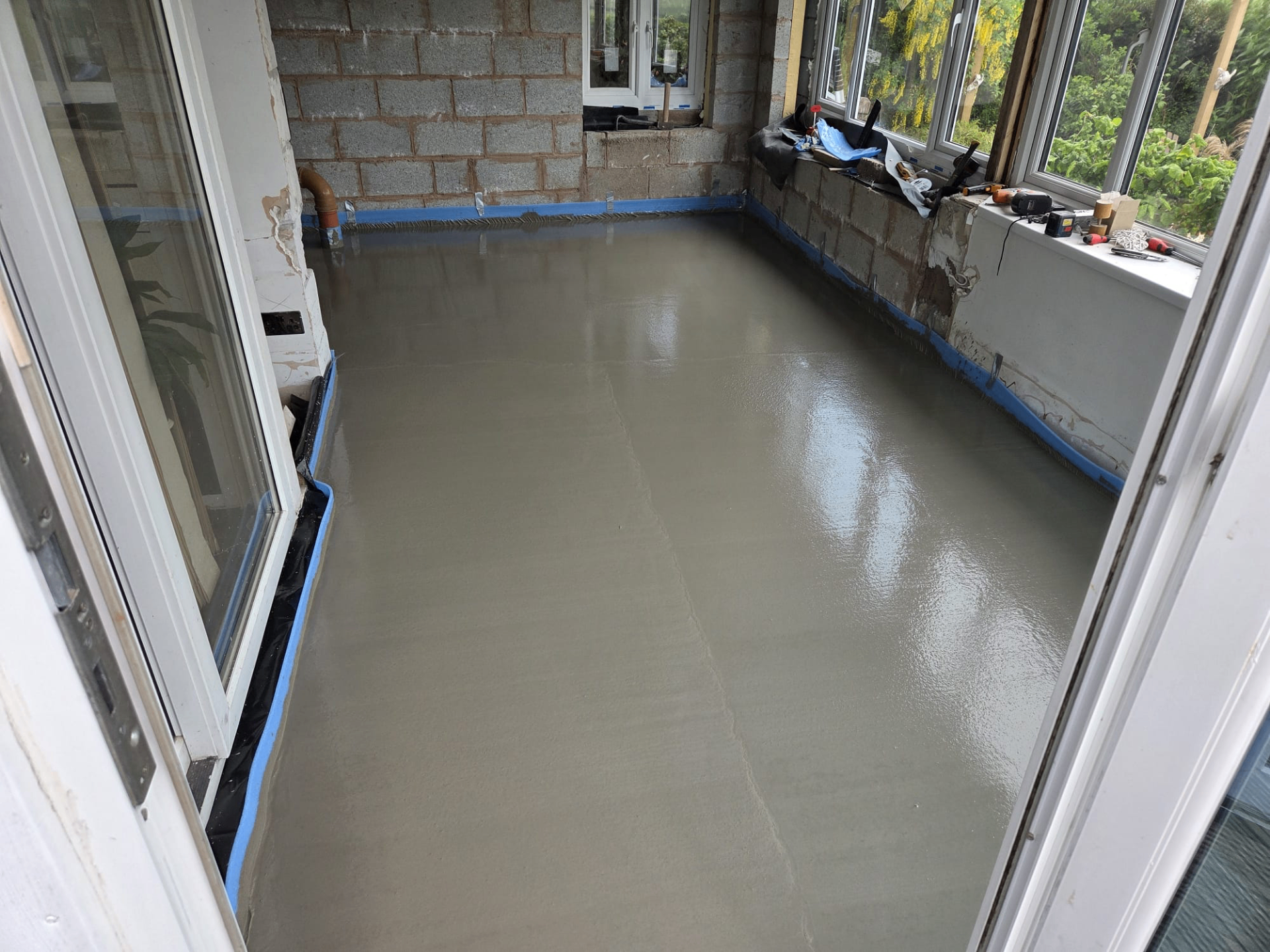
What causes insulation to move during a pour
- Boards laid loose without taping joints or fixing down
- Insufficient perimeter restraint allowing boards to drift sideways
- Uneven or debris-covered subfloor leaving boards unsupported at the edges
- Pour started too fast, creating a pressure wave across a large open area
- Lightweight EPS boards used without enough ballast or overlay membrane
How we check for it
- 1
Sounding survey
Tapping the finished screed reveals hollow-sounding areas that often correspond to a gap or void beneath a shifted board.
- 2
Core sample
A small core confirms whether the insulation below is intact, gapped or has been fully displaced.
- 3
Visual and level check
A laser survey identifies localised dips that align with suspected board movement rather than a general pour-quality issue.
Prevention vs cure
Getting it right before the pour
- Tape all board joints continuously
- Fix or ballast boards against float
- Check flatness of the subfloor first
- Pour in a controlled sequence, not one fast flood
If it's already happened
- Core and sound to map affected areas
- Cut out and relay insulation locally
- Re-pour the affected zone to correct depth
- Re-survey before covering
Concerned about insulation movement under your screed?
Send us photos or let us survey the floor, and we'll tell you honestly whether it's a cosmetic issue or one that needs remediation.
Or call our landline on 01392 237700
Ninety percent of insulation movement problems are prevented in the twenty minutes before the pour starts, not fixed afterwards. It's worth getting that prep right the first time.
— Exeter Liquid Screeders
Insulation Movement Under Screed — questions we get asked
Keep reading across the site
Concerned about insulation movement under your screed?
Send us photos or let us survey the floor, and we'll tell you honestly whether it's a cosmetic issue or one that needs remediation.