
Fault Diagnosis
Cracks at Internal Corners of a Liquid Screed Floor
Internal corners concentrate restraint stresses as screed shrinks, and cracking here is usually a sign that isolation detailing was missed rather than a material fault.
Seen a corner crack in your screed?
Send us a photo and the room layout and we can help you work out whether it is cosmetic restraint cracking or something that needs closer inspection.
Or call our landline on 01392 237700
Internal corners — where two walls meet, or where a chimney breast, stair enclosure or built-in cupboard projects into a room — are one of the most predictable places for a liquid screed to crack. As the screed dries and shrinks slightly, it wants to pull away evenly from the perimeter walls, but a re-entrant corner restrains that movement unevenly, concentrating tensile stress at the point of the angle.
This is a well-understood behaviour in monolithic floor slabs and screeds alike, and it is why perimeter isolation strips and correctly detailed corners matter more than they might appear to. A crack radiating diagonally from an internal corner, often forty-five degrees to the walls, is a classic restraint crack rather than a structural or subfloor defect.
The good news is that this type of cracking is largely preventable at installation stage, and where it does occur it is normally cosmetic rather than a sign of the floor's load-bearing capacity being compromised.
Why corners concentrate stress
A liquid screed shrinks very slightly as excess water leaves the mix during drying. Along a straight run of wall this shrinkage is uniform and the isolation strip simply allows the slight movement without transferring load into the wall. At an internal corner, however, the screed is restrained on two adjacent sides at once, so the stress has nowhere to relieve itself except by cracking through the body of the screed, usually along the bisecting diagonal of the angle.
This is the same mechanism seen in concrete ground-bearing slabs, and it is why re-entrant corners are flagged in guidance on slab design as locations needing additional detailing or control joints.
Getting the detailing right
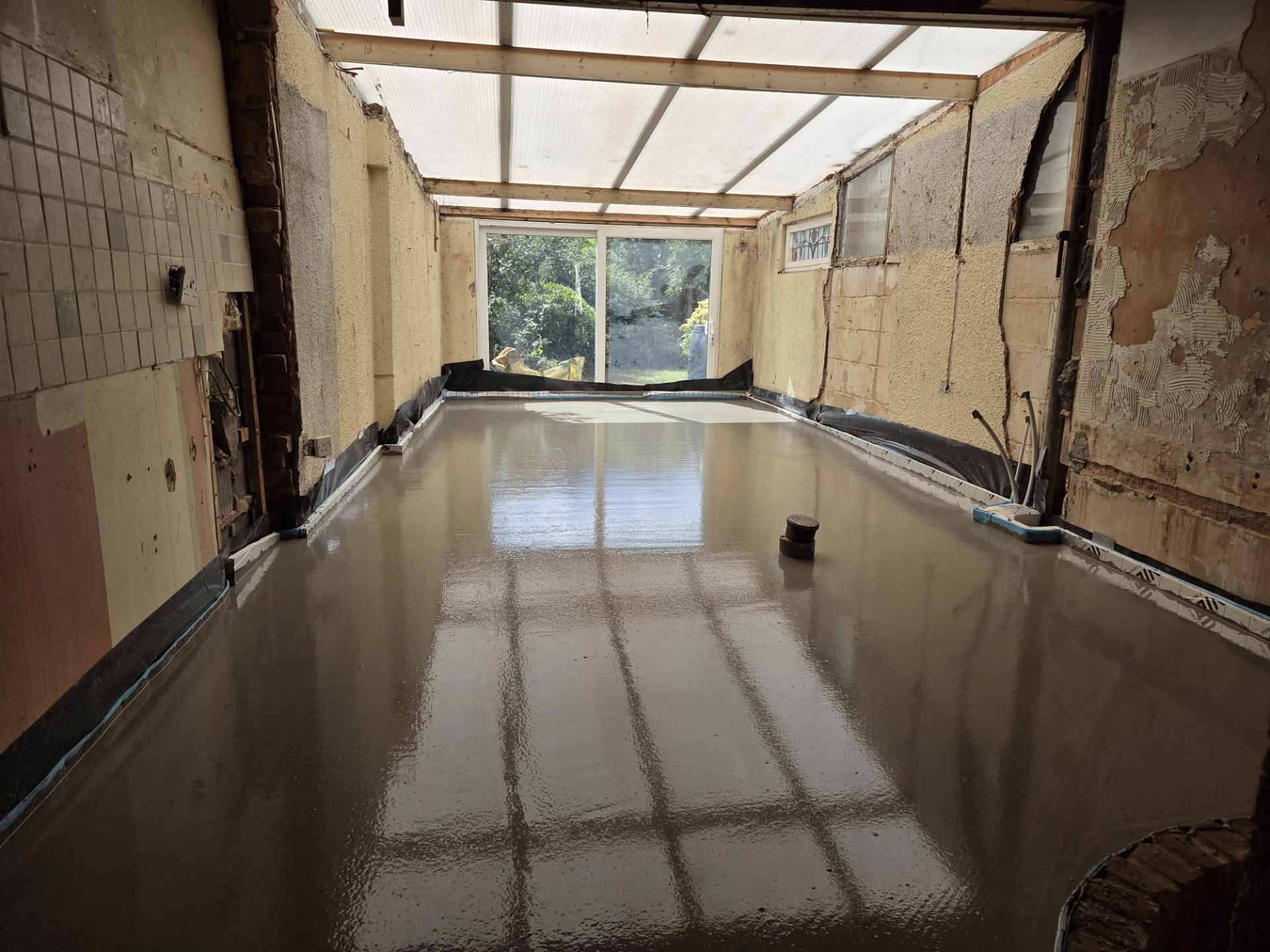
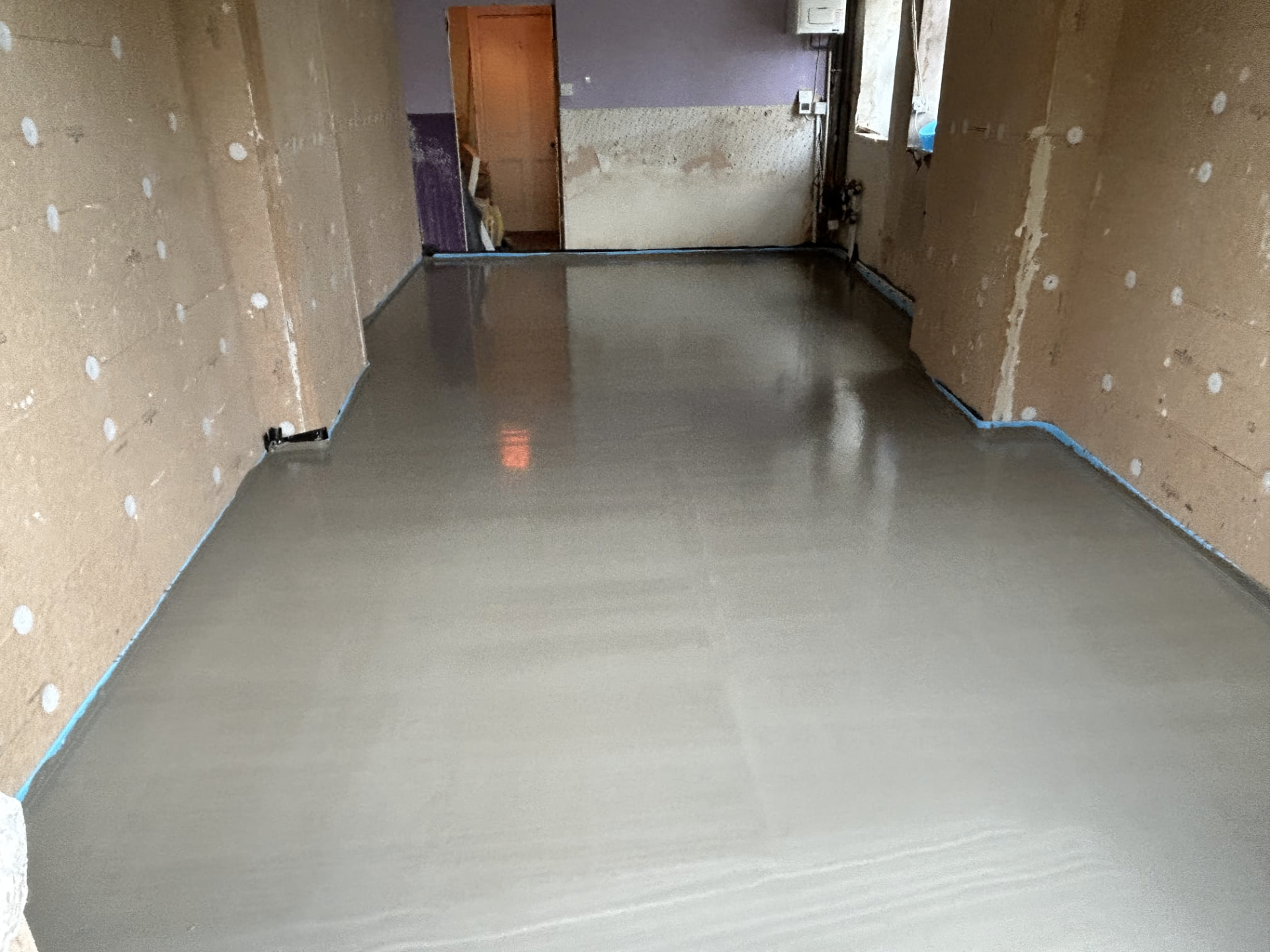
The isolation strip should run continuously around every column, pipe upstand, hearth and internal corner, not just the outer perimeter walls. Where a heavily re-entrant corner exists, some specifiers introduce a diagonal cut or additional joint at the corner deliberately, so that any shrinkage crack occurs neatly along a formed joint rather than randomly through the screed.
Where cracking has already occurred and the strip was fitted correctly, the priority is confirming the crack is static (not still moving) before deciding on a cosmetic repair, particularly under a rigid floor finish such as tile.
On-site diagnostic checks
A useful first step is measuring the crack width at several points along its length and marking the ends with a pencil line and date, then rechecking after a week or two to see whether it has extended or widened. A crack that has stopped moving is a much simpler proposition than one still opening, since ongoing movement points toward ground or subfloor issues rather than settled drying shrinkage.
Tapping either side of the crack with a hard object can also reveal whether the screed has begun to lift or delaminate near the corner, which would change the repair approach from a simple fill to something addressing the loss of bond beneath the surface.
Repair approaches once the cause is confirmed
For a static, cosmetic corner crack, a rigid or semi-rigid resin injected along the crack line, followed by surface finishing appropriate to the intended floor covering, is the usual route, restoring a sound surface without needing to lift the screed. Where the crack sits beneath a planned tile or stone finish, a crack-isolation membrane or a formed movement joint carried up through the tile bed is often added as extra insurance against future telegraphing.
Where the corner crack coincides with wider symptoms such as several cracks radiating from multiple corners, or hollow sounding areas nearby, it is worth stepping back and considering whether the isolation strip was omitted more broadly, which points toward a bigger discussion than a single localised repair.
Internal Corner Cracking — the points that decide it
- Diagonal cracks from internal corners are typically restraint cracks caused by drying shrinkage
- Isolation strips must be continuous around every projection, not just straight perimeter walls
- Sharp internal angles concentrate stress more than gently detailed junctions
- Cracking usually appears within the first weeks of drying as shrinkage develops
- The pattern is diagnostic: corner-radiating cracks point to restraint, not subfloor movement
- Reinforcement (fibre or mesh) can reduce crack width but will not eliminate the crack plane entirely
- Repair generally involves resin injection or a matched filler rather than replacing the floor
- A moisture and structural check should rule out subfloor movement before blaming restraint alone
- An experienced screed contractor or flooring inspector can usually confirm the pattern quickly on site
Seen a corner crack in your screed?
Send us a photo and the room layout and we can help you work out whether it is cosmetic restraint cracking or something that needs closer inspection.
Or call our landline on 01392 237700
Internal Corner Cracking — your questions
In short
Internal corners concentrate restraint stresses as screed shrinks, and cracking here is usually a sign that isolation detailing was missed rather than a material fault.
Seen a corner crack in your screed?
Send us a photo and the room layout and we can help you work out whether it is cosmetic restraint cracking or something that needs closer inspection.