
Screed vs exposed concrete finish
Screed vs Power-Floated Concrete Floors
Power-floated concrete skips the screed layer entirely and finishes the structural slab itself. It's a different build philosophy, not just a different product.
Not sure which finish suits your slab?
Name, phone, email — we'll reply the same working day with a fixed price.
Or call our landline on 01392 237700
Power-floated concrete finishes the structural slab directly with a mechanical trowel, producing a hard-wearing exposed floor without a separate screed layer on top. Liquid screed, by contrast, is a dedicated flooring layer poured over insulation or an existing slab, usually to receive UFH pipework or a floor covering.
They get compared because both can end up as a smooth, flat, industrial-look floor — but power-floated concrete is a structural finish, while screed is a functional layer that's often covered by tile, LVT or carpet.
The right choice depends on whether you want the slab itself as the visible floor, and whether UFH or a covering is part of the plan.
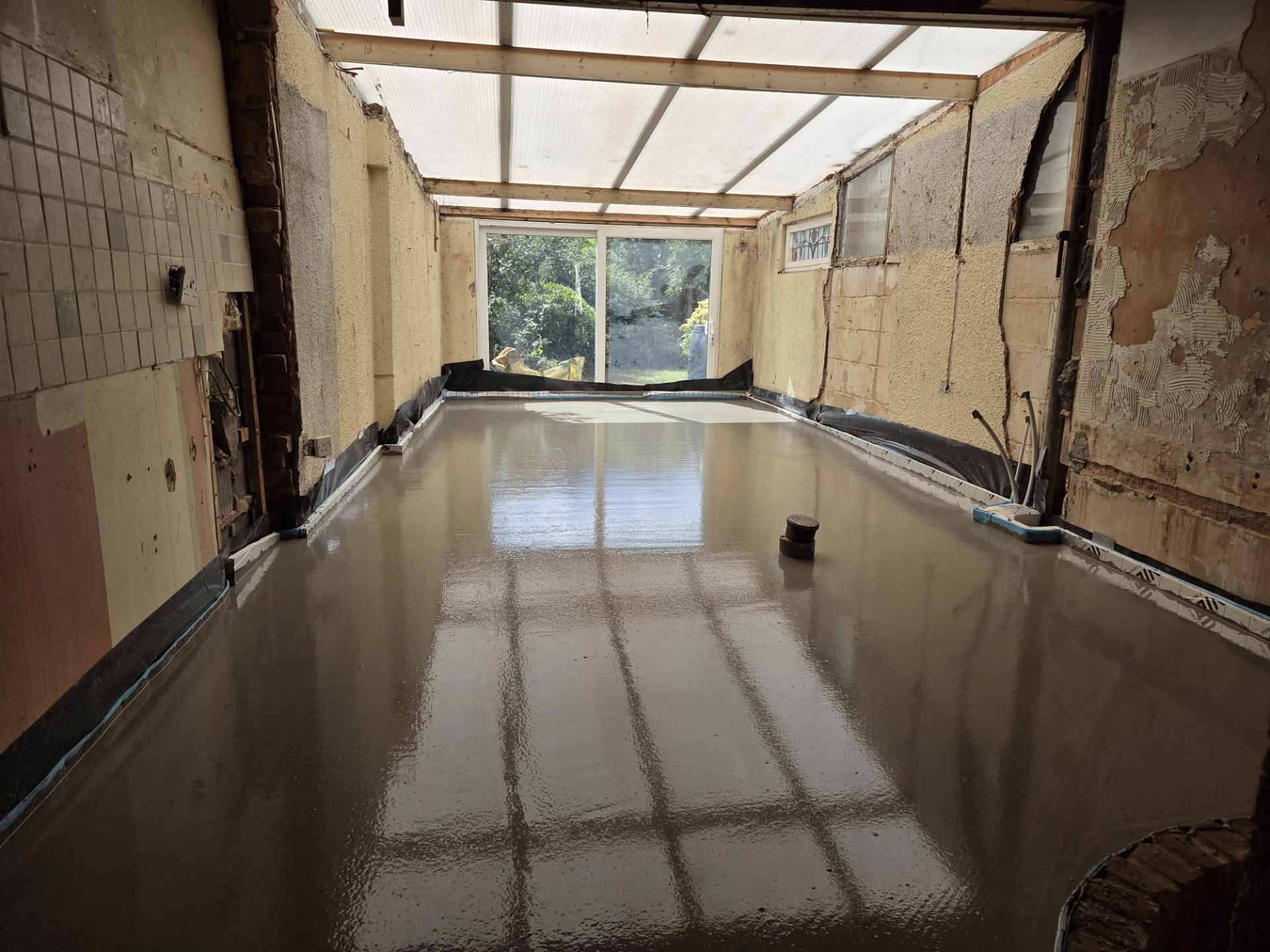
Power-floated concrete vs liquid screed
Power-floated concrete
- Slab is the finished floor — no covering
- Very hard-wearing, industrial aesthetic
- No separate screed layer needed
- Limited flexibility for later UFH retrofit
Liquid screed
- Designed to receive UFH and floor coverings
- Can be poured over insulation for thermal performance
- Much better flatness tolerance (SR1)
- Works with tile, LVT, carpet or engineered wood
Where power-floated concrete makes sense
- Warehouses, workshops and garages with no floor covering planned
- Budget-led industrial units where aesthetics are secondary to durability
- Self-build projects wanting an exposed polished-concrete look without a separate finish layer
Where liquid screed is the only sensible choice
- Any residential project with UFH
- Anywhere tile, LVT, carpet or wood is the planned finish
- Renovation floors needing SR1 flatness for a demanding covering
Not sure which finish suits your slab?
Tell us the intended use of the space and whether UFH or a covering is planned, and we'll advise honestly on screed vs a power-floated finish.
Or call our landline on 01392 237700
The decision test
If the concrete slab itself is the finished floor and no covering or UFH is planned, power-floating is the simpler, cheaper route.
If UFH is involved, or any covering is going down, or you need genuine SR1 flatness, a liquid screed is the correct layer — power-floated concrete alone won't achieve the same tolerance or thermal performance.
Screed vs Power-Floated Concrete — questions we get asked
Keep reading across the site
Not sure which finish suits your slab?
Tell us the intended use of the space and whether UFH or a covering is planned, and we'll advise honestly on screed vs a power-floated finish.