DIY vs professional
DIY Self-Levelling Compound vs Professional Liquid Screed
A bag of self-levelling compound and a pumped liquid screed pour solve related but different problems — mixing them up is a common and costly mistake.
Not sure which route suits your project?
Name, phone, email — we'll reply the same working day with a fixed price.
Or call our landline on 01392 237700
Homeowners searching for a DIY floor levelling solution often land on self-levelling compound sold in 20kg bags at builders' merchants, then wonder whether it's a substitute for a proper liquid screed. It usually isn't, and the confusion is understandable given both pour and self-level to a flat finish.
Bag-mixed compound is designed for thin applications — typically a few millimetres up to around 10–15mm — smoothing an existing subfloor before flooring goes down. A professionally pumped liquid screed is a structural floor layer in its own right, poured tens of millimetres thick and engineered to carry UFH and long-term loading.
Here's an honest comparison of what each is actually good for.
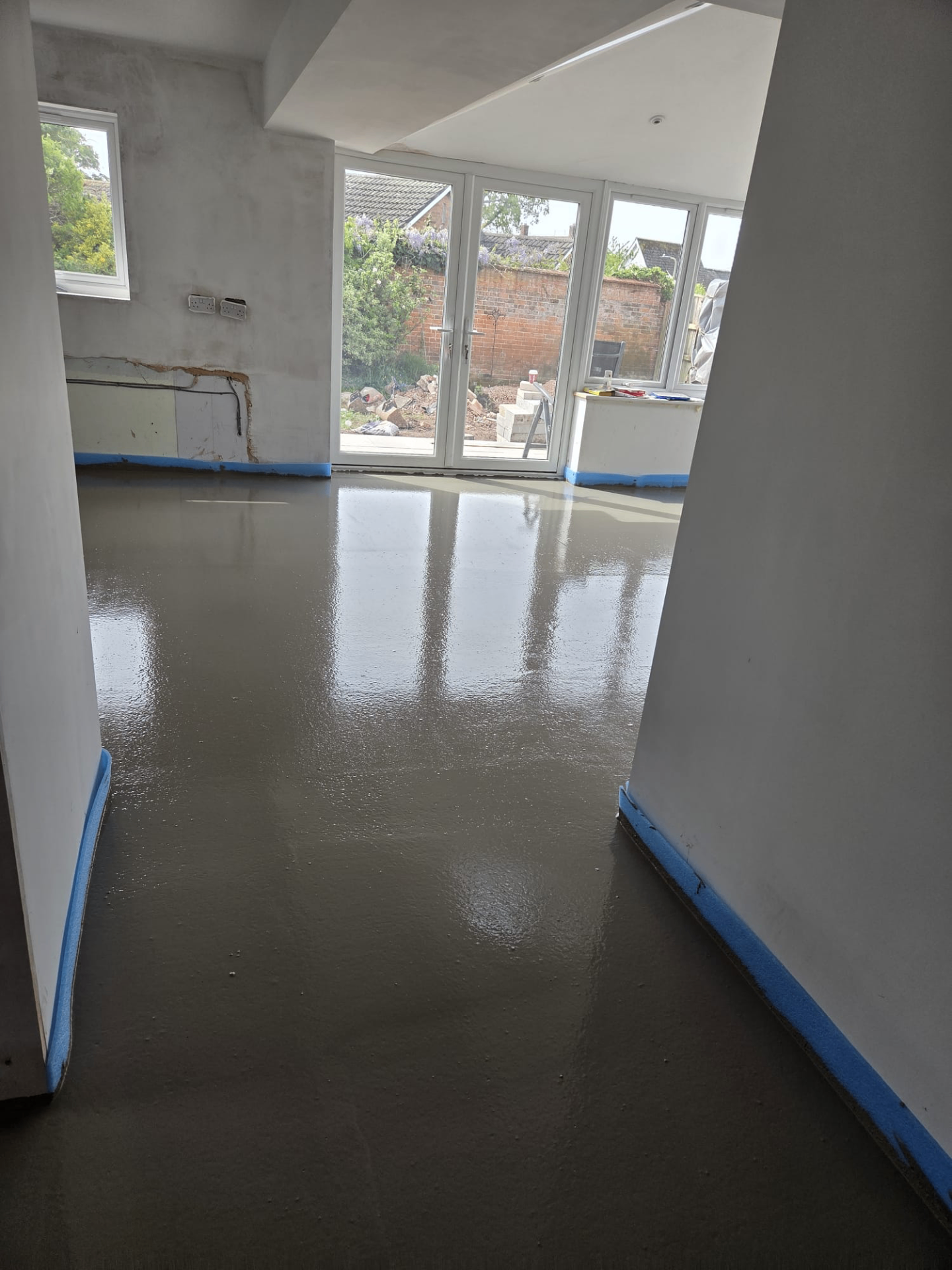
DIY levelling compound vs professional liquid screed
DIY self-levelling compound
- Thin applications, typically under 15mm
- Hand-mixed in small batches
- Good for smoothing an existing sound subfloor
- Not designed to encapsulate UFH pipework
Professional liquid screed
- Structural depths from 30mm upward
- Pumped in a single continuous mix
- Purpose-built for UFH pipe encapsulation
- Engineered flatness (SR1) across large areas
Coverage, cost and reliability
| Factor | DIY compound vs professional screed |
|---|---|
| Area per session | A room at a time vs whole floor in a day |
| Consistency | Batch-to-batch variation likely vs one controlled continuous mix |
| Cost for large areas | Can exceed professional screed once labour/time counted vs single fixed quote |
| UFH suitability | Not suitable at depth vs designed for it |
| Warranty | Manufacturer product only vs product warranty + workmanship guarantee |
When DIY levelling compound is genuinely the right tool
- Small area, minor unevenness before laying LVT or carpet
- No UFH involved
- Confident, experienced DIYer working to a tight budget
- Existing subfloor is otherwise sound and stable
Not sure which route suits your project?
Tell us the area and whether UFH is involved, and we'll tell you honestly whether you need a professional pour.
Or call our landline on 01392 237700
DIY compound wins for small, thin, UFH-free jobs where a confident DIYer is smoothing an already-sound floor. Professional liquid screed wins for anything structural, anything with UFH, or any area large enough that consistency across the whole floor actually matters. Test it against whether you're smoothing a floor or building one.
— Exeter Liquid Screeders
DIY Levelling vs Professional Screed — questions we get asked
Other comparisons worth reading
Keep reading across the site
Not sure which route suits your project?
Tell us the area and whether UFH is involved, and we'll tell you honestly whether you need a professional pour.