
Speeding up drying safely
Force Drying Screed, Explained Properly
Force drying can genuinely shorten a programme, but only when it's done at the right time and in the right order.
Get a force-drying plan for your programme
Name, phone, email — we'll reply the same working day with a fixed price.
Or call our landline on 01392 237700
When a programme is tight, force drying a screed is often the first thing people reach for, and it can work well, provided it's started at the right point in the curing process and carried out with the right method for the situation. Start it too early or too aggressively and it can do more damage than the days it saves.
There are three broad approaches used to speed up drying: dehumidification, indirect heat, and using the underfloor heating system itself as a commissioning-style drying tool. They're not interchangeable, and using the wrong one, or the right one at the wrong time, is where problems creep in.
This page explains how each method works, why the seven-day rule exists, what a sensible UFH ramp schedule looks like, and the specific risks of forcing a screed to dry before it's ready.
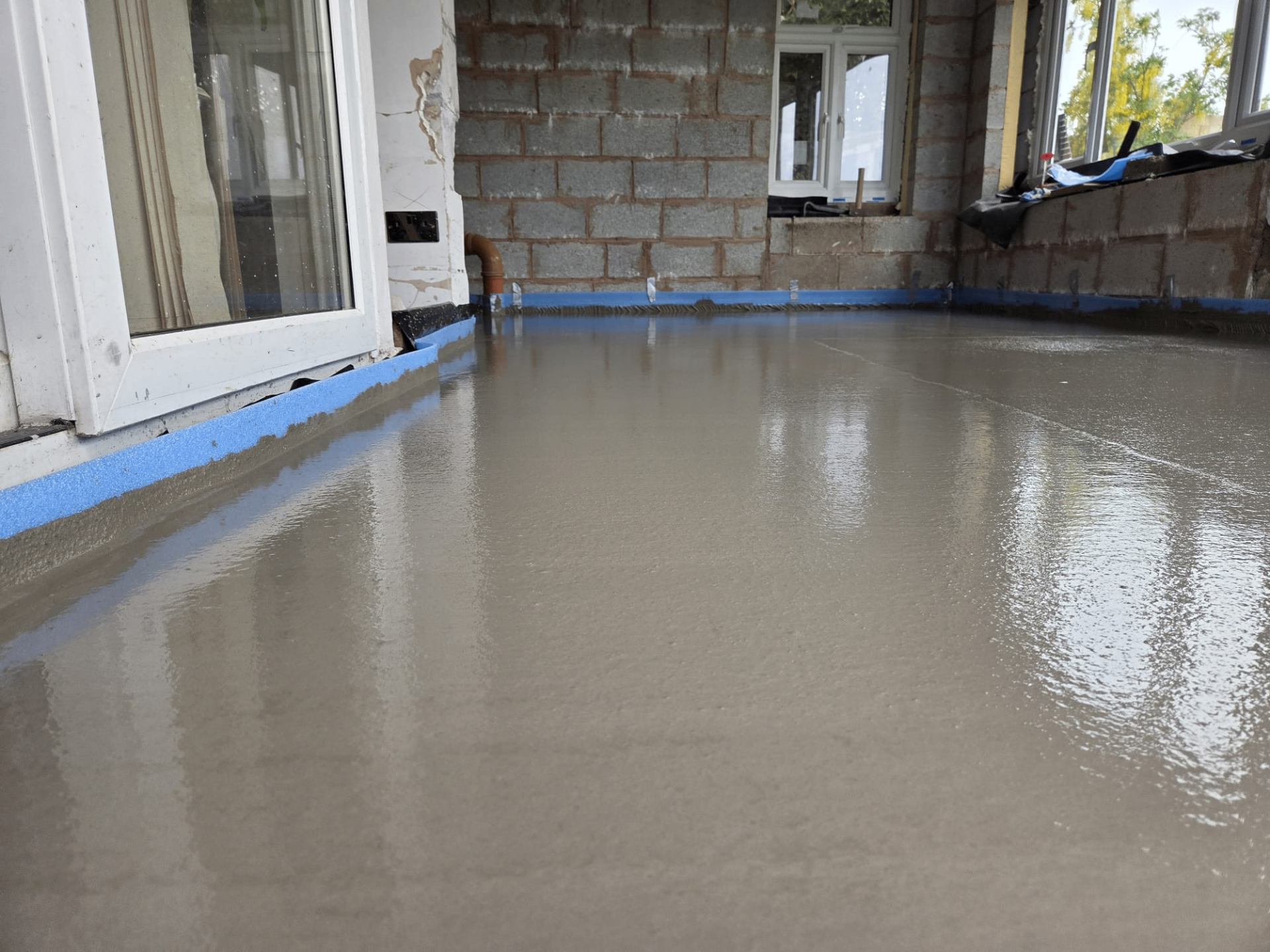
The three force-drying approaches
Dehumidification
- Removes moisture from the air rather than heating the slab
- Works well in enclosed rooms with limited natural ventilation
- Gentler on the screed than direct heat, lower risk of surface cracking
- Needs the room to stay closed to be effective
Indirect heat / heaters
- Warms the air to increase its capacity to hold moisture
- Needs to be paired with ventilation or dehumidification to actually remove that moisture
- Direct or unevenly placed heat too early can cause surface cracking or curling
- Best used to support, not replace, good air movement
Why the seven-day rule matters
Force drying, whether by dehumidifier, heater or UFH, should not begin before the screed has had roughly seven days of natural curing at ambient temperature. Before that point the screed hasn't developed sufficient early strength, and rapid moisture loss from the surface can cause shrinkage cracking, curling at the edges, or an inconsistent cure through the depth of the pour.
This applies to both cement-based and calcium sulphate screeds, though calcium sulphate products in particular are sensitive to being disturbed thermally before they've properly set, since the whole material relies on a controlled hydration and drying sequence.
The seven-day figure is a minimum, not a target. On thicker pours or in cold weather, waiting longer before starting any force drying is often the more sensible choice.
A sensible UFH ramp-up schedule for drying
- 1
Day 1: Pressure test only
Confirm the pipework holds pressure with the system cold; this checks for leaks without introducing any heat to the screed.
- 2
From day 7: Start at low flow temperature
Bring the system on at a low setting, typically in the region of 20-25°C flow temperature, and hold it there for several days.
- 3
Increase in small steps
Raise the flow temperature by a small increment every 24 hours rather than jumping straight to full design temperature.
- 4
Hold at design temperature, then step back down
Once at full working temperature, hold for a period to complete the drying process, then reduce gradually before flooring is laid, since some coverings require the floor to be cool during installation.
Risks of force drying too early or too aggressively
- Surface cracking from moisture leaving the top layer far faster than it can migrate up from below
- Curling at bay edges or around penetrations, caused by uneven shrinkage through the depth
- Debonding from the substrate if thermal movement happens before adequate bond strength has developed
- A false sense of readiness — heat can dry the surface enough to pass a quick visual check while the depth of the screed remains wet
- Damage to underfloor heating pipework or manifolds if the system is run at full temperature before it's designed to
Get a force-drying plan for your programme
Tell us your screed type, depth and target handover date and we'll set out a safe force-drying and UFH ramp schedule.
Or call our landline on 01392 237700
Force drying shortens a programme when it starts on day seven and steps up gradually. Start it on day one or jump straight to full heat, and it can cost you more time than it saves.
— Exeter Liquid Screeders
Force Drying Screed Explained — questions we get asked
More on costs and planning
Keep reading across the site
Get a force-drying plan for your programme
Tell us your screed type, depth and target handover date and we'll set out a safe force-drying and UFH ramp schedule.