Structural screed vs levelling layer
Liquid Screed vs Self-Levelling Compound
These two get confused constantly because both self-level and both get pumped or poured. They solve completely different problems.
Not sure which layer your floor needs?
Name, phone, email — we'll reply the same working day with a fixed price.
Liquid screed and self-levelling compound (SLC) share a marketing vocabulary — both 'self-level', both go down wet, both flow into a flat surface. That's roughly where the similarity ends.
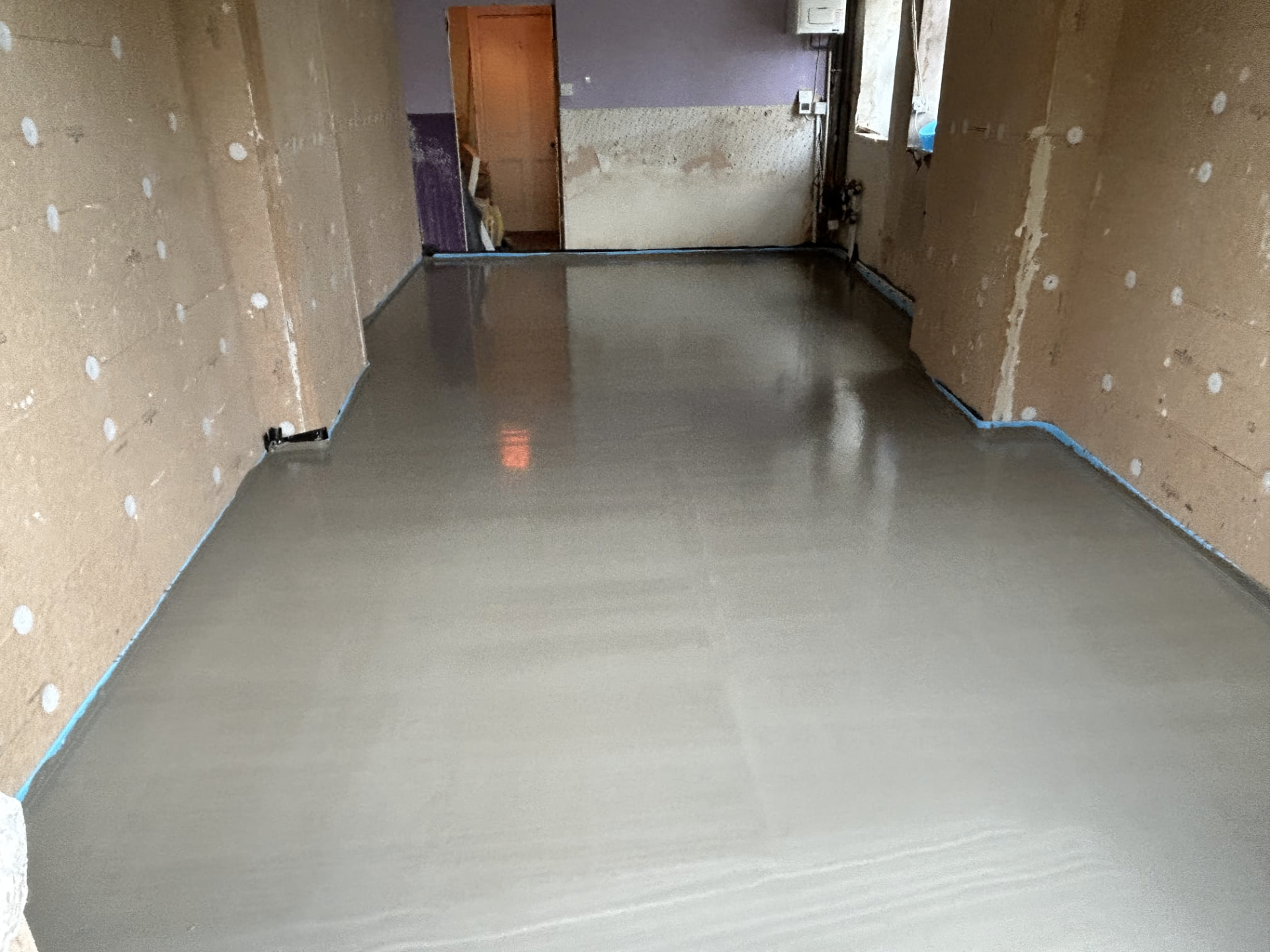
A liquid screed is a structural floor layer, typically 30–75mm thick, designed to encapsulate UFH pipework or provide a load-bearing wearing surface over insulation or a sub-floor. A self-levelling compound is a thin skim, usually 2–10mm, designed to correct minor unevenness in an existing floor before a covering goes down.
Confusing the two — or trying to use one to do the other's job — is one of the most common and expensive floor defects we get called out to assess.
Liquid screed vs self-levelling compound
| Property | Liquid screed / SLC |
|---|---|
| Typical depth | 30–75mm / 2–10mm |
| Structural role | Yes — load-bearing floor layer / No — cosmetic levelling only |
| Encapsulates UFH pipework | Yes / No |
| Typical use | New floor build-up / Correcting an existing sub-floor before covering |
| Cure to walk-on | 24–48h / A few hours |
Signs you need a liquid screed, not SLC
- There's UFH pipework or a manifold in the build-up
- You're building up from insulation or a joisted sub-floor, not an existing slab
- The area needing correction is more than about 10mm out of level
- You need a genuinely load-bearing floor layer, not just a smooth surface
Not sure which layer your floor needs?
Describe your build-up and we'll tell you plainly whether it's a liquid screed job, an SLC job, or both.
Signs SLC is all you need
- An existing concrete or screed floor just needs minor flatness correction
- You're prepping for LVT, vinyl or carpet tile over a sound sub-floor
- No UFH and no structural build-up requirement
- The unevenness is a few millimetres, not centimetres
We've been called to floors where a self-levelling compound was poured at 25mm trying to do a screed's job, and it's cracked and delaminated within months. They are not interchangeable products, whatever the tin says.
— Exeter Liquid Screeders
Liquid Screed vs SLC — questions we get asked
Keep reading across the site
Not sure which layer your floor needs?
Describe your build-up and we'll tell you plainly whether it's a liquid screed job, an SLC job, or both.