
Traditional Sand & Cement Screed · Devon
Dawlish Traditional Sand & Cement Screed Specialists
Not every Dawlish floor wants a pump on the driveway. A traditional sand and cement screed, hand-laid to bays and trowelled flat, still earns its place on deep fills, external thresholds and jobs where a wet-mix, robust finish matters more than speed.
Get a fixed price for Dawlish Traditional Sand & Cement Screed Specialists
30 seconds. We'll come back same-day with a fixed price and next available date.
Or call our landline on 01392 237700
Not every Dawlish floor wants a pump on the driveway. A traditional sand and cement screed, hand-laid to bays and trowelled flat, still earns its place on deep fills, external thresholds and jobs where a wet-mix, robust finish matters more than speed.
Unlike a self-levelling liquid screed, sand and cement is placed and compacted by hand, so we control the fall towards a drain, form an upstand at a threshold, or feather it into an existing floor level in a way a pumped pour cannot.
Most of our Dawlish jobs sit within 30 minutes of base, so site visits stay simple and pour days run to time. Dawlish sits Exeter (13 mi), and we work the surrounding villages on the same week's diary.
EX7 access, routes and logistics
County
Devon
District
Teignbridge
Postcode
EX7
Nearest city
Exeter (13 mi)
Nearest motorway
M5 (J30, ~12 mi)
Primary A-road
A379
Local industries
holiday lettings, hospitality
Common builds
seafront flats, holiday parks
Traditional Sand & Cement Screed in Dawlish — how it works
Unlike a self-levelling liquid screed, sand and cement is placed and compacted by hand, so we control the fall towards a drain, form an upstand at a threshold, or feather it into an existing floor level in a way a pumped pour cannot.
Sand and cement screed is laid in bays with day joints, which we set out to avoid future cracking at natural stress points such as doorways and changes in depth. It is a more labour-intensive process than liquid screed, but it is proven, robust and unaffected by moisture the way calcium sulphate screeds can be.
Who this is for in Dawlish
Dawlish is a coastal town, so damp control, salt exposure and tight winter pour windows shape every brief. We work the diary around that — and around the holiday-let turnover that funds half the jobs here.
Materials and systems we use in Dawlish
Sand and cement (typically 4:1 or 5:1 mix)
Semi-dry, hand-compacted mix ratio adjusted to depth and loading.
SBR bonding agent
Slurry-brushed onto the substrate for bonded screeds under 40mm.
Polypropylene fibre reinforcement
Added to reduce shrinkage cracking on larger bays.
DPM and separating membrane
For unbonded or floating screeds over insulation.
Falls formed to drain outlets
Built into the screed thickness for wet rooms and balconies.
Edge and movement joints
Set at bay lines, doorways and around columns.
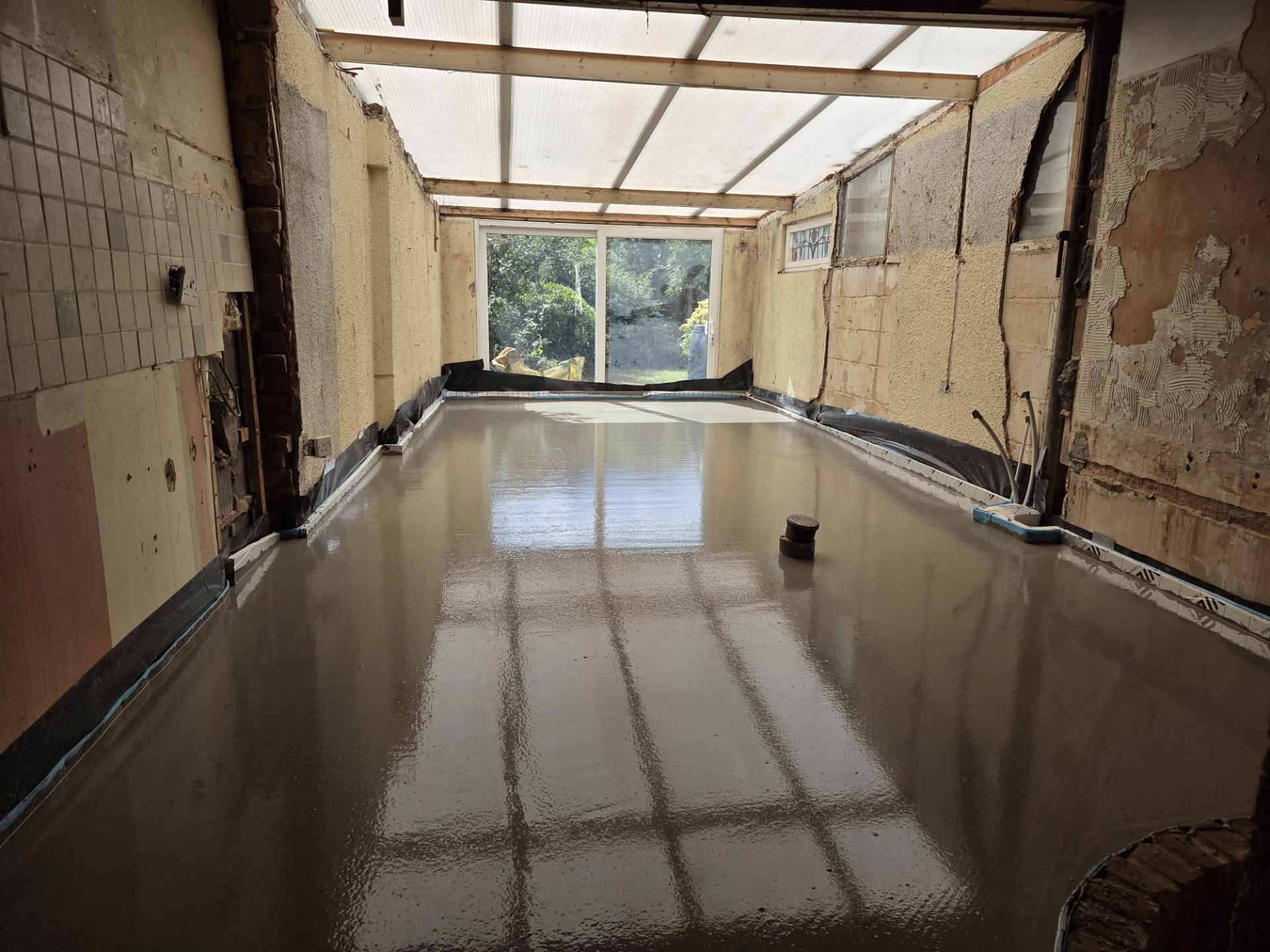
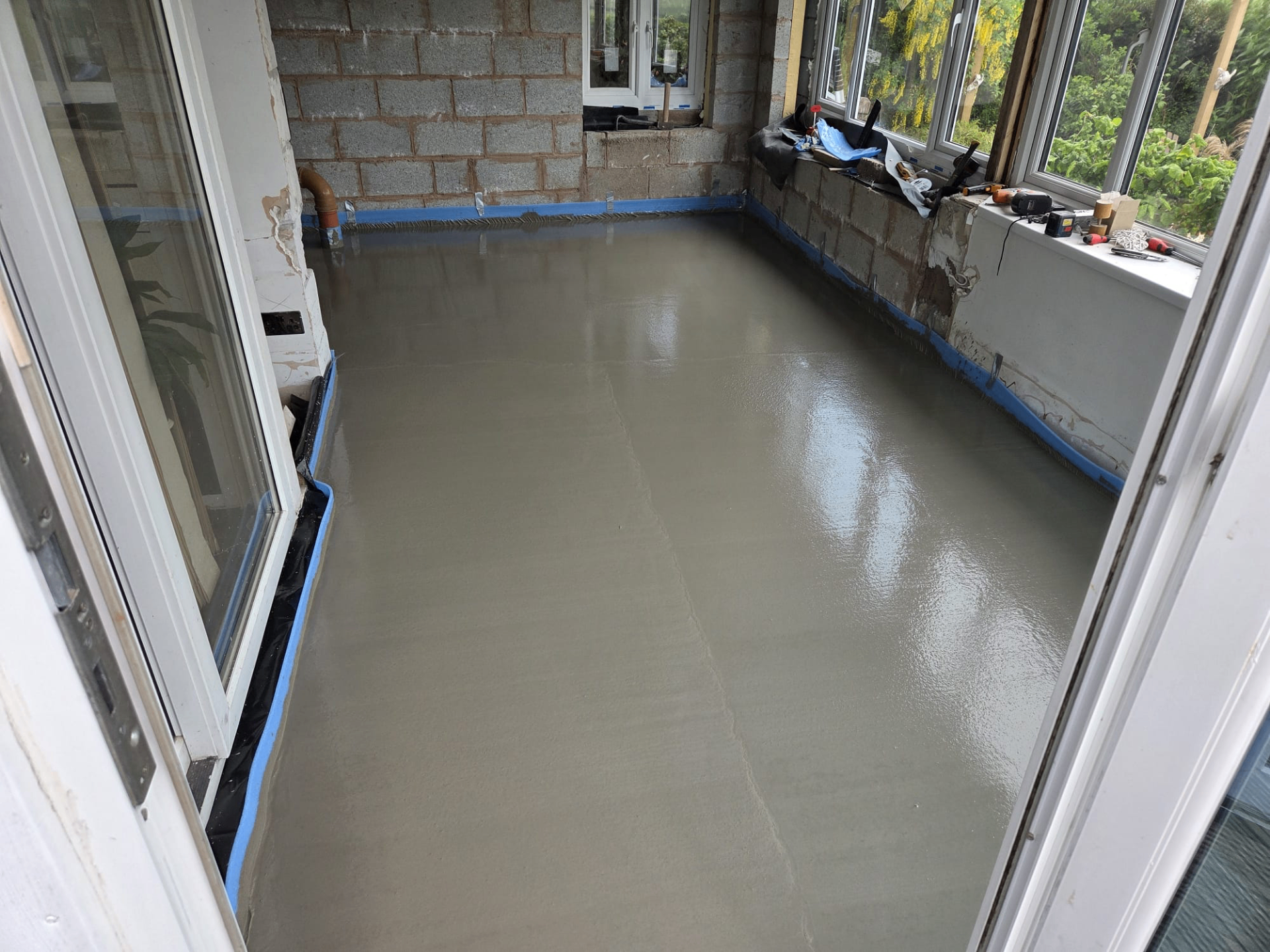
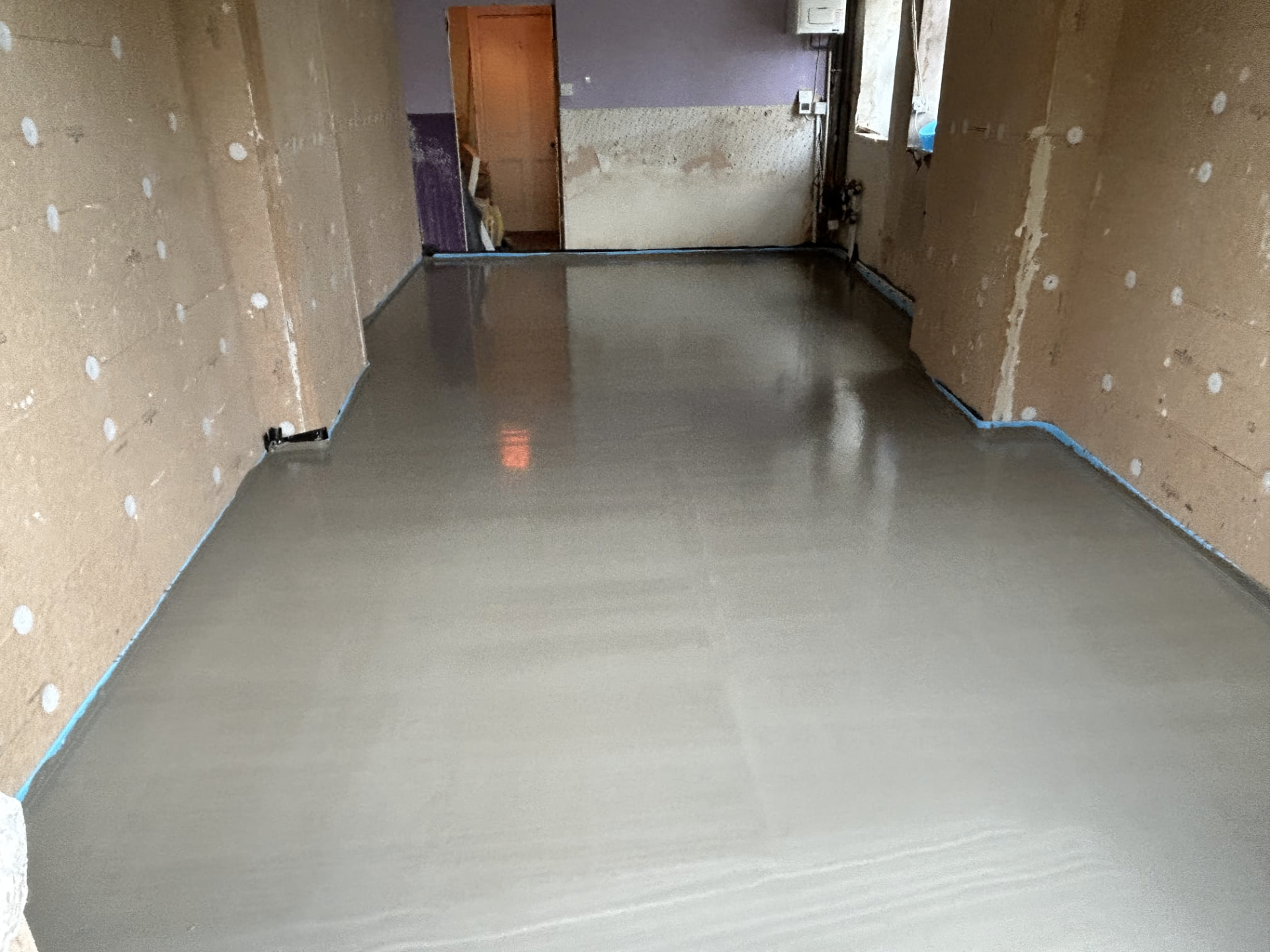
Recent work near Dawlish
Trust points for a Dawlish brief
FAQs from Dawlish clients
What SR rating do you achieve on a trowelled screed?+
We finish sand and cement to SR2, within 3mm under a 2m straight edge, which is suitable for most tiled finishes. If you need SR1 flatness for large-format tile or resin, liquid screed is usually the better route.
Will the screed crack?+
Bay joints and fibre reinforcement control shrinkage cracking. We set bay sizes and joint positions at doorways and depth changes to minimise the risk on any Dawlish job.
How is sand and cement screed different from liquid screed in Dawlish?+
Sand and cement is a semi-dry mix, hand-laid and trowelled in bays, whereas liquid screed is pumped and self-levels. Sand and cement suits deep fills, external areas and wet rooms; liquid screed suits large flat internal floors that need to dry quickly.
How long does a sand and cement screed take to dry in Dawlish?+
Roughly a day per millimetre of depth once past the first 50mm, so a 65mm floor is typically ready for coverings in around six to eight weeks, depending on ventilation and site conditions.
Do you use a screed pump for sand and cement in Dawlish?+
On larger jobs, yes, a screed pump can deliver the semi-dry mix into the building, which speeds up placement while keeping the hand-trowelled finish.
Can you match an existing sand and cement floor level?+
Yes, we set datums off your existing finished floor level and build the new screed to match, allowing for whatever covering goes on top.
Dawlish-area service radius
From site visit to final trowel pass, our Dawlish sand and cement jobs are quoted as one fixed price, with drying time explained up front so nobody is caught out.
Talk through your Dawlish sand and cement job
No pump access, an awkward fall, or a wet area, call and we'll talk through the right build-up for your Dawlish floor.
Ready to get a price?
Tell us the rough size and location — we'll come back with a fixed quote today.
Or call our landline on 01392 237700
Related on this site