
Groundwater and DPM checks, Clyst St Mary
Dry before it can go ahead: water table checks for Clyst St Mary pours
Low-lying ground around Clyst St Mary can bring the water table close to sub-floor level, which makes damp-proof membrane integrity and confirming a genuinely dry sub-floor the central question before a pour, rather than an afterthought.
Land close to the Clyst valley sits lower than much of the surrounding area, and on plots like this the water table can be close enough to the surface to matter for a ground-floor slab. Before a liquid screed pour goes ahead, the sub-floor beneath it has to be confirmed genuinely dry, because a screed poured onto a damp or actively wet base, or over a compromised damp-proof membrane, risks moisture problems that are far harder to fix once the floor is finished.
This shifts a good part of pour planning toward checking, rather than assuming: has standing water been seen in the sub-floor void at any point, is the damp-proof membrane continuous and correctly lapped and sealed at joints and upstands, and has the insulation and membrane build-up had a chance to dry out fully rather than trap moisture beneath the screed.
None of this means a pour cannot go ahead on low-lying ground — the great majority do, without issue — but it does mean the checks need to happen and be documented before the wagon is booked, rather than being taken on trust, and it means treating a wet spell in the run-up to the pour date as a reason to look again rather than a reason to press on regardless.
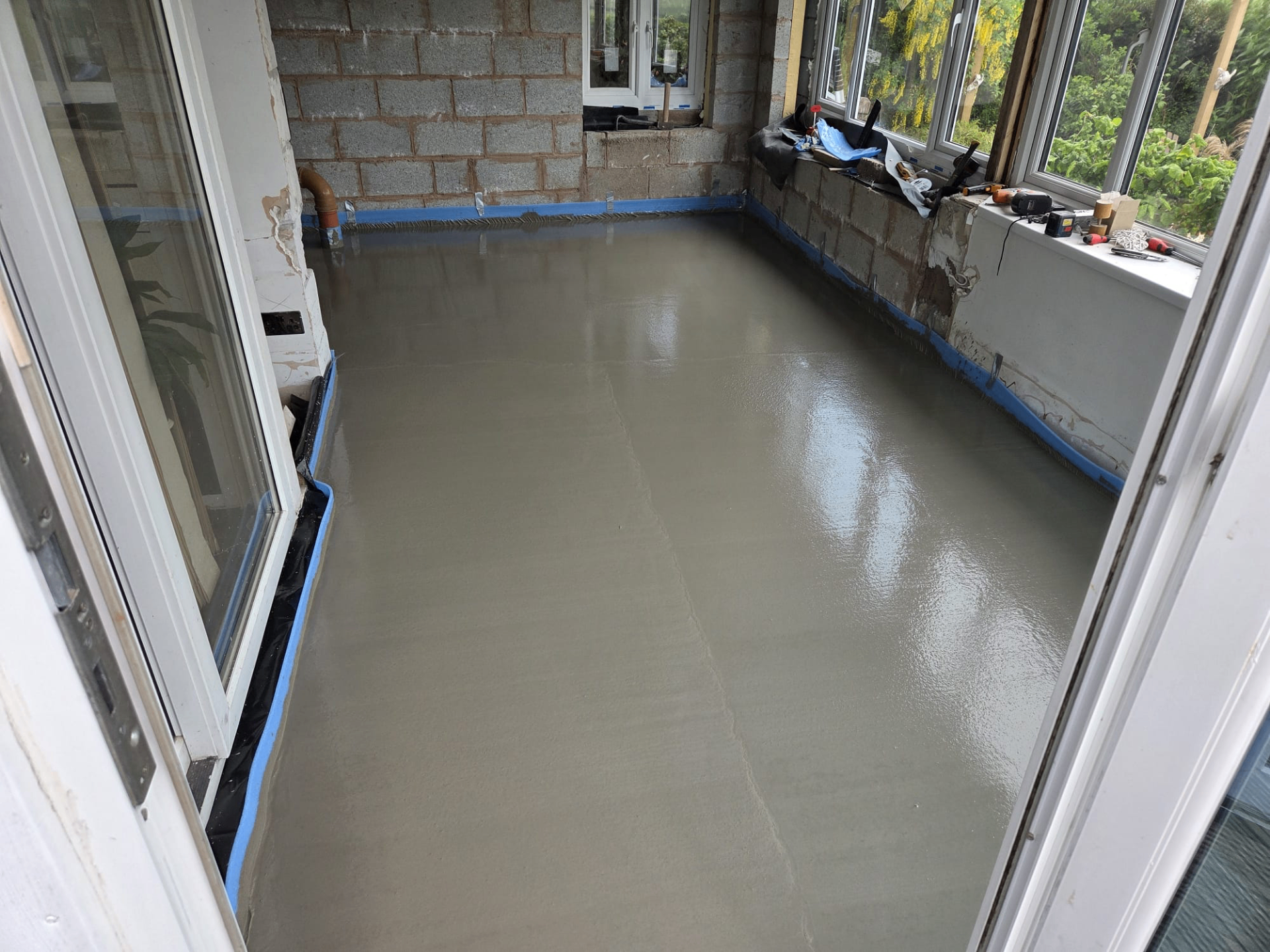
Why the water table matters for a screed pour
Liquid screed is workable and self-levelling because it is a fluid mix, and that same fluidity means it will find and reveal problems in what lies beneath it. If the damp-proof membrane below the insulation is not properly continuous, or if water is present in the sub-floor void, there is a real risk of moisture reaching the underside of the floor build-up over time, which can affect floor coverings and, in underfloor heating installations, the performance of the system itself.
On low-lying ground this risk is higher simply because the water table sits closer to the surface, and because heavy or prolonged rainfall can raise it further, at least temporarily. That is enough reason to treat dryness checks as a standard part of the pre-pour process on a plot like this rather than something only investigated if a problem is suspected.
What a proper membrane check actually looks at
A damp-proof membrane that looks intact from a quick glance can still have gaps at laps that have not been taped or sealed correctly, or tears around service penetrations such as pipework passing through the floor. These are the points most likely to let moisture through, and they are also the points most easily missed in a cursory inspection.
Checking lap widths, seal continuity and penetration detailing before the screed goes down is worth the time it takes, because once the screed is poured the membrane beneath it is no longer visible or accessible without breaking out the floor.
Confirming the sub-floor is actually dry on the day
Beyond the membrane itself, the insulation boards and any residual construction moisture in the sub-floor need to have had a genuine chance to dry before the screed is poured over them. On a low-lying site this can take longer than expected, particularly after a wet spell, and pushing ahead with a pour before the base has dried out risks trapping moisture beneath the finished floor.
A simple, documented check close to the pour date — looking for any visible dampness, standing water, or recent heavy rainfall that might have affected groundwater levels — gives a clear basis for deciding whether the pour should go ahead as planned or be held back briefly.
What happens outside the building matters too
It is easy to focus entirely on what lies beneath the slab and overlook the ground immediately outside it, but external levels and drainage falls play a part on a low-lying plot as well. If the ground around the building slopes toward rather than away from the wall, or if surface water regularly pools close to the foundation, that water has a route to reach the sub-floor void even where the membrane itself is sound.
A quick look at external drainage and ground levels alongside the internal membrane checks gives a fuller picture of the plot's overall dryness, rather than treating the membrane as the only factor that matters on a site where groundwater is already a known consideration.
Clyst St Mary — the points that decide it
- Check for any history or evidence of standing water in the sub-floor void before insulation and membrane went down
- Inspect damp-proof membrane laps, joints and upstands for continuity rather than assuming full coverage
- Confirm the membrane is sealed correctly around service penetrations, since these are common failure points
- Establish current groundwater conditions, particularly after recent heavy rainfall, close to the pour date
- Check that insulation boards have not absorbed moisture from below before the screed is poured over them
- Confirm land drainage or a sump/pump arrangement is functioning if the plot relies on one
- Document the pre-pour dryness check so there is a clear record of sub-floor condition before covering it with screed
- Check external ground levels and drainage falls away from the building, since surface water close to the wall can find its way in
- Agree who is responsible for re-checking conditions if the pour date has to move because of weather
Confirming your Clyst St Mary sub-floor is pour-ready
Talk to us about groundwater conditions and membrane detailing on your plot so the dryness check happens before the screed goes down, not after.
Or call our landline on 01392 237700
Clyst St Mary — your questions
Reference points for clyst st mary
| Membrane check | Laps, joints and penetration seals inspected before covering |
|---|---|
| Site readiness cut-off | Sub-floor confirmed dry, with no visible standing water, before booking |
| Groundwater review | Check conditions again after any recent heavy rainfall near the pour date |
| Documentation | Pre-pour dryness check recorded before the floor is covered |
In short
Low-lying ground around Clyst St Mary can bring the water table close to sub-floor level, which makes damp-proof membrane integrity and confirming a genuinely dry sub-floor the central question before a pour, rather than an afterthought.
Confirming your Clyst St Mary sub-floor is pour-ready
Talk to us about groundwater conditions and membrane detailing on your plot so the dryness check happens before the screed goes down, not after.